
Tell me about yourself logistics is best answered with an accurate snapshot of your relevant work, one task you can explain and a reason for pursuing this particular role. Lead with a real example, not a copied personal biography. The interviewer needs to understand what you actually did, what you checked, and which decisions belonged to someone else. The examples below are illustrative and must be replaced with your own truthful experience.
Introduce the logistics work you actually own
A logistics interview opening should describe where you fit in the movement of goods or information: receiving, tracking, scheduling, documenting or resolving exceptions. “I keep everything moving” is too broad. Start with the shipment, inventory or administrative context you have seen, then describe a reliable check and the person or team who used your update. The employer should hear a specific contribution rather than a claim that you controlled an entire supply chain.
O*NET describes logistics analysts tracking product flow, records and service providers; logisticians may coordinate broader operations. These profiles show why job titles alone are unreliable. A warehouse coordinator might update a tracking system, whereas a transportation manager could approve route or carrier changes. Read the posting before deciding whether to emphasize order accuracy, carrier communication, exception reporting or process analysis. Do not claim authority based on a job title you have not held.
Structure the introduction around a real handoff
Choose one event you can explain: a missing scan, a late arrival update, a count discrepancy, or a scheduling conflict. State where the information came from, what you checked, how you logged the issue and who took the next decision. An example from a classroom shipping simulation can help someone entering logistics, but it must be identified as a simulation. A real inventory support role can be relevant without being renamed “supply chain manager.”
Show that you distinguish observation from action. Noticing that a shipment is late does not mean you authorized a new carrier. Preparing a route comparison is not the same as changing the shipping contract. In the introduction, use accurate verbs such as monitored, reconciled, recorded, contacted or escalated. “Optimized the national logistics network” belongs only to someone who actually performed defensible analysis and obtained the required approval.
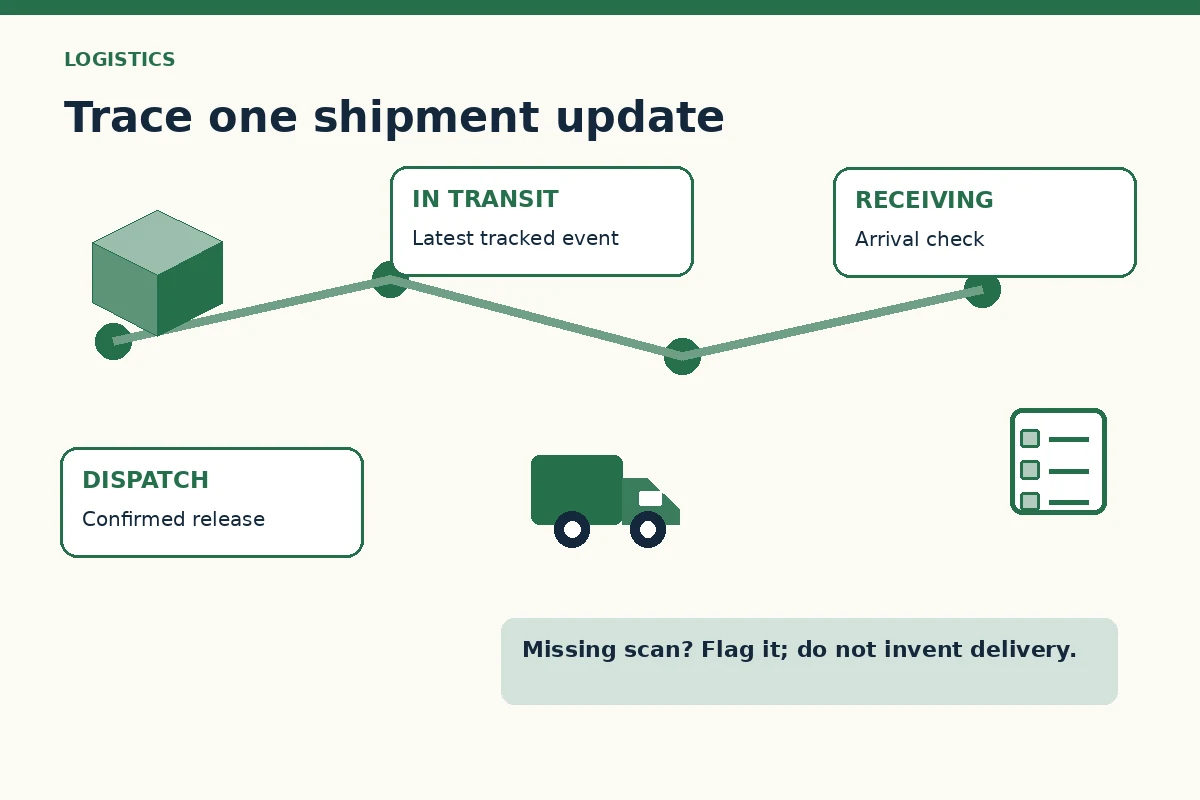
Sample answer based on a shipment discrepancy
Illustrative answer, not a real worker: “I have experience keeping order and stock information organized and checking when records do not line up. In a supervised inventory exercise, I compared a dispatch list with the receiving log, noticed that one item had no arrival confirmation, and documented the gap for the coordinator instead of marking it delivered. I’m interested in logistics roles where clear status updates and timely handoffs help teams plan their next steps.”
This example is deliberately modest and works only if those actions are true for you. A candidate with actual employment experience might substitute a warehouse handoff or scheduling task. Avoid inventing shipment volumes, savings, delivery percentages or carrier agreements. If you were one member of a team, say which record you maintained and what others did. A truthful, clear exception story can make a better impression than an inflated operations claim.

Show how you verify shipment status
Tracking is not simply reading a single status label. An update may need comparison among an order, a carrier message, a receiving note and the system’s timestamp. Your introduction can describe a check you performed or a record you kept consistent. Do not reveal a client’s actual shipping details, confidential rates or warehouse access information. A generic example with anonymized item numbers is enough to explain your method.
When two records disagree, state that you would flag the difference and follow the company’s process for finding the authoritative source. Some staff can contact a carrier directly; others communicate through a dispatcher or account owner. Do not promise customers a revised delivery date that the authorized team has not confirmed. The useful behavior is a timely, accurate update with a clear next owner.
Tailor the answer to the segment of logistics
For warehouse support, emphasize receiving records, scan accuracy and safe escalation when physical counts disagree. For transportation coordination, focus on shipment milestones, carrier communications and careful schedule updates. For logistics analysis, discuss comparing source data, reporting patterns and documenting assumptions. For procurement support, explain purchase order references and supplier handoffs without implying that you negotiated contracts. The posted responsibilities determine which evidence is strongest.
If moving into logistics from customer service, demonstrate clear case notes and careful expectations, not a false history of freight operations. A candidate from retail may connect stock checks and discrepancy reporting to inventory reliability. If you are new to shipment software, name the systems you have genuinely used and say you are ready to learn the employer’s tools. Interviewers can test what you know; unsupported software claims are easy to expose.
Describe an exception without promising a result
An exception is a useful storytelling opportunity because logistics depends on knowing when the standard path failed. State what the expected milestone was, which record differed, what you did to verify it and when you passed it along. If the issue was still open when your shift ended, tell the truth. A documented open issue with a clear handoff is not the same as a solved delivery, and it may still reflect good work.
Avoid borrowing an organization-wide on-time rate or cost saving from a manager’s report. Even if the team improved, ask whether you can attribute any part of the result to your action. If not, describe the output you personally completed: a corrected log, a verified exception note or a handoff with the relevant timestamps. That level of specificity gives the interviewer something reliable to discuss.
Rehearse the opening and prepare for follow-ups
Practice one concise introduction containing a role context, a record or shipment example, and a statement about the job you are seeking. Do not recite every logistics acronym. A clear account of where you got a status, which system you updated and who took the next step is more useful than jargon. The interview may include colleagues from operations or service teams who need the same explanation in ordinary language.
Then test the answer with three follow-up questions: What if the carrier update differs from the warehouse scan? Who may authorize a route change? How do you prevent an unresolved issue from disappearing during a shift handoff? Answer only from your real past experience or, for a hypothetical question, explain that you would follow company procedures. Finish by showing the part of the process you can reliably support and the skills you want to develop.

How We Research Job Interview Introductions
We checked O*NET logistics analysts profile for occupation-specific responsibilities and CareerOneStop’s interview preparation guidance for researching employers and practicing honest examples. We also consulted U.S. OPM structured-interview guidance to distinguish the situation, individual action, and result in a follow-up answer. These sources do not authorize particular workplace actions or verify a candidate’s history; employer processes vary.
All sample introductions and scenarios on this page are illustrative, not actual applicant statements or hiring guarantees. The sources are paraphrased and cannot certify a particular organization’s process. Review the affiliate disclosure for the site’s general policy; no employer endorsement, paid placement, or affiliate relationship is assumed here.
More Interview Preparation Guides
Yes. Describe receiving, inventory, scanning or dispatch checks you actually performed and avoid claiming responsibility for transport strategy.
Only if they are documented and you can explain your individual contribution. Otherwise use verified task evidence.
State what you verified, recorded and escalated. Do not turn an open exception into a successful delivery.
Not necessarily. Read the posting to distinguish operations coordination, recordkeeping and formal analytical responsibilities.
Explain the evidence and proper escalation channel. Do not imply that you could renegotiate or approve a contract unless that was your role.