
Caregiver experience on a resume should show the kinds of daily support you provided, the setting where you worked, how you coordinated routines and which concerns you reported. Use your real employer, title and employment dates; then describe personal care, meal preparation, scheduling, mobility assistance, companionship or home tasks only as applicable. A personal care aide and a home health aide may have different training and permitted duties, and state and employer requirements differ. Avoid copying client diagnoses, names, medications or private home details. Show the work you performed and your careful handoffs without presenting yourself as a nurse or clinician if that was not your role. All example bullets below are hypothetical.
Name the care setting and your actual job title
Care can take place in a private home, assisted living setting, community day program or an agency-managed assignment. The BLS distinguishes personal care aides, who generally provide nonmedical services, from home health aides who may perform limited health-related services under practitioner direction where allowed. Describe the actual arrangement rather than combining every care role into one credential. If you were an unpaid family caregiver, label that experience honestly and focus on transferable tasks when relevant. For an agency position, use the employer’s legitimate title and dates instead of inventing individual client employers. The setting makes your experience understandable without identifying the person receiving care.
Choose daily living tasks that match your real work
Daily activities can include helping with dressing or meals, light housekeeping, transportation coordination, grocery shopping, appointment reminders or companionship. Pick only the work you actually did. If you handled supplies, describe restocking or organized routines in general terms; do not claim you established medical treatment plans. A concise bullet can say ‘Supported assigned daily routines and maintained a clear shift handoff for the incoming aide.’ More detail is helpful when a job asks about a particular population or work environment, but never include a client’s private health condition simply to make the resume sound specific.
Separate observation and reporting from medical assessment
Caregivers may notice changes in behavior, appetite or participation and communicate them to an authorized supervisor. Observation is not the same as making a diagnosis or changing a care plan. The BLS discusses recordkeeping and reporting changes in client condition for home health aides, while also noting that certain health tasks depend on training and state requirements. Write ‘noted observations and reported concerns per the service plan’ if true, rather than ‘diagnosed health issues.’ If a nurse reviewed your records or directed a task, that supervision can be relevant context. Keep any precise clinical activity tied to your actual authorized scope.

Build work-history bullets without exposing a client
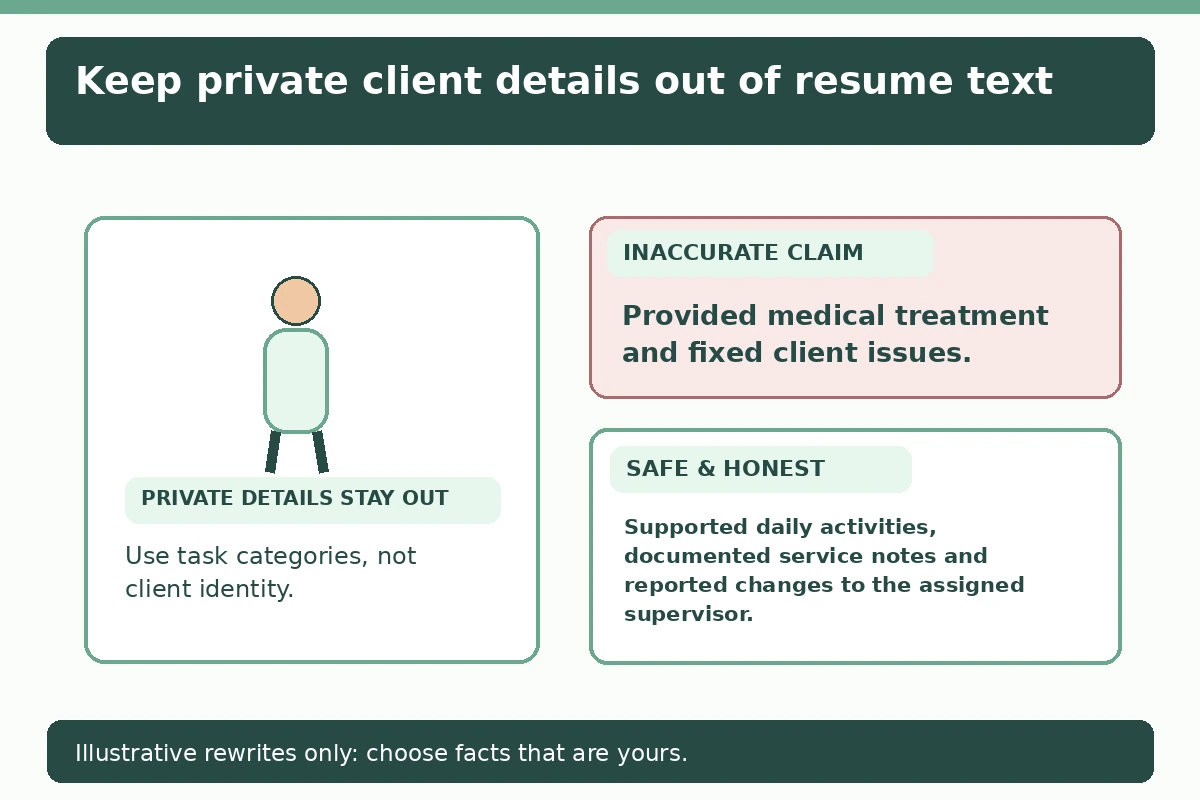
Weak hypothetical: ‘Treated patients and cured serious conditions.’ Better for personal support: ‘Assisted with scheduled daily activities, coordinated meal and appointment reminders, and communicated routine changes to the supervising team.’ A separate bullet might read: ‘Prepared accurate service notes and completed handoff updates while following agency privacy practices.’ Do not describe an identifiable client’s age, address, diagnosis and unusual situation together, even without a name. You can demonstrate empathy and reliability through task categories, repeatable processes and appropriate escalation instead of telling private stories from a person’s home.
Be precise about medication and mobility support
Job postings may mention medication reminders, assistance or administration, and these are not synonyms. Whether an aide can perform a particular procedure varies by setting, training, supervising practitioner and applicable rules. Never write ‘administered medications’ if you only reminded someone of a schedule. Likewise, assistance with walking, use of mobility devices and transfers may require training and specific instructions; do not claim specialized techniques you were not authorized to perform. If your role was nonmedical, focus on the daily living tasks you safely supported. When unsure, use the exact language from your approved job duties rather than guess at a healthcare title.
| Work area | Real evidence to consider | Boundary to respect |
|---|---|---|
| Daily support | Meals, hygiene or routines actually helped | Do not present this as clinical treatment |
| Observations | Accurate notes and supervisor contact | Do not claim diagnosis or plan changes |
| Credentials | Real training and role-specific scope | Do not invent licenses or qualifications |
Show schedules and handoffs without false outcomes
Care is often organized around routines, coverage and changes across shifts. Useful skills include following written assignments, noticing incomplete supply needs, updating a log and giving another caregiver a clear handoff. If you coordinated multiple appointments, state that only if you really did. Avoid fabricated claims of improved health outcomes, zero incidents or hundreds of satisfied clients. A trustworthy supervisor may be able to confirm consistency and communication; those qualities are valuable even when outcomes cannot ethically be measured or publicly disclosed. Focus on the work you controlled rather than a person’s medical progress.
Describe training and credentials with exact status
List CPR, first aid, home health aide training or state credentials only if actually completed and current when the job requires currency. Some credentials are not interchangeable across states or employer programs. Do not claim licensed practical nurse status from caregiver experience or a short employer orientation. If you completed limited training, say exactly what it covered and where it belongs on the resume. In the work section, concentrate on how you used the skills in real tasks. If a potential employer needs verification, provide permitted documents through its official hiring process rather than putting personal certificate identifiers in public resumes.
Make an unpaid family-caregiving entry truthful
A period helping a relative can demonstrate scheduling, meal planning, household organization and practical support. It should not be rewritten as paid employment at an imaginary clinic. Depending on the job application, an optional section such as ‘Family Caregiving’ or ‘Relevant Experience’ may be clearer than inserting the entry among salaried jobs. Use only true dates and tasks, and do not reveal the family member’s medical details. If the employment application specifically requests paid jobs, follow that instruction and place relevant unpaid experience elsewhere. Your goal is to provide useful context without misrepresenting a formal employer relationship.

Review the entry for privacy and professional limits
Read the resume as if a client, supervisor and recruiter would all see it. Are dates and titles accurate? Could you explain the routine and the escalation process without naming anyone? Did you remove diagnoses, locations, medical files, exact medication lists and direct client quotations? Have you clearly differentiated nonmedical support from practitioner-directed care? A strong caregiver work-history entry presents attention, respectful communication, dependable coverage and appropriate reporting while avoiding personal health disclosures or unsupported claims of clinical authority. It should prepare you for a professional interview, not turn a client’s private life into a work sample.
How We Research Resume Work Experience
JobAsk reviewed these public primary sources on November 16, 2026: BLS differentiates personal care support, home health aides, supervision and potential limited health tasks. CareerOneStop supports readable work history, honest duties and relevant work accomplishments. HHS describes protected health information and HIPAA privacy obligations for covered entities; not every private family setting is automatically covered. We compared this intent with the WordPress post inventory supplied for the project and checked neighboring JobAsk drafts. Local inventories and public search do not guarantee the availability of a private WordPress slug. All example resume bullets are hypothetical, not descriptions of real applicants. Duties and authorizations vary by employer and state. Do not share confidential records or claim certifications, measured outcomes or authority you cannot verify. Read the affiliate disclosure.
More Resume and Cover Letter Guides
Yes when relevant, but label unpaid family caregiving clearly and follow instructions when an application asks only for paid employment.
Avoid identifiable health details. Describe care tasks and general settings without exposing private client information.
Not necessarily. Their duties, permitted health tasks and supervision can differ; describe your actual role and applicable training.
Only if you truly performed that task within your authorized role. Medication reminders and medication administration are different activities.
Describe true schedules, notes, coverage and handoffs. Use measured results only if verified and appropriate to disclose.