
A cleanroom work experience entry should explain the environment you worked in, the procedures you were trained to follow, the work you actually performed, and the records you completed. The word ‘cleanroom’ alone does not identify whether you supported medical devices, pharmaceutical production, electronics or a laboratory. Start with your real job title, employer and dates, then specify the product or process only when permitted. Use precise verbs such as prepared, assembled, inspected, logged or escalated. Do not claim sterile processing, formal certification, deviation approval, release authority or a particular cleanroom classification unless your actual records and training support it. The examples below are hypothetical and must be adapted to genuine work.
Describe the facility and operation without implying sterility
Cleanrooms are used in several industries and do not all operate under the same procedures. A person assembling electronic components in a controlled environment should not automatically describe the work as aseptic drug processing. The employer’s instructions, product requirements and training records define the context. An experience entry can state ‘controlled-environment assembly’ or ‘cleanroom packaging support’ if that reflects the job. If you know an area classification, include it only when it was formally part of your work and does not expose confidential details. Avoid using sterile, GMP-certified or contamination-free as decorative adjectives; they may communicate assurances you were not qualified to make.
Distinguish gowning completion from process qualification
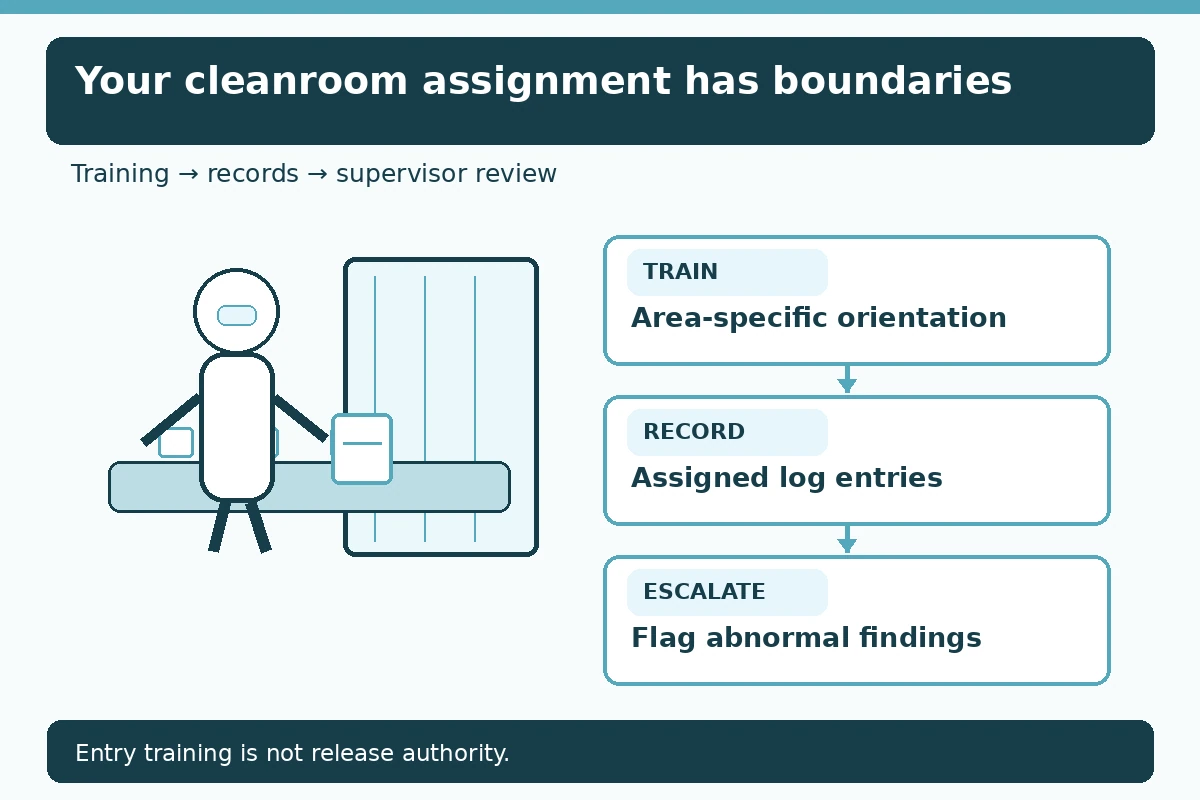
Following a gowning sequence is a useful work habit, but training to enter an area is not identical to authorization to operate its production equipment. FDA materials for pharmaceutical manufacturing discuss employee qualifications, procedures and records; those requirements are context-specific, not a blanket credential for every cleanroom. Record what you completed: employer-provided gowning training, access orientation, documented observation or job-specific instruction. Do not claim an industry certification merely because a supervisor demonstrated a gowning process. If you performed a task only while shadowing, say observed or assisted under supervision rather than independently operated.
Reconstruct the shift from actual records
List the work sequence that you personally touched, without disclosing a proprietary procedure: received approved materials, checked identification against instructions, prepared the station, handled assigned components, logged observations and transferred work for review. If your role was inspection only, remove production steps you did not perform. A resume bullet is stronger when it names the traceable record type—such as a controlled log or assigned checklist—than when it says ‘maintained strict quality.’ Record your actual part of the process, not the whole facility’s quality system. Internal batch identifiers and product data should stay out of your public resume.
Write cleanroom bullets around handling and documentation
Hypothetical before: ‘Guaranteed sterile products and ran all production.’ Better for an entry operator: ‘Prepared assigned materials and completed controlled work logs in accordance with documented station instructions; reported discrepancies to the shift lead.’ Better for an inspector: ‘Recorded permitted visual checks and separated questionable components for authorized review.’ Neither statement claims authority to approve a released batch. If you did monitor an instrument, name the type in general terms and note that you followed approved instructions; do not invent calibration expertise. Explain exactly what you did when a check did not match expectations, rather than implying you corrected a regulated process without authorization.
Show deviation reporting without claiming disposition rights
A worker may recognize a mismatch, stop a task when required by instructions, preserve evidence and notify a designated supervisor. Deciding whether materials are acceptable, closing a formal investigation or approving product release can require other roles. FDA information about manufacturing records and quality units illustrates this division in regulated drug settings. Separate ‘notified quality staff of a log discrepancy’ from ‘approved deviation and released material.’ When drafting, create an authority column for each task: I performed it, I documented it, I escalated it, or I approved it. Leave the last category blank unless it is genuinely part of your documented position.
| Work area | Real evidence to consider | Boundary to respect |
|---|---|---|
| Entry and gowning | Employer-specific training and access | Do not imply universal certification |
| Process records | Completed logs and labels | Leave release decisions to authorized staff |
| Exceptions | Escalated mismatch or deviation | Avoid claiming closure or disposition |

Use training names and tools only when supportable
Relevant evidence may include a training sign-off, an observed qualification, a controlled document system or specific inspection equipment. List software, instruments and cleanroom grades only if you actually used them, and keep internal SOP numbers or employer-confidential versions out of your resume. If you used a form to record a step, you do not automatically qualify as a system administrator or quality engineer. State competence in ordinary language: completed required entries, followed change notices, or checked material labels against approved instructions. Recruiters can ask about the process at a safe level without requiring confidential work instructions.
Explain supervised and temporary assignments clearly
Some workers entered the cleanroom for limited projects, cleaning support, staged packaging or training rotations. Keep dates honest and name the arrangement. If the work was a temporary assignment inside a larger manufacturing job, one bullet under the actual employer may be clearer than inventing a separate position. Identify the supervisor relationship where it matters. If you participated in observation or training but never handled production materials, treat it as training, not commercial operating experience. An honest narrow description helps a prospective employer identify which onboarding or requalification you may need.
Tailor the evidence to the target industry
A medical device packaging role may prioritize component identification and records; electronics work may emphasize handling practices and inspection; a pharmaceutical role may have additional documented procedures and quality reviews. Read the new employer’s posting closely and match only your transferable steps. It is reasonable to write that you followed controlled-area work instructions when true, but not to suggest automatic authorization to work in another facility’s specific environment. The new employer should verify and train you under its own procedures. Use general safety and documentation skills to connect the experience without suggesting that one employer’s training transfers as an unrestricted license.

Finish with a confidentiality and scope check
Review the final entry as though a quality supervisor will interview you. Does it identify your actual shift work, training status, records, deviations you escalated and decisions you did not make? Delete confidential batch codes, device designs, production yields, unpublished methods and personal data. If you cannot confirm a performance metric from records, avoid it. Replace blanket claims like ‘fully GMP compliant’ with accurate employee actions such as ‘followed assigned controlled procedures and completed records for supervisor review.’ This is useful evidence of care and consistency while leaving regulatory or quality conclusions with authorized people.
How We Research Resume Work Experience
JobAsk reviewed these public primary sources on November 16, 2026: FDA explains manufacturing records, qualified personnel and quality unit responsibilities for regulated drug operations. FDA inspection guidance describes personnel training, gowning and production documentation in sterile drug manufacturing. CareerOneStop explains how to present actual work responsibilities and verifiable accomplishments. We compared this intent with the WordPress post inventory supplied for the project and checked neighboring JobAsk drafts. Local inventories and public search do not guarantee the availability of a private WordPress slug. All example resume bullets are hypothetical, not descriptions of real applicants. Duties and authorizations vary by employer and state. Do not share confidential records or claim certifications, measured outcomes or authority you cannot verify. Read the affiliate disclosure.
More Resume and Cover Letter Guides
Only if you can accurately substantiate it, it is relevant, and the information may be shared. Do not infer a grade from protective clothing.
No. Training for access or a specific task is not the same as formal quality disposition or product release authority.
Yes. Use a general product family, your actual process tasks and the type of records you completed, without confidential identifiers.
Describe it as observed or supervised training. Do not claim independent operation or equipment qualification.
Only when it accurately describes the regulated setting and your genuine procedures or training. Do not use it as a generic synonym for neatness.