
A finance internship cover letter works best when it proves how you handle numbers, assumptions, and uncertainty—not when it declares that you are an investment expert. State the exact role and then describe one spreadsheet, forecasting, accounting, or economics project that you personally built or checked. The reader should understand the question you analyzed, the type of data you used, how you validated it, and what a reviewer could see in your deliverable.
The Bureau of Labor Statistics says financial analysts evaluate financial information, study trends, and prepare reports. An intern may support parts of that workflow, but a college model is not a real recommendation to invest, and a classroom portfolio is not managed client money. A credible letter uses phrases such as “modeled scenarios from public financial statements” or “checked calculations against source tables.” Avoid invented returns, guaranteed forecasts, and claims of regulatory approval.
Match Financial Work to the Actual Internship
Identify whether the posting emphasizes corporate finance, FP&A, banking operations, risk support, accounting, or investment research. The word “finance” does not make these jobs interchangeable. A budgeting internship may call for expense categorization and variance notes; an analysis internship may prioritize public filings and model assumptions; a financial operations internship may focus on controls and clean records. Select the relevant project rather than scattering references to trading, tax, and valuation in the same paragraph.
Look for specific tools and restrictions in the listing. If it names Excel, explain a function or checking step you can demonstrate, such as SUMIFS, lookup validation, sensitivity tables, or a reconciliation. Do not claim proficiency in an expensive enterprise platform you have only seen in a demonstration. If the employer asks for academic standing, schedule, or work eligibility, answer through the requested application fields; the cover letter should focus on practical fit and accurate proof.
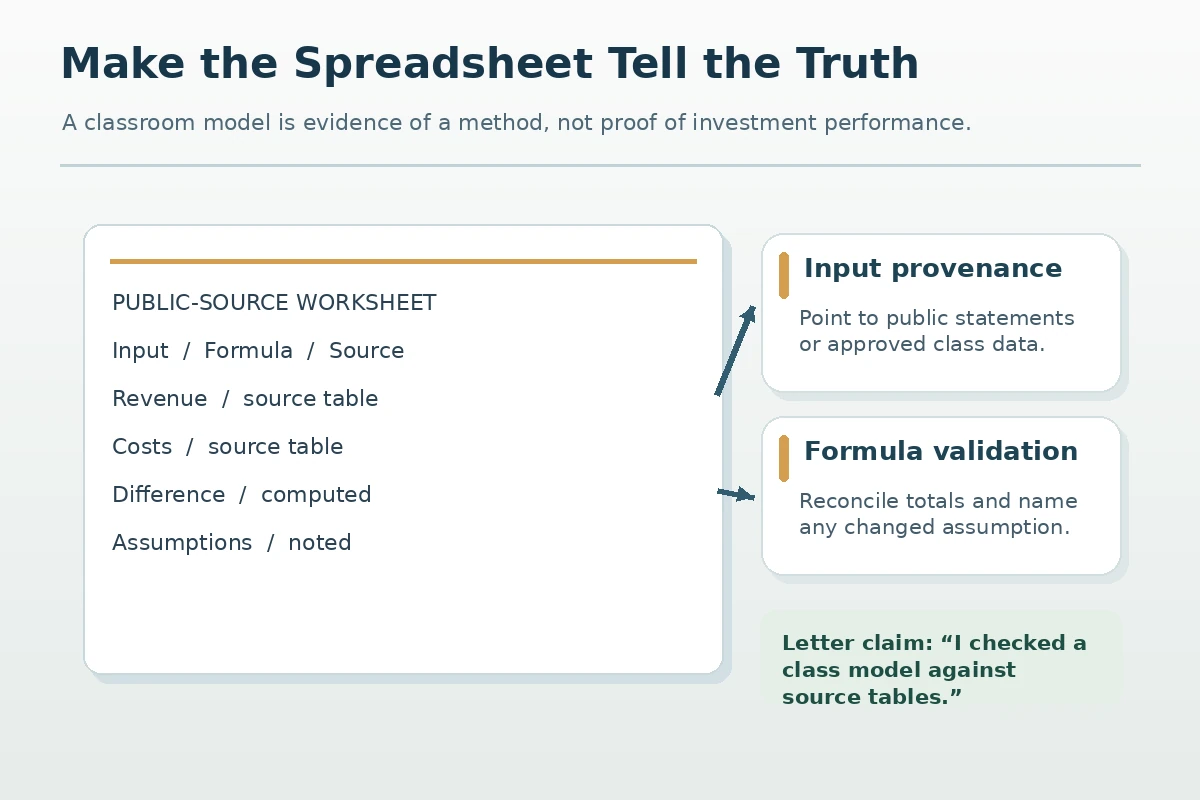
Describe a Student Model Without Inflating Its Outcome
A good classroom example names the input, calculation, and limitation. You could say you organized public-company statement data, built a simplified revenue scenario, and compared outputs after changing one assumption. If you worked in a group, write which worksheet or review pass was your responsibility. The model does not need an impressive invented dollar value; its value is that you can explain why a formula or dataset was chosen and how an error would be noticed.
Include one verification behavior. Perhaps you compared totals across worksheets, reconciled a subtotal to the original statement, documented a missing observation, or asked a teammate to review a formula. An explanation of a failed first check can show sound judgment: “The initial total differed from the source table; I traced the duplicate rows and corrected the import.” Do not imply that the change generated employer revenue or prevented a real financial loss if it happened only in class.

Use an Example Letter With Honest Analyst Scope
Your first paragraph should identify the finance intern role and explain why a project speaks to its tasks. The middle can connect data checking to clear communication, followed by a sentence about teamwork or documentation. Use an employer-specific reason that you have verified from its own published materials, such as the type of reporting the group does. Avoid describing a bank as an investment manager simply because both are financial employers.
Keep oversight visible in the wording. “Prepared a draft variance summary for class review” describes an academic output; “approved forecasts for leadership” implies delegated authority. Even if your group submitted a final presentation, explain whose decision was being simulated. End with a short availability line and a request to discuss how you could contribute to an actual analyst workflow while learning the organization’s controls.
| Experience to cite | Useful proof | Scope to keep clear |
|---|---|---|
| Course model | Scenario assumptions and source checks | Not an investment track record |
| Reporting task | Draft chart or variance note | Approval belongs to reviewer |
| Tools | Formula or script you can explain | Do not list untested systems |
Check Assumptions, Files, and Confidential Information
If you attach a spreadsheet or portfolio, remove third-party restricted data and check whether the material is yours to distribute. Public datasets and instructor-permitted class samples are easier to document. Save formulas rather than screen captures alone if the employer requests working files, but do not include passwords, live account identifiers, or internal financial files from a previous employer. Some internship recruiters request PDF samples only; honor that rather than inventing a technical test.
Differentiate data observations from conclusions. “The scenario changed after the input assumption was revised” is verifiable; “the business should buy the stock” is an investment recommendation and out of scope for an illustrative class letter. If you mention SQL, Python, or dashboards, describe a specific use and any review. A concise, accurate letter is more credible than listing every framework you have encountered.
Proofread the Finance Letter Like a Spreadsheet
Check employer names, department, application code, and every reference to a tool. Reconcile the numerical claims to your project records, including dates and group size if stated. Read each achievement in the context of what you controlled: did you build the analysis, test formulas, present findings, or approve a decision? Change verbs that imply sign-off you did not possess. Your resume and cover letter should not disagree on the project stage.
Finally, verify that the attachment requested is the one uploaded, that PDF text remains selectable, and that any links open without exposing private folders. Keep a clean copy of the submission and a note of the internship description. You can prepare an interview demonstration from the same nonconfidential project, using assumptions and limitations as talking points instead of memorizing a fabricated performance result.
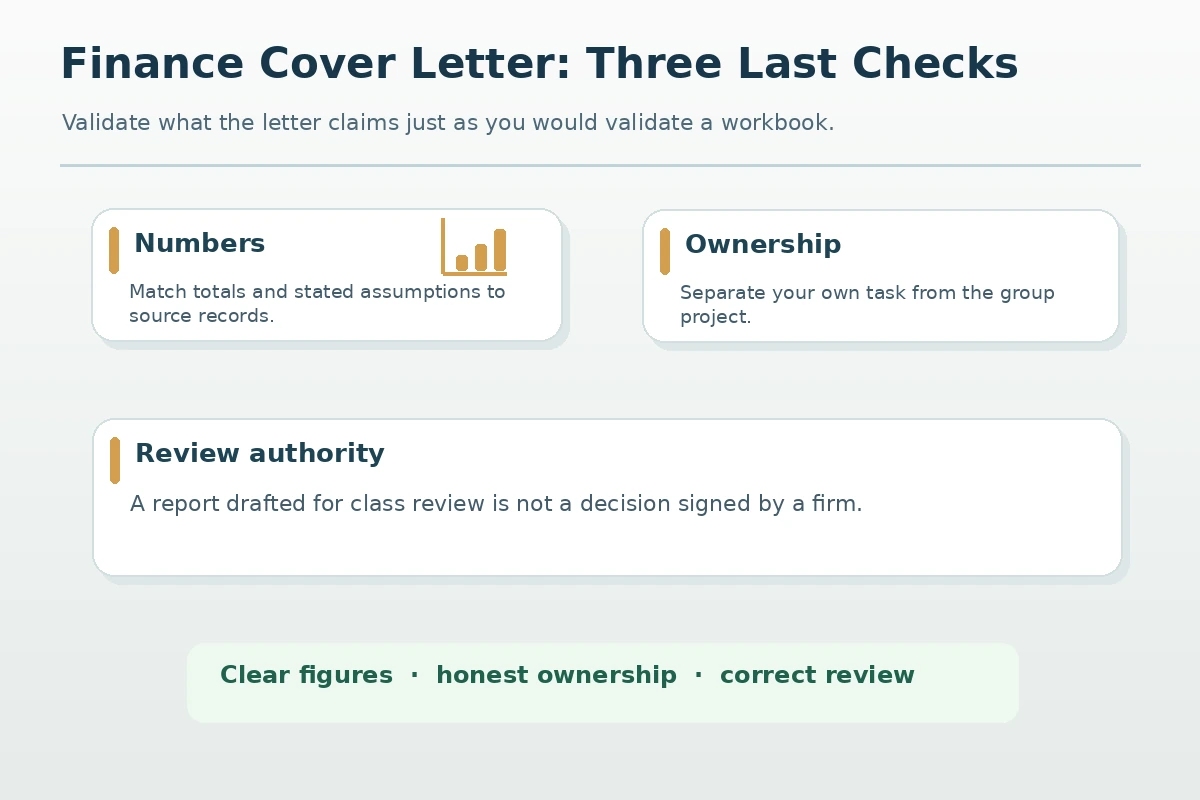
A Complete Example Letter With Truthful Project Details
Illustrative example only: The application below is fictional and must be rewritten using the applicant’s real work, program, employer, and availability. Do not copy any hypothetical experience as a factual achievement.
Dear Finance Internship Team,
I am applying for the Finance Intern role. In an undergraduate financial analysis project, I organized figures from public financial statements, built a spreadsheet scenario using documented assumptions, and checked subtotals against the source tables. When one total did not reconcile, I traced the inconsistency to a duplicate input and corrected the model before our class presentation.
The project strengthened my interest in careful financial analysis, but it was an academic exercise rather than an investment recommendation or a live client assignment. I also worked with classmates to summarize the scenario’s limitations in language that a nontechnical reader could follow. I would welcome the chance to bring that same source-checking habit and willingness to receive review to your reporting and analysis team.
Thank you for considering my application. I would be glad to discuss the project and the specific assignments described in your internship posting.
What a Realistic Revision Looks Like in Practice
A hypothetical candidate writes “managed a $2 million portfolio” after completing a classroom simulation that displayed notional balances. That phrasing would mislead a recruiter. The candidate can instead describe a simulated portfolio allocation exercise, the data used, and how the team compared assumptions. The correction is not merely modest language: it gives the interviewer a project that can be examined without pretending the student held responsibility for real assets.
The same applicant notices a mismatch between the resume’s description of “forecasting” and the project record, which actually shows a short scenario table rather than a formal forecast. They revise both documents to use “scenario comparison,” keep the original worksheet for discussion, and remove an unsupported percentage improvement. This imaginary example illustrates a review habit that can be repeated on a real application; it makes no claim about whether the employer will interview the candidate.
How We Research and Verify Internship Letters
We checked primary occupational guidance and career-center writing advice on 2026-11-14. The UC Berkeley Career Engagement cover letter guide recommends relating an applicant’s concrete experience to the exact organization and role. The BLS financial analysts profile supports this article’s treatment of financial data, scenarios, communication, and review. Descriptions of class projects and model letters here are hypothetical teaching examples, not reports of applicants or actual hiring outcomes. Sources describe general work and eligibility; the employer notice and authorized supervisors determine internship duties. For commercial relationships and editorial transparency, see our affiliate disclosure.
More Resume and Cover Letter Guides
Yes, if it is clearly called a simulation and you explain your own analysis. Do not present notional returns as verified real investments.
No. A credible checking process and relevant deliverable are more valuable than an invented percentage or transaction size.
Name a relevant technique only if you used it and it illuminates the task. Save detailed formulas for an authorized sample or interview.
Identify your contribution, such as cleaning inputs, building a sheet, or writing limitations, rather than claiming ownership of the entire model.
No. Use permission-cleared or public-source examples and follow the employer’s attachment instructions.