
What this skill should look like in a resume
To list Python skills on a resume, identify what you actually built or changed, the libraries you used, and how you checked that the program worked. Writing “Python (expert)” after following a tutorial is weak evidence. A more useful line might describe a personal CSV-cleaning script with input checks and repeatable tests. Keep coursework, hobby projects, internships, and paid production systems clearly distinguished. Python proficiency includes writing and reading code, handling failures, and explaining why a tool was chosen; none of these should be implied unless you can demonstrate them.
Separate syntax familiarity from shipped work
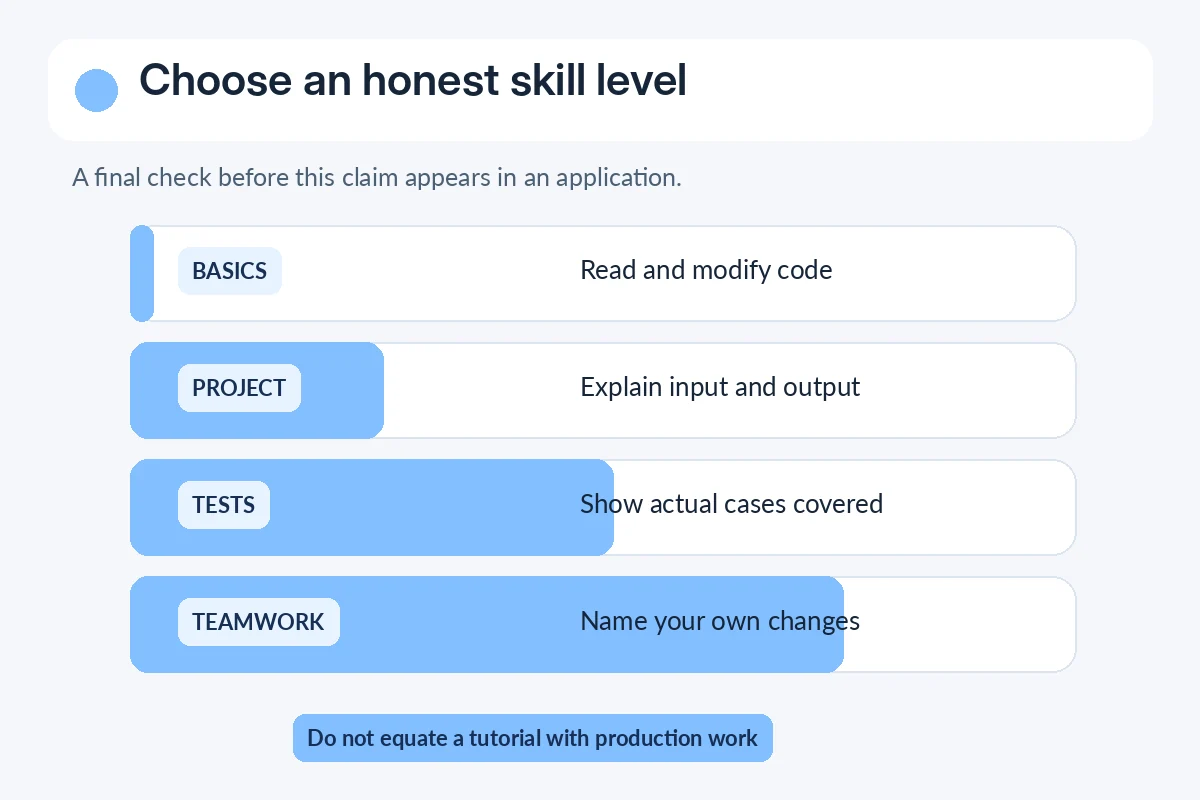
A beginner may be able to read variables, loops, conditions, functions, and simple files. An intermediate project might also require reusable modules, error handling, data validation, and tests. Working in a professional production environment introduces code review, operations, security, and collaboration that a solo class exercise does not automatically prove. Pick the level your actual projects demonstrate. Rather than claiming “advanced Python,” name a particular application and the task you completed so an interviewer can ask targeted questions.
List libraries only when you used them
It is reasonable to mention pandas, requests, NumPy, matplotlib, or a web framework if those tools were part of your hands-on work. Do not list every Python package you recognize from a course outline. Explain the use case: cleaning tables, making an API request, plotting data, or writing a basic service. If you copied a tutorial line without understanding it, do not turn that exposure into proficiency. Be ready to explain data types, inputs, expected outputs, and how you handled an incorrect file or failed request.
Describe a project by inputs, transformation, and output
A good Python bullet shows the data or problem, your script’s work, and what output a user could inspect. Illustrative personal project: “Wrote a Python script that checks required columns in a sample CSV, flags missing values, and exports a summary for review.” If that is a fictional example, it must not be copied as an accomplished fact. Use an actual project with its own input constraints and output. Avoid saying your script “automated the entire workflow” when humans still entered data or approved decisions.

Show testing without claiming quality guarantees
The Python documentation describes unit testing tools, including test cases and discovery. On a resume, report the test types you actually wrote: normal inputs, missing fields, invalid dates, empty files, or expected exceptions. “Added unittest checks for empty input and column names” is stronger than “bug-free code.” A test suite does not prove that every real-world scenario is safe. If a manager reviewed your changes, mention code review accurately; if the script was an independent hobby exercise, do not present it as enterprise QA.
Clarify individual contribution to a shared repository
In a team assignment, identify the module, feature, test, or documentation you personally produced. Someone who wrote a parser should not claim authorship of the whole application. If your pull request required review, describe preparing the change and addressing feedback rather than approving it. A clean GitHub project can help demonstrate work, but only share repositories that you own or are authorized to expose. Avoid pushing credentials, user records, internal endpoints, proprietary code, or employer scripts into a public portfolio.

Distinguish analysis from software engineering scope
A data analyst may use Python for cleaning, merging, or visualizing data; a developer may build applications, tests, and services. Both can be valuable, but the scope differs. If your role involved notebooks, name the analysis questions and the validation steps. If you wrote scripts that others ran, explain how they were packaged or documented. Do not claim deployment, monitoring, or production support just because a notebook ran once on your laptop. The best evidence is not a buzzword list but a truthful, interview-ready description.
Write a precise beginner-friendly bullet
Illustrative example only: replace “Expert Python programmer with many frameworks” with “Built a personal Python script to normalize sample filenames, check duplicates, and write a review report.” If the project used a particular library, include it only if you can explain it. If your contribution was updating existing code, prefer “modified and tested a file parser” over “developed a platform.” Add verified project dates or a working sample link if appropriate. A thoughtful beginner project is useful without pretending to be professional production experience.
Use a technical-skills line without inflating proficiency
A skills section can show “Python; pandas; unittest” when you have actually used all three. For a target role, add the most relevant library rather than a long collection of unrelated packages. Do not claim certification just because a course completion badge exists. Keep tool versions out of the resume unless required by the job. If a project is recent and strong, place it in Projects or Experience with a clear task, contribution, and test description; the skills list alone cannot communicate scope.
Review security and reproducibility before linking code
Run the sample using clean input files, read the README, and remove secrets or private data before publishing any repository. Confirm that dependency instructions match the code you actually wrote. A sample data file must be synthetic or authorized. Remove outdated references to APIs, credentials, or employer-specific environments. If a code sample will not run outside your computer, explain the limitation rather than implying universal reproducibility. A recruiter may not execute it, but clear documentation helps them understand your thinking.
Adapt the example to your own verifiable history
The before-and-after example in this guide is hypothetical and is not an achievement you should paste as your own. Weak version: “Python expert; automated all business operations.” Possible revision when true: “Built a personal Python CSV checker, added empty-file tests, and documented review output.” Replace the setting, verbs, and tools with your actual work; remove anything you cannot explain in an interview. If you participated in a team, distinguish your contribution from a coworker’s decision and never infer a numerical result that was not measured. Use the skill only when it is relevant to the vacancy.
How We Research These Resume Skill Examples
We compared the job-search intent with previous JobAsk resume subjects, used the primary and university sources below to check how work skills should be evidenced, and made the examples deliberately hypothetical. Skill terminology does not guarantee a particular hiring or applicant-tracking-system outcome. Your responsibilities, authorization, and source records determine which claims belong on your own resume.
Sources reviewed 2026-11-03: The official Python documentation describes unit-test cases, loaders, and test discovery. UC Davis explains that technical skills and software proficiency can be listed specifically. UC San Diego recommends tailoring technical skills and documenting personal contributions in experience bullets. Editorial and relationship disclosure: affiliate disclosure. No partner recommendation or guaranteed hiring result is implied.
More Resume and Cover Letter Guides
You may list what you can demonstrate, preferably with a clearly labeled course or personal project rather than an expert rating.
No. Prioritize libraries used in genuine work you understand and can discuss.
Yes when it solves a clear question, shows your work, and accurately labels its academic or personal context.
No. Describe the inputs and cases covered, not a blanket guarantee.
Only if the organization expressly permits sharing it. Never disclose private code, data, credentials, or internal endpoints.