
What this skill should look like in a resume
To list documentation skills on a resume, name the kind of record you maintained, how you checked its completeness, and who used or reviewed the result. “Good documentation” is vague; “maintained equipment service tickets and routed unresolved items to technicians” is concrete. Employers use many different record systems, so avoid presenting basic data entry as regulatory compliance, medical charting, or authorized record approval. Explain the workflow you actually handled, including file naming, version control, accuracy checks, and privacy boundaries.
Identify the documents you really handled
Documentation may mean case notes, meeting minutes, incident logs, technical instructions, checklists, service tickets, controlled forms, research records, or customer account notes. These differ in sensitivity and approval rules. Start with the actual nouns from your work, not an inflated title. An office assistant who attached invoices to purchase records should say that, rather than claiming to have controlled financial reporting. A student who maintained a lab notebook can claim project documentation but should not imply professional regulatory responsibility.
Explain the lifecycle from capture to handoff
A useful documentation bullet answers what started the record, what you entered, how you checked it, and where it went next. For example, the worker may receive a service request, record the symptom and timestamp, check required fields, then assign it to the authorized technician. A different workflow may involve draft instructions, supervisor review, and publication. These steps reveal judgment and quality without falsely claiming control of the whole system. Draw a boundary between preparing records and making the decisions supported by those records.
Describe versions without overselling tools
If you used naming conventions, shared folders, change histories, or document libraries, explain the behavior and tools at the right level. “Compared the latest approved procedure against draft edits before routing updates” is more credible than “managed enterprise version control” if you did not administer the system. Word Track Changes, shared-drive revision history, issue trackers, and formal document control are not equivalent. Use exact software names only when you can show hands-on work, and do not claim administrator permissions based on ordinary user access.

Show accuracy checks that actually happened
Documentation quality may involve mandatory fields, duplicate detection, spelling of identifiers, date consistency, or review against source material. Name the check you performed. Illustrative example: “Checked new service tickets for contact details and routed missing information back to the requester.” Do not say a record was error-free or audit-ready unless there was a genuine verification process. If a supervisor signed off on a record, say you prepared or routed it for review, not that you certified it personally.
Protect privacy when describing recordkeeping
A resume should explain the type of information handled without reproducing a real patient, customer, student, employee, or client record. Do not link to a live employer system or attach raw documents with personal details. For a portfolio, create a fictional example from scratch or share a version explicitly cleared for release. If the job involves medical, legal, or financial records, distinguish your support duties from licensed decisions or privileged access. Competence includes knowing what must stay out of a resume.
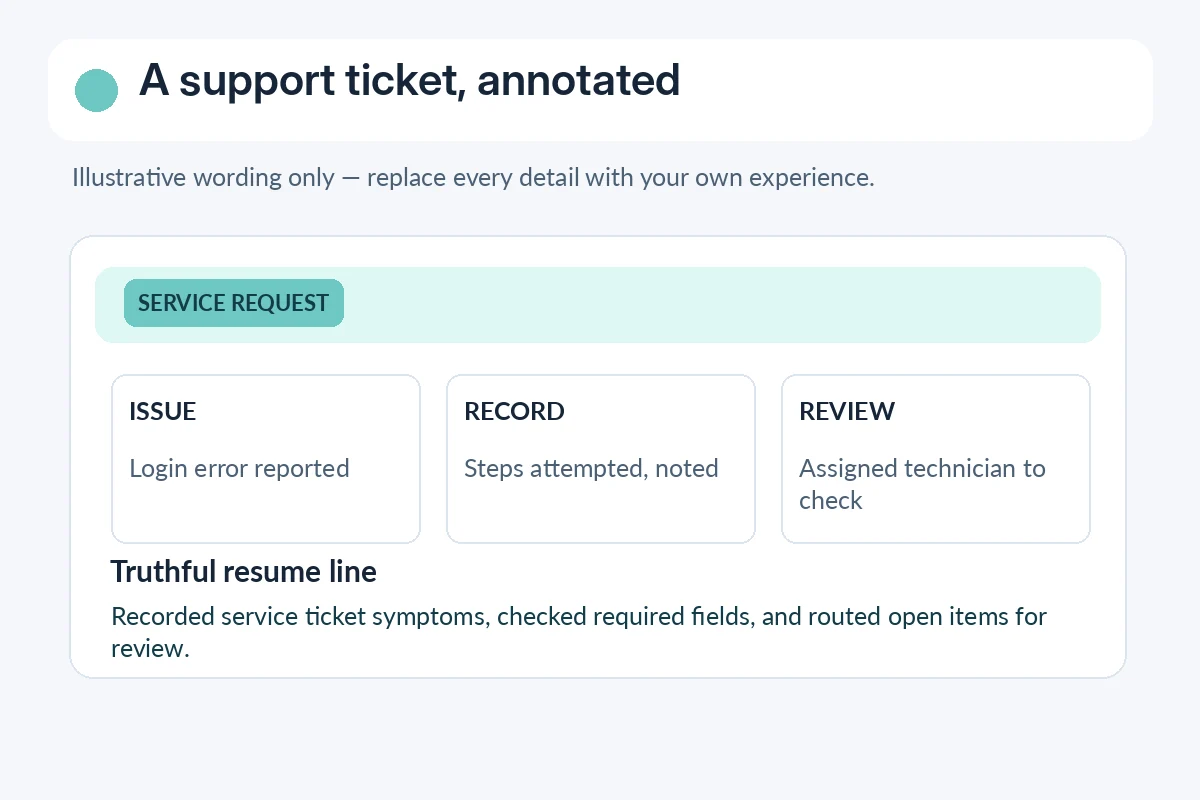
Turn a ticket workflow into a precise bullet
Illustrative example only: a help-desk trainee entered user-reported symptoms, recorded steps suggested by the support lead, and tagged items that required escalation. A truthful bullet might read: “Documented incoming help-desk tickets with issue summaries, attempted steps, and escalation notes for technician review.” This is not equivalent to diagnosing the root cause or closing incidents. Readers can see what information became useful to the next person and what the trainee did not have authority to decide.
Tailor the evidence to a specific role
For an administrative job, records organization and follow-up may be most persuasive. For quality support, revision status and traceable notes may matter more. For IT support, ticket clarity and the next troubleshooting owner are central. For education, authorized classroom records and confidentiality may be relevant. Compare the job’s actual deliverables with your evidence instead of listing every app you have opened. A small but relevant example can outweigh an unverified claim about enterprise document management.
Place technical systems and habits in separate sections
Put hands-on software skills in a technical-skills list when the employer requests them, but explain the documentation process under the job or project where you used it. The phrases “SharePoint” or “Google Drive” alone do not prove version discipline. A bullet can show a record-check routine, while a concise tools line can identify a platform. Review the export to ensure abbreviations are understandable and that any sample portfolio link points to a sanitized, accessible file.
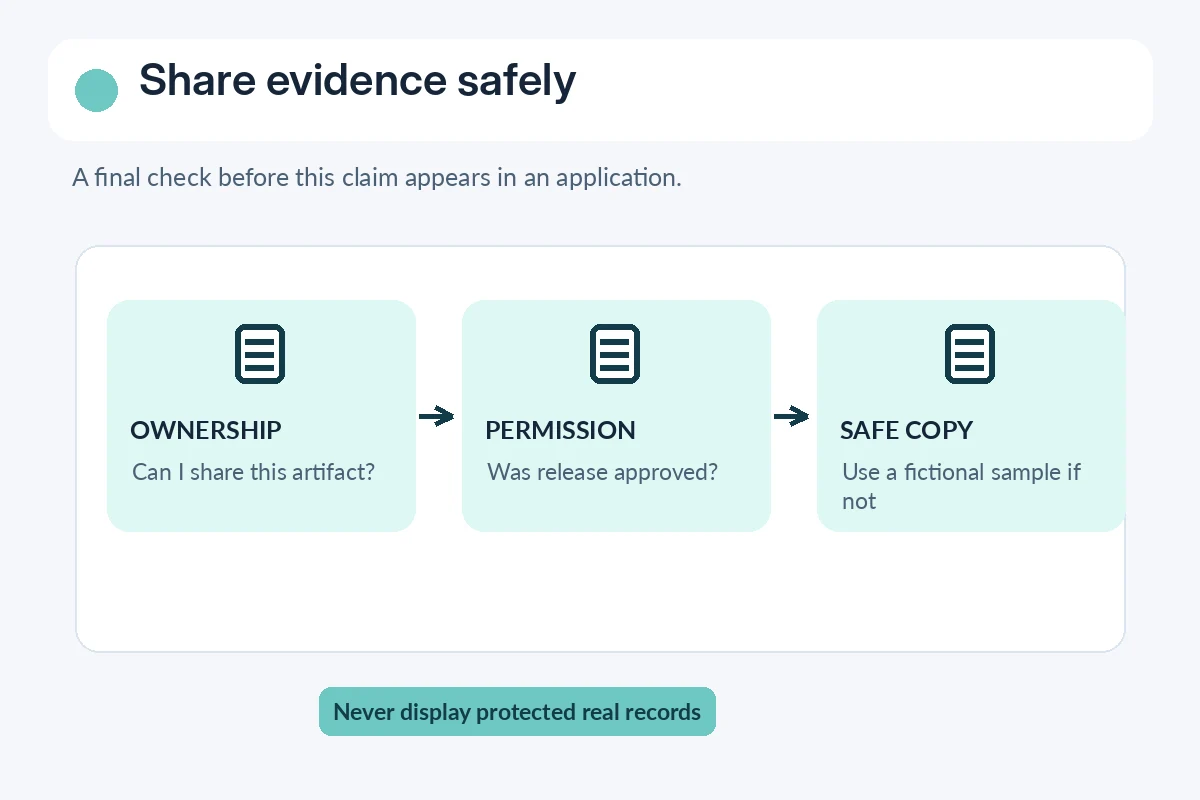
Use an audit before including documentation claims
Ask: Did I create the record, check it, update it, review it, or simply read it? Was I authorized to share the resulting artifact? Did I own the procedure or follow someone else’s instructions? What precisely happened when information was missing? The answers determine the best verb. If you cannot defend a percentage, omit it. If you worked on a shared file, name your contribution rather than the entire project. This preserves the distinction between competence, participation, and approval.
Adapt the example to your own verifiable history
The before-and-after example in this guide is hypothetical and is not an achievement you should paste as your own. Weak version: “Responsible for all documentation and compliance.” Possible revision when true: “Recorded service ticket symptoms, checked required fields, and routed open items for review.” Replace the setting, verbs, and tools with your actual work; remove anything you cannot explain in an interview. If you participated in a team, distinguish your contribution from a coworker’s decision and never infer a numerical result that was not measured. Use the skill only when it is relevant to the vacancy.
How We Research These Resume Skill Examples
We compared the job-search intent with previous JobAsk resume subjects, used the primary and university sources below to check how work skills should be evidenced, and made the examples deliberately hypothetical. Skill terminology does not guarantee a particular hiring or applicant-tracking-system outcome. Your responsibilities, authorization, and source records determine which claims belong on your own resume.
Sources reviewed 2026-11-03: CareerOneStop recommends showing work history, relevant responsibilities, and accomplishments clearly. UMBC advises collecting skill demonstrations and documentation artifacts for job portfolios. University of Minnesota recommends selecting and organizing work samples that show skills and training. Editorial and relationship disclosure: affiliate disclosure. No partner recommendation or guaranteed hiring result is implied.
More Resume and Cover Letter Guides
Data entry can be one part. Stronger evidence also explains completeness checks, version management, review, or handoff when these happened.
Yes if you used it. Describe actual functions such as organizing files or reviewing versions rather than implying administrator access.
Only with explicit authorization and no protected information; a fully fictional example is often safer.
Say you prepared or updated them for review, and do not imply that you approved or certified the final record.
Name the checks, such as required-field review or source comparison, and describe the next step when something did not match.