
A cold email for an informational interview should explain why you chose this specific professional, identify what you want to learn, and request a brief conversation that is easy to decline. Do not misstate a mutual connection, imply an employer owes you time, or turn a career-research email into an unsolicited job application. Use the subject-line checks, fictional email, and follow-up boundary below before pressing send.
Find a legitimate contact route before drafting
Begin with a public professional profile, official organization bio, alumni directory you are authorized to use, or a career platform’s messaging feature. A publicly visible work contact is not an invitation to send a promotional campaign. Confirm that you have the right person, their role is relevant, and the channel is suitable for professional correspondence. Avoid harvesting private email addresses, guessing personal accounts, or impersonating a shared contact.
Your first test is whether you can write one truthful sentence about why this person is a useful source: “I saw your university career panel about supply planning,” or “Your public project notes explain the move from operations to analytics.” If you cannot support the connection, do more research or choose someone else. A good cold message is selective, not mass-sent to hundreds of people with a generic “Dear Professional.”
Write a subject line that matches the request
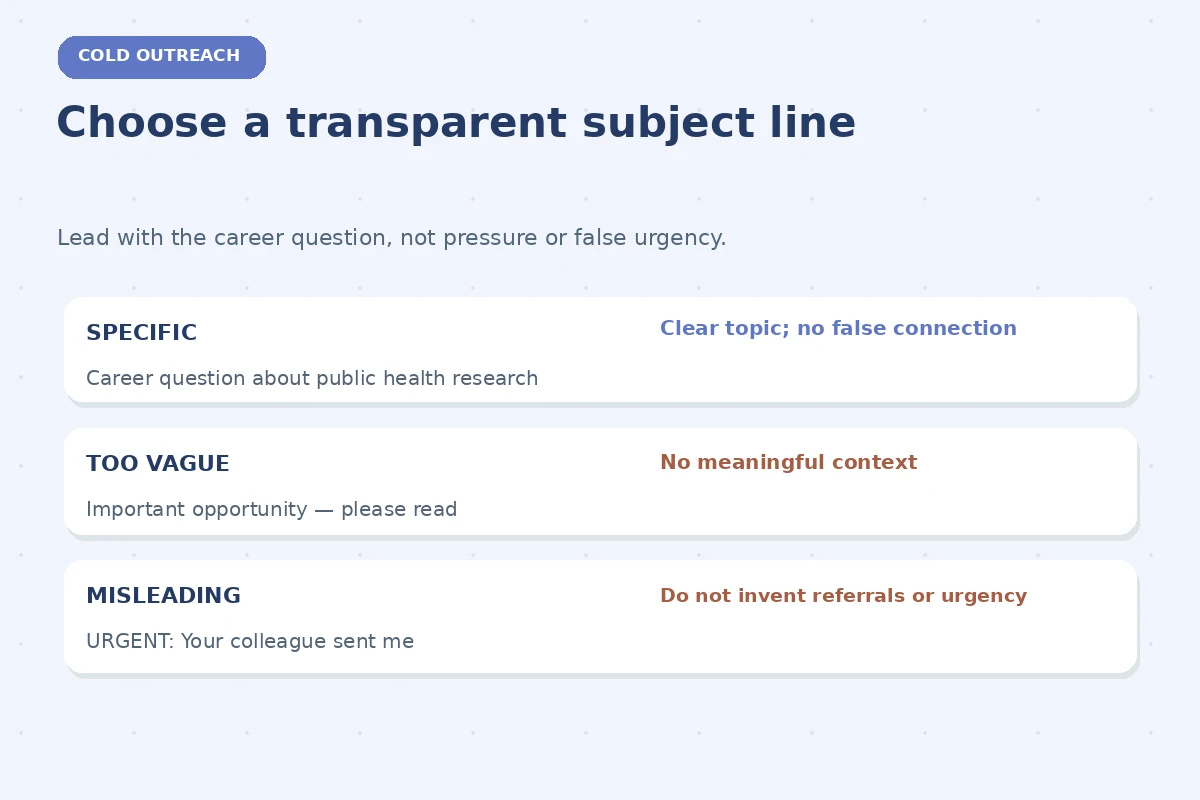
A subject line should signal the topic and the size of the ask. Examples: “Question about a career in nonprofit operations,” “Request for a brief design-research conversation,” or “Student exploring environmental data work.” If you are not a student, do not claim to be one. Avoid “URGENT,” “Guaranteed opportunity,” fake reply prefixes, or an employer’s name used as if the message came from that employer.
The message body should follow the same promise. A request for career advice should not hide a demand for a job, an attached sales presentation, or a long questionnaire. A subject such as “Can we discuss your role?” is polite but less informative than a specific field or transition. A clear subject also makes the message easier for a busy person to categorize and decline if they cannot help.
Use this fictional cold email as a structure
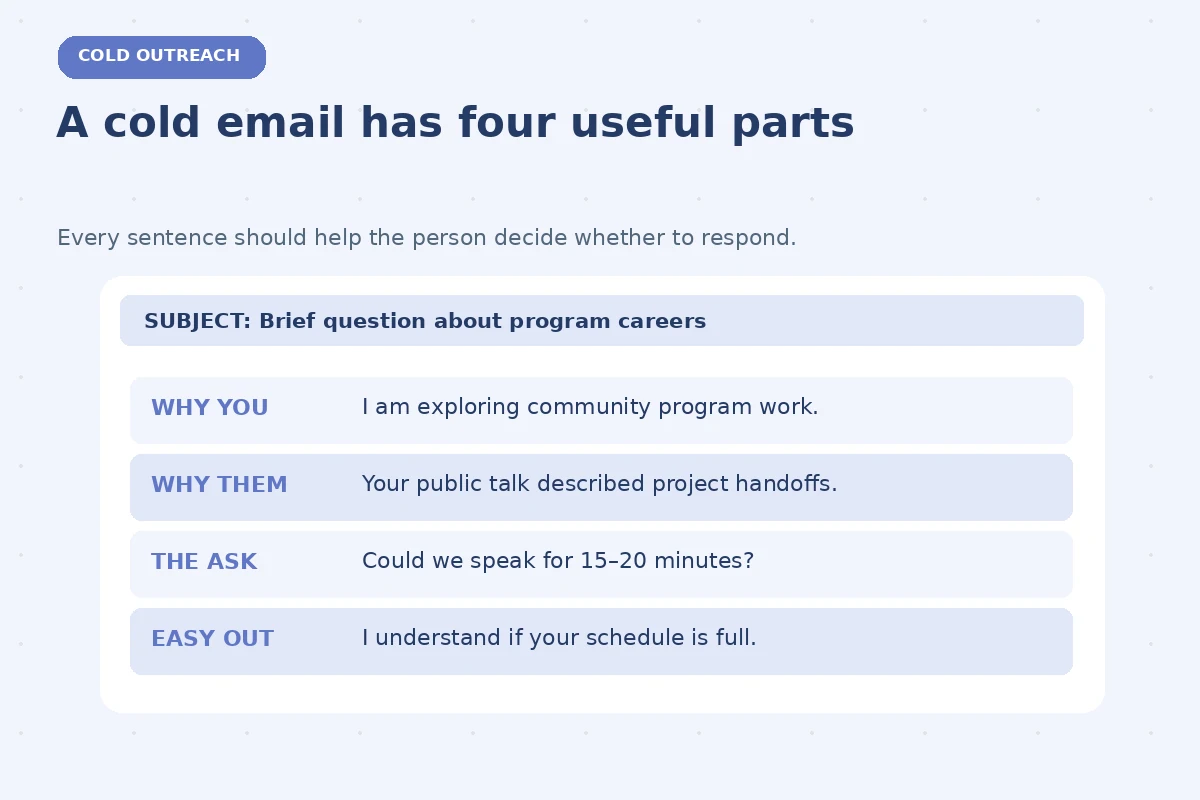
The following is a hypothetical template, not a report of a real contact or a ready-to-send message. Replace the claims only with verified facts. Subject: Brief question about community program careers. Hello Jordan, I am exploring roles in community program coordination and read your public talk summary about keeping outreach activities organized. I am particularly interested in how early-career staff learn to track tasks across partners. Would you be open to a 15–20 minute phone or video conversation in the next two weeks? I understand if your schedule does not allow it. Thank you for considering my request. Best, Taylor [your verified contact details].
This version contains an identity, a public reason, one learning question, an attainable time request, a medium choice, and an easy opt-out. It does not invent a referral. It does not attach a resume uninvited. It gives the recipient enough context to decide whether the conversation is relevant.
Edit for the person instead of adding flattery
Ask whether each sentence earns its place. “Your company is the most incredible employer anywhere” sounds like generic praise and often signals a copy-and-paste campaign. “I noticed your published explanation of the scheduling handoff” points to an actual topic. Be precise without suggesting you have access to private projects. You can mention a shared event if you truly attended; otherwise say you found the work through an accessible publication or organization page.
Keep the learning request small. One narrowly framed topic is usually easier to answer than an invitation to advise your entire career. If the person is not a fit, end the draft rather than forwarding it to unrelated colleagues. Proofread the recipient’s name, employer, field, and time zone. Remove any automated signature that exposes unnecessary personal data.
Choose a realistic follow-up and stopping point
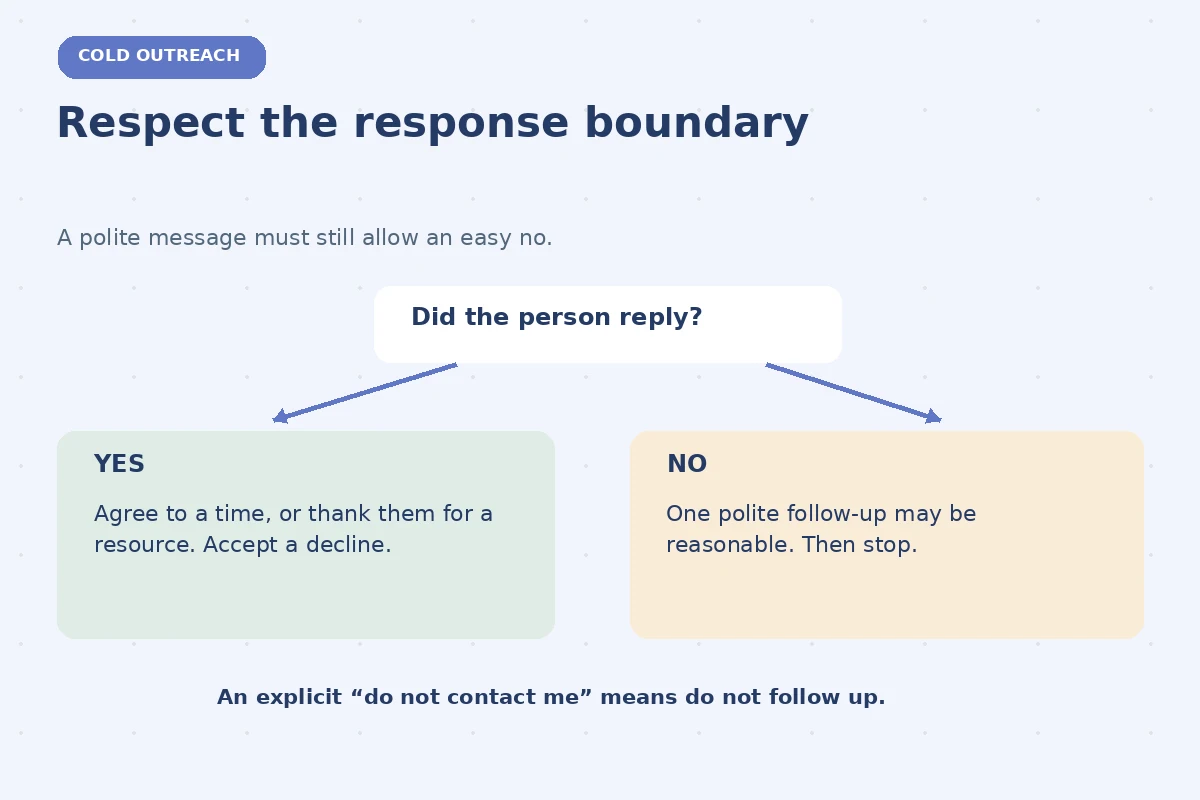
Some people may not respond. They might be away, unable to take outside meetings, or simply not interested. If no answer arrives, one short follow-up after a reasonable interval can restate the career question and give the person permission to decline or ignore it. Do not mark repeated email as urgent, call private numbers, copy supervisors, or send messages through every platform. Silence does not require explanation.
If a contact says “not now” or “please do not contact me,” stop. If they recommend a resource instead, thank them and use it. If they refer you to someone, confirm whether their name may be included before mentioning that connection. The aim is an appropriate relationship, not a measured response rate or a guarantee of an invitation.
Prepare for a positive reply without changing the goal
When they agree, propose several short windows with time zones and ask which channel they prefer. Confirm the agreed time, avoid sending a calendar invitation without consent, and research their field before the call. Prepare three or four questions that cannot all be answered by the company homepage. You should be ready to use the conversation to learn rather than to sell your qualifications.
Afterward, send a specific thank-you and identify one public, verifiable next step. Do not disclose material the person described privately, publish their words without permission, or post a screenshot of the meeting to imply endorsement. A successful cold email may lead only to useful advice; that is still aligned with the purpose of an informational interview.
How We Research Career Conversations
We compared published U.S. university career-center guidance on informational interviews, outreach, preparation, note-taking, and follow-up. Where this article discusses occupational duties, we checked the cited occupational description separately. The question scripts and dialogues are hypothetical teaching examples, not actual interviews, employer policies, or guarantees that a professional will respond. Guidance from one organization may not reflect every profession, employer, or school assignment.
Sources reviewed November 13, 2026: fisher.osu.edu — Ohio State Fisher College of Business explains how to introduce yourself, identify a specific connection, and ask a clear question in a cold networking email.; careers.tufts.edu — Tufts advises explaining who you are, why this contact matters, and a concise request for 15–30 minutes without directly asking for a job.; career.ucsf.edu — UCSF provides examples of specific rather than generic informational interview requests and suggests giving a clear time frame..
This is general U.S. career guidance, not professional hiring or legal advice. Ask permission for sensitive notes or recording and follow applicable institutional policies. Review the JobAsk affiliate disclosure. The navigation links here are informational, not evidence of employer endorsement, a job placement, or an affiliate agreement.
Related Job Search Guides
Usually not unless the recipient requests it or it directly helps the agreed conversation. Keep the first message about learning.
Only if that is true. Ideally confirm that the mutual contact is comfortable being named.
Introduce yourself honestly through your work, interest, or career research. You do not need to invent a student status.
One polite follow-up may be reasonable after a suitable interval. Stop if the recipient declines or asks not to be contacted.
No. An informational interview request asks for career information and advice, not an endorsement or access to a hiring process.