
If one job posting lists several cities, branches or work sites, your cover letter should identify the role and give only the location preference or mobility information the employer actually needs. First determine whether this is one multi-site requisition, several separate openings, a rotating assignment or a remote/hybrid arrangement. Then write one short, truthful location sentence, paired with a real qualification. Do not promise immediate relocation, unlimited travel or availability at every site unless that is genuinely possible. The examples below show how to make the letter useful without guessing how the employer assigns candidates.
Identify Whether the Posting Is One Role or Several Openings
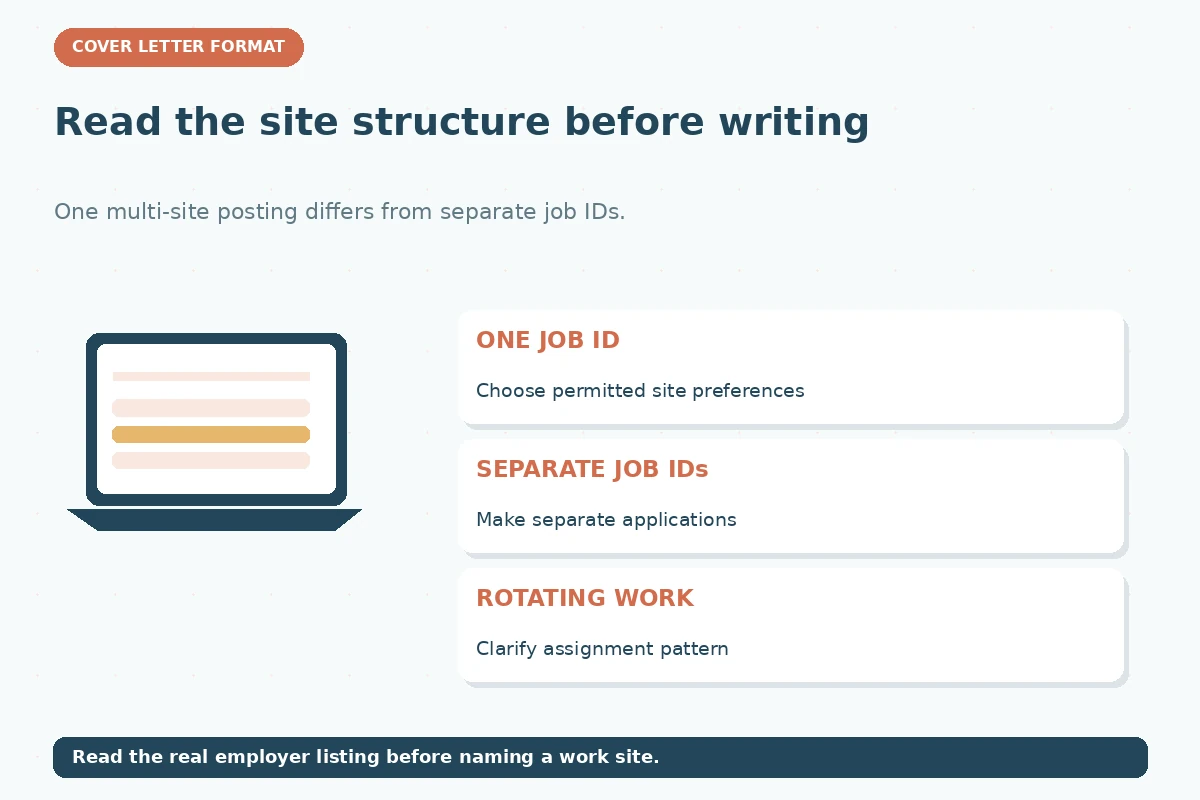
Read the employer-side announcement carefully: does one requisition show a choice of branches, or are different positions listed for each city? Is the work site fixed, variable within a region, or subject to later placement? Check the application fields; some portals provide a location-preference selector while others require one application per site. Do not infer that every site has an active vacancy merely because it appears in a corporate locations list. When there are distinct openings with separate requisitions, each application should name its own role and location.
Write down the official job title, posting number if available, locations actually included, expected schedule, and where preferences should be entered. The letter should not replace an explicit preference field in the portal. If no work site is stated, avoid inventing a branch address in the header. U.S. university career centers emphasize adapting the letter to the specific job and employer; a verified location is part of that adaptation. A candidate who copies a city from another application risks showing interest in the wrong opening.
Write One Clear Preference Sentence Near the Opening
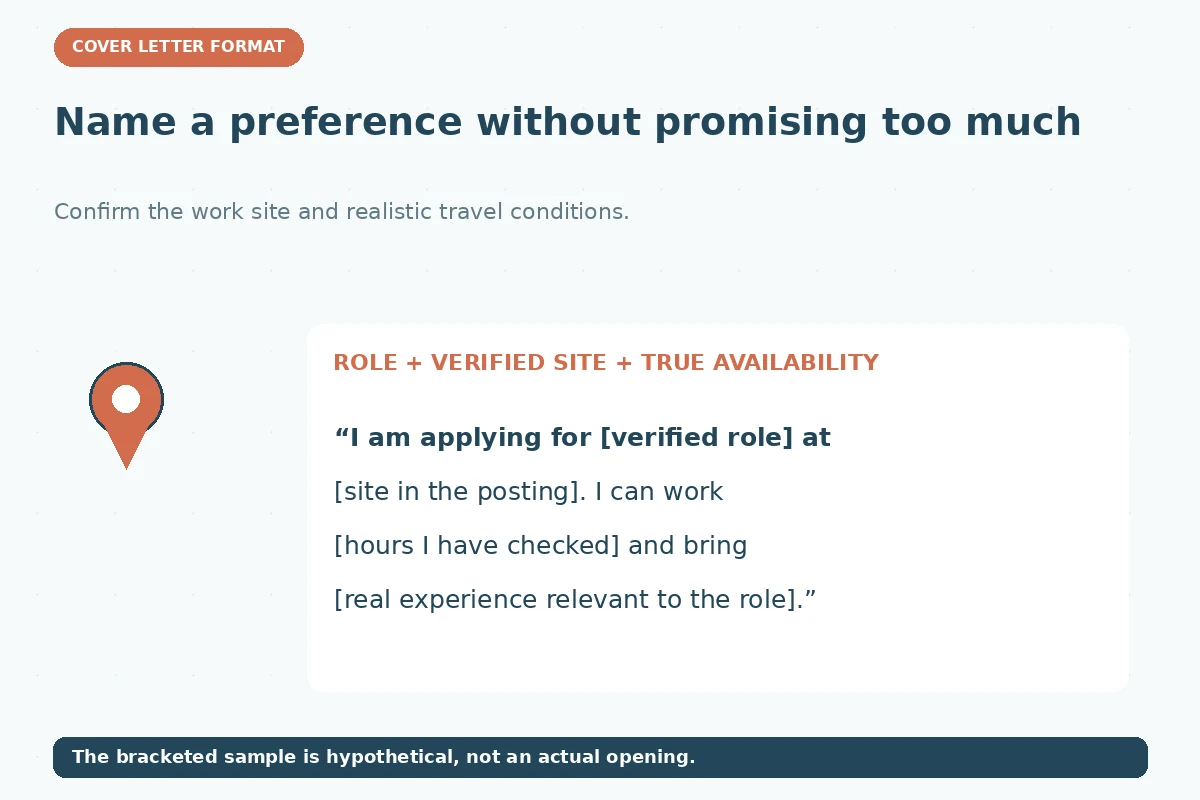
Your first paragraph can name the role, the employer and a site preference when relevant. For a hypothetical posting at branches in North and South City, an applicant might write, “I am applying for the Customer Support Associate opening and would prefer the North City location listed in the posting.” If both sites are genuinely practical, “I can work at either listed location, subject to the posted schedule” may be more accurate. Replace the fictional names, role and conditions with your actual details.
Avoid saying you would accept every site in the network or relocate anywhere in the country if you have not checked what that means. If the employer asks for one location only, follow the form rather than adding a contradictory letter claim. A short preference statement helps a reviewer, but it should not occupy the whole opening. After identifying the role and preferred site, show one relevant action or responsibility from your real experience. A location request cannot substitute for demonstrating that you meet the job requirements.
Separate Commuting Reality From Flexible-Sounding Promises
A candidate may have genuine travel constraints arising from transit schedules, care responsibilities, a second job or school. You do not need to provide personal detail, but you do need to state availability accurately when the employer asks. Before claiming that a branch is workable, check likely transit times, shift start and end times, required onsite days and whether the location changes during training. Do not use a cover letter to promise a commute you cannot reliably complete. Employment terms may require in-person attendance even when other staff work remotely.
For example, “I can work weekday mornings at the two listed downtown sites” is useful only if that is actually true and the role's schedule permits it. Saying “fully flexible for any shift” while knowing you cannot work evenings creates a preventable mismatch. If the employer has not shared the schedule, say “I would welcome clarification of shift locations and hours” rather than inventing details. There is no universal cover-letter rule that forces candidates to disclose personal scheduling reasons. Keep the work-related facts and questions clear.
| Posting situation | Letter detail | Check separately |
|---|---|---|
| One requisition, sites listed | True site preference | Portal choice |
| Several job IDs | Correct role and city each | Separate files |
| Rotating assignment | Actual flexibility limits | Site rotation policy |
| Relocation possible | Confirmed plan only | Start date and onsite needs |
Explain Relocation Only When It Is Relevant and Real
When a job is in a different region, your letter may briefly state an actual relocation plan or openness, but do not invent a signed lease, move date, available address or paid relocation arrangement. An accurate hypothetical statement is “I plan to move to [city] in [confirmed month] and can discuss start-date requirements.” If your move is only a possibility, “I am considering relocation and would welcome discussion of the expected on-site schedule” is more honest. Neither statement guarantees the employer can accommodate the plan.
Distinguish current location from work preference. You may omit a full street address from the letter when it is not requested while giving an appropriate email and phone contact. If the posting explicitly requires local residency, clearance, license or site-based credential, confirm eligibility instead of using confident wording to bypass the requirement. Your evidence paragraph should still address the job's tasks; a relocation sentence is context, not a qualification. Follow official employer instructions where they request geographic preferences in a separate form.
Handle Rotating Sites and Hybrid Expectations Precisely
Some jobs require visits to several locations, coverage at different branches or a mix of remote and on-site days. Read the duty statement rather than assuming that “multi-location” means you can choose one permanent branch. If you have genuine multi-site scheduling experience, describe the exact coordination you performed, including who approved changes. Do not claim you controlled staffing at multiple locations if you only transported materials between sites. Work-site assignments, travel reimbursement, and hybrid policies are employer-specific; do not state assumed benefits or remote privileges as facts.
You can use a direct question in a later recruiter conversation: “Are assignments fixed to one branch, or do employees rotate among the listed sites?” In the letter itself, a concise sentence about real availability is often enough. If the application requires a preference ranking, use the employer's dropdown or form exactly as intended and keep the cover-letter wording aligned. A separate travel availability worksheet helps you avoid a promise that the form and the letter contradict.
Cross-Check Posting, Form and Final PDF
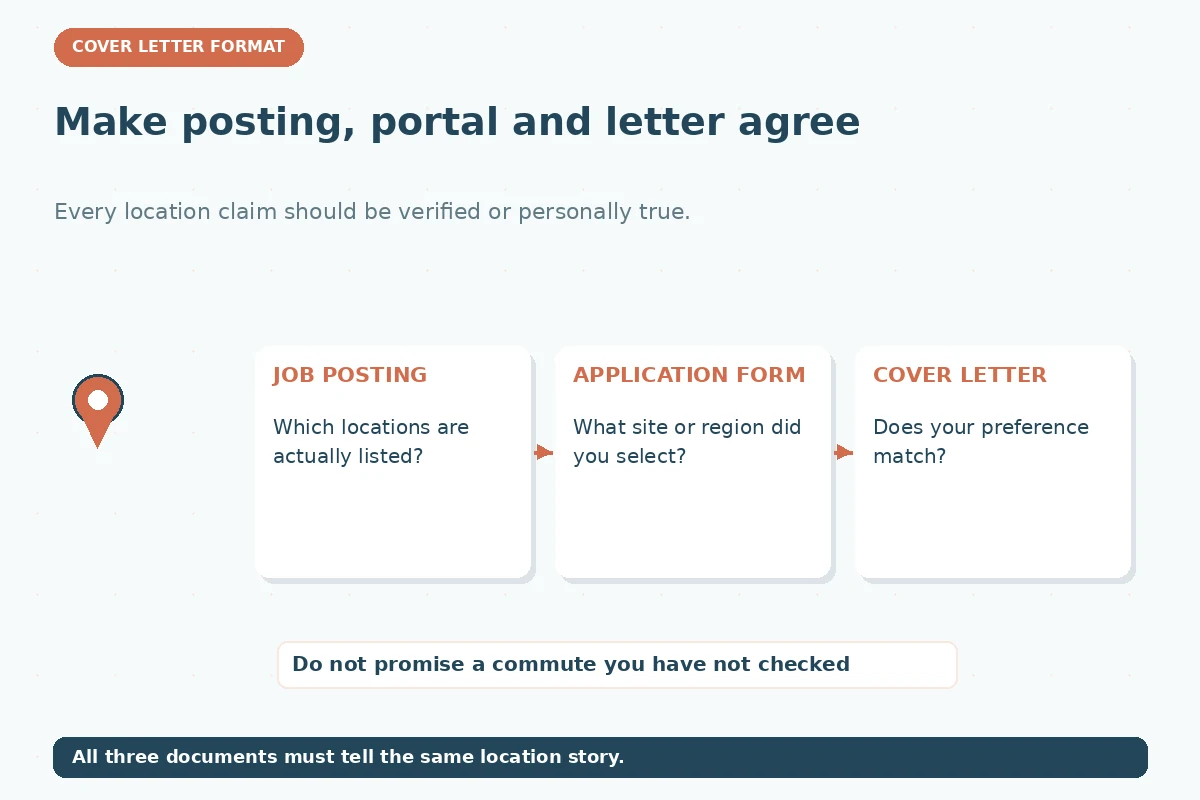
Make a final three-way comparison. In the actual job posting, confirm the relevant locations. In the application, confirm the site or region you selected. In your cover letter, check that any preference or relocation sentence says the same thing. Then read the rest of the document for a meaningful evidence example tied to the job. Remove leftover branch names, invented hiring-manager addresses and formatting placeholders from the final PDF. The clearest letter fits the vacancy and reads naturally when sent to a person at any listed site.
If the employer later confirms a different work site, update your availability through the official recruiting route rather than pretending the original letter already covered it. Keep private notes of the locations discussed and any confirmed next steps. A well-structured letter cannot force a location decision or guarantee an offer; it can prevent misinformation and show you checked the actual opportunity. The main test is whether every geographical claim is verified by the posting or true of your own circumstances.
How We Research and Maintain This Guide
This guide was reviewed against the linked U.S. university and professional career resources on 2026-11-13: University of Maryland Career Center Tufts Career Center UC Berkeley Career Engagement University of Pennsylvania Career Services. Every template, role, organization and decision example is illustrative unless expressly attributed; adapt it to the actual employer instructions and your true experience. See the affiliate disclosure for relationship transparency. No hiring outcome or employer approval is implied.
More Resume and Cover Letter Guides
Only if the job or form asks for preferences or naming a site clarifies your application. Use the actual listed location.
Only if that is true after checking travel, scheduling and relocation realities.
Generally yes when the employer lists distinct openings, unless the application instructions say otherwise.
Avoid guessing. Ask the recruiter about fixed versus rotating assignments and state only confirmed availability.
Follow the requested submission format; many application letters can use reliable contact details without an unnecessary full personal address.