
When applying for two positions at the same company, write a separate cover letter for each actual opening. Keep your work-history facts identical, but change the job title, the relevant proof and the reason you want that particular position. One generic letter naming both jobs often leaves the hiring team unsure which duties you can perform. The two-column evidence exercise below shows how to prepare distinct documents without inventing achievements or creating confusing files. First check whether the employer allows applications to both vacancies or has a preferred process.
Confirm the Two Roles Are Real, Relevant and Open
Start by reading both official postings rather than relying only on an aggregator's abbreviated descriptions. Write down each job title, posting ID if supplied, department, location, required qualifications, and application route. Confirm that both opportunities are genuinely attractive to you and that you meet the nonnegotiable requirements for each. If one job is a different level or department, acknowledge that distinction. Applying to two jobs is not itself a formatting trick; it is a decision about two separate recruiting processes.
Some employers prefer one profile with multiple applications; others may restrict submissions or ask you to identify a preferred role. Follow their instructions, and do not submit extra cover letters through channels not offered. A new posting may have been updated after your first application. Check the latest employer-side job description before adapting your letter. If only one job truly fits, putting energy into that one is more useful than crafting two versions simply to increase the number of submissions.
Make a Separate Evidence Map for Each Position
Use a simple comparison with columns for Role A, Role B, and your verified evidence. Suppose one vacancy is a scheduling coordinator and the other is an inventory assistant. A true example of coordinating event volunteers might demonstrate follow-up and calendars for the first; a separate example of tracking equipment sign-outs might support careful records for the second. Do not stretch a single activity to claim two unrelated specialist competencies. Tufts Career Center advises selecting the portions of your experience that answer the requirements of the particular position rather than rewriting the entire resume.
Copy the two actual job requirements into your private working notes, then identify one work product, action or responsibility for each. The facts must remain unchanged between letters: same dates, same supervisor relationship, same level of authority. The framing changes because the hiring question changes. A coursework spreadsheet can support basic data checking when clearly identified as a class exercise; it cannot become formal inventory-management experience in the second letter just because the keyword fits.

Write Two Distinct Openings Without Contradicting Yourself
For Role A, a hypothetical opener might say: “I am applying for the Scheduling Coordinator opening. Your description of calendar updates and handoff records matches my experience organizing volunteer shift changes and maintaining an accurate sign-up sheet.” For Role B, an appropriate separate opener could be: “I am applying for the Inventory Assistant opening. In a campus equipment room, I recorded checkouts and flagged missing returns to the staff coordinator.” Only use these examples if you have equivalent actual experience; the occupations, tasks and scenarios are illustrative.
Each opening names one position and a believable link to that job. Avoid “I would accept either job at any level” unless that is explicitly relevant and true. If a recruiter asks why you applied to both, you can explain the distinct aspects that interested you. You do not have to conceal the other application; you also do not need to announce it in both letters unless the employer instructs applicants to do so. The cover letter should first make sense as a standalone response to its own requisition.
| Application check | Role A | Role B |
|---|---|---|
| Job identity | Scheduling Coordinator | Inventory Assistant |
| Evidence focus | Shift-change records | Equipment sign-out logs |
| True authority | Reported to event lead | Flagged to staff lead |
| File label | Scheduling cover letter | Inventory cover letter |

Keep the Body Evidence True Across Both Letters
The middle paragraph should be selected, not rewritten into a new history. Use the same factual dates, training status and quantitative results across your applications. Do not change a team project into independent management work or a supervised exercise into a licensed duty. If you completed one project with several phases, name the phase you personally handled in each version. Where a number is uncertain, remove the number and explain the process instead of inventing a stronger metric for the second role.
An effective structure is “task → action → supporting evidence → role relevance.” In the scheduler letter, this might describe confirming changes before sending updated schedules. In the inventory letter, it might describe reconciling a record with physical sign-out sheets and referring discrepancies. Both are defensible if they are true. Utah Valley University's cover-letter guidance discourages mass-producing the same text for several positions; personalization is about meaningful selection, not just changing the header and job title.
Use File Names and Submission Steps That Cannot Be Mixed Up
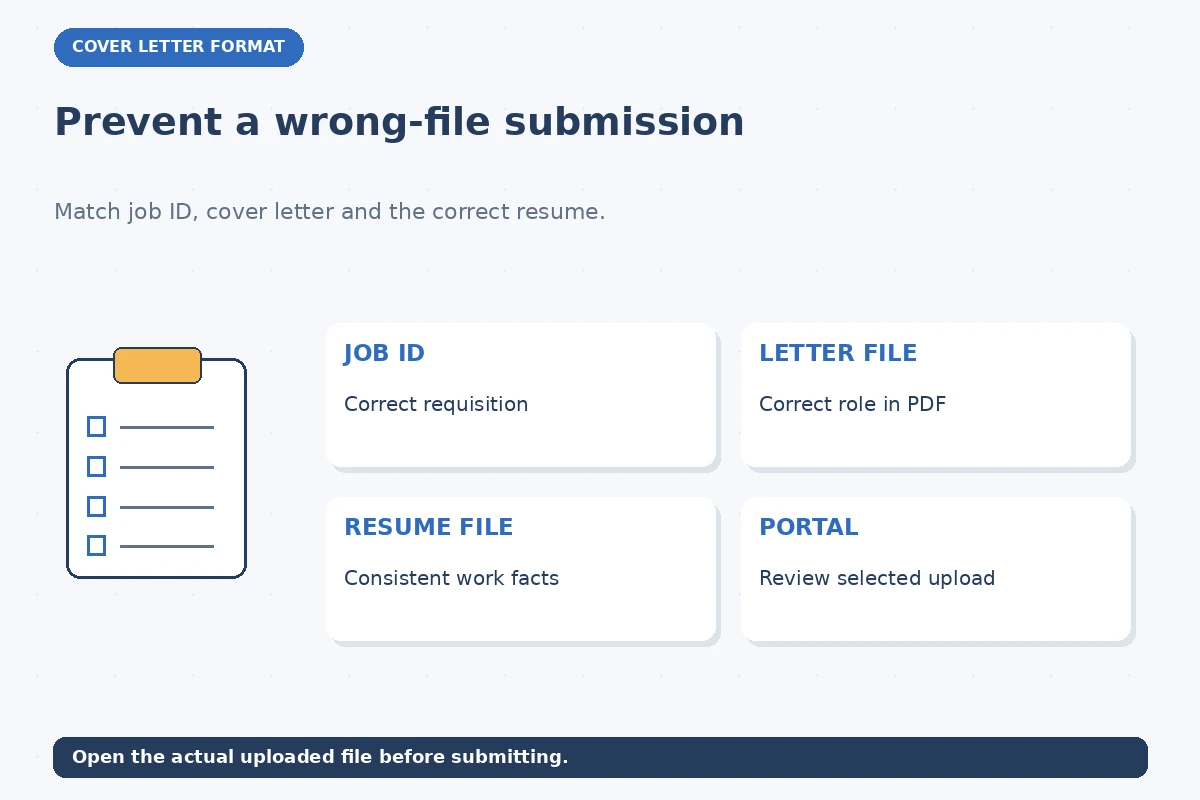
Create two clearly named documents in a private folder, such as “Alex-Lee-Scheduling-Coordinator-Cover-Letter.pdf” and “Alex-Lee-Inventory-Assistant-Cover-Letter.pdf.” These are fictional filenames, not files to upload as-is. Check that the title inside each document agrees with its filename and the portal form. If you use a generic template, remove all leftover names, employer descriptions and closing references from earlier applications. The final PDF should be readable and consistent with the matching resume.
A practical audit uses two rows: job ID, role title, employer unit, cover-letter filename, resume version, destination page and submission status. Before pressing Submit, open the exact file selected in the form instead of trusting the file picker. If an automated portal lets you upload only one document for several role preferences, follow its actual field limits and make your primary preference clear where requested. Do not upload a second unsolicited version to work around the application system.
Decide What to Do if a Recruiter Connects the Applications
A recruiter may ask which vacancy you prefer, how your experience matches each, or whether your availability differs by team. Answer plainly; do not pretend you have not applied to both. If your interest has changed, use the employer's official process to update or withdraw the relevant application when possible. Avoid repeated informal messages to individual hiring managers simply to direct attention to both letters. A concise, truthful explanation of your preferences is better than an invented strategic narrative.
Use the official role requirements rather than guessing that different teams share a selection system or can transfer your documents. After submission, record any confirmation for each requisition separately. A status change on one job does not automatically mean the other has changed. The cover letters do not guarantee consideration for both opportunities, but correctly separated documents help prevent a basic version-control error and give each reviewer information suited to the actual role.
How We Research and Maintain This Guide
This guide was reviewed against the linked U.S. university and professional career resources on 2026-11-13: Tufts Career Center Utah Valley University Career Center University of Pennsylvania Career Services University of Maryland Career Center. Every template, role, organization and decision example is illustrative unless expressly attributed; adapt it to the actual employer instructions and your true experience. See the affiliate disclosure for relationship transparency. No hiring outcome or employer approval is implied.
More Resume and Cover Letter Guides
Often yes, but first check the employer’s current application instructions and whether both jobs match your qualifications and interest.
Usually make two separate letters when each opening has its own application. Use a shared letter only if the employer specifically requests it.
Yes, if it is truthful and genuinely relevant to each role. Keep dates, scope and any numbers consistent.
You need not announce it in every letter unless instructed. If asked directly, answer accurately.
Use distinct filenames, compare the form’s requisition title with the PDF header, and open the selected file before submitting.