
A portfolio link belongs in a cover letter when it helps the employer evaluate a skill relevant to the job. Choose one strong example, briefly say what you personally contributed, and verify that the link opens for someone without your account. Do not upload confidential work or imply that a team project was yours alone. The link is supporting evidence, not a replacement for a clear explanation of fit.
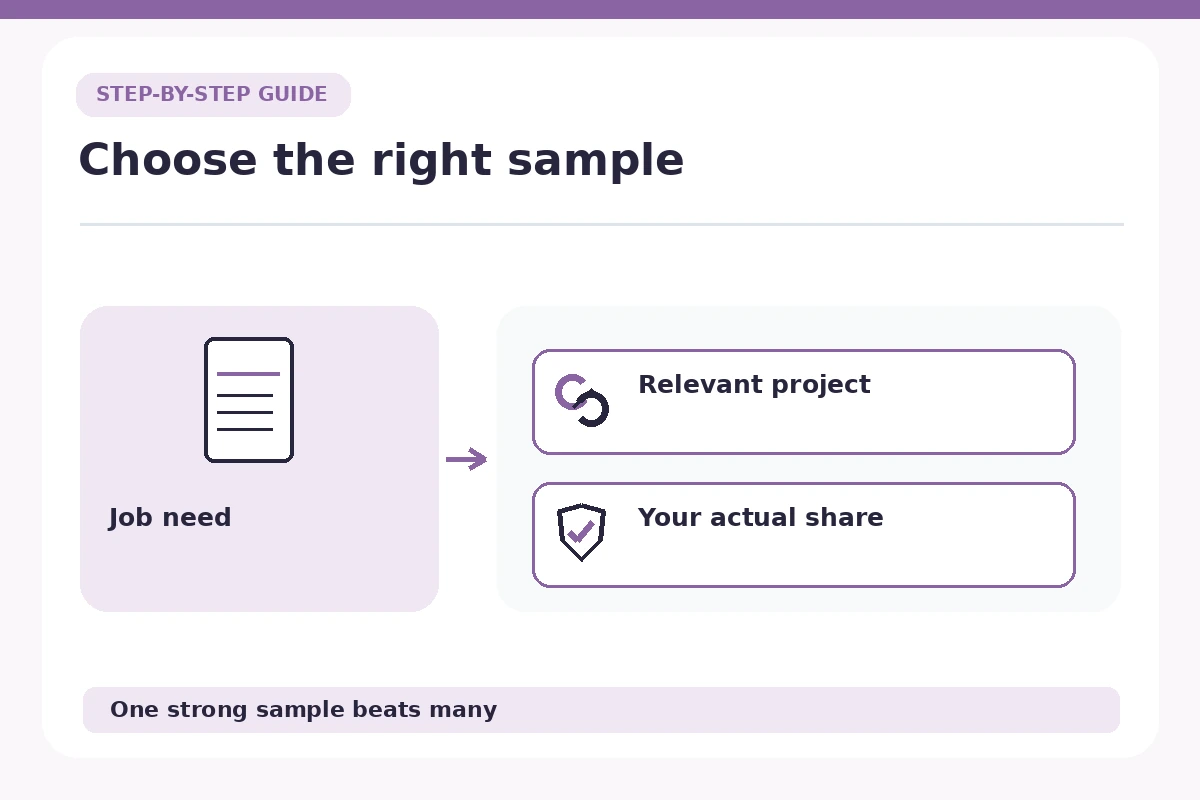
Choose one sample that answers a real job requirement
Read the posting and identify the kind of evidence an employer would reasonably find useful: a public writing sample, an approved design, a documented software project, or a clear instructional resource. Then select one or two samples that demonstrate that skill. A broad homepage linking to dozens of unrelated items gives the reader too much work. If the employer requests a specific portfolio format or work-sample submission route, follow it rather than replacing it with a personal website link.
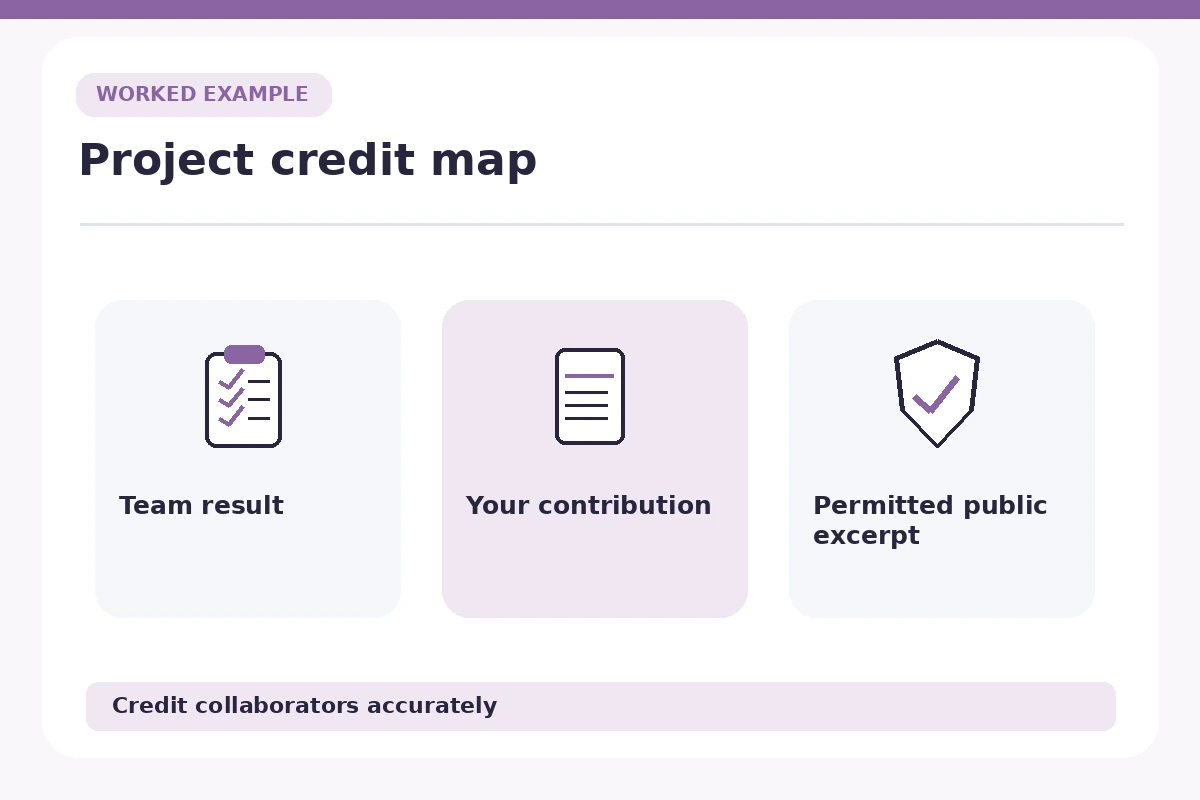
Ask whether the sample shows the right level of responsibility. A contributor to a group interface redesign may have produced wireframes and usability notes without implementing the whole product. The letter should name that contribution. A student may show a class project, but should label it as academic work. Keep claims about users, revenue, testing results, or business impact tied to evidence you actually possess. A sample’s value lies in how accurately it illustrates a relevant skill.
Describe your contribution and give the reader context
Use a short reference that identifies the artifact, the problem, and your role. Illustrative wording: ‘My portfolio includes a publicly shareable onboarding-guide sample. I organized the instructions, tested the navigation with classmates, and revised the wording based on their feedback.’ This does not state that the guide was adopted by an employer or that formal user research was conducted. Adapt the description to what actually happened. If other people contributed, credit them in the portfolio’s project description.
The strongest explanation points the reader to a concrete part of the artifact: a workflow diagram, a short excerpt, a revised section, or a documented test. Do not claim exclusive authorship merely because your name appears on the page. If you used templates, stock assets, open-source packages, or third-party content, respect their terms and identify your own work. An employer should understand what they are evaluating rather than guessing which features you created.
Check permission and confidentiality before sharing
A completed project is not automatically yours to publish. Client files, employer internal dashboards, student records, unreleased designs, customer lists, and screenshots of private systems may be restricted. Ask for written permission when required, or create a clean demonstration from information you are authorized to use. Removing a name from a confidential screenshot may not be enough if other details are identifiable. When unsure, describe the method generally and choose a different public sample.
Respect your collaborators as well. A team portfolio entry should identify which work was shared and who contributed, where appropriate and permitted. If you used a public repository, confirm that code and history contain no secrets, client data, or credentials. A cover letter should not ask recruiters to log into a private system or request access to restricted folders. Explain the sample in ordinary language and keep the reader’s path straightforward.
Test the link from the recipient’s point of view
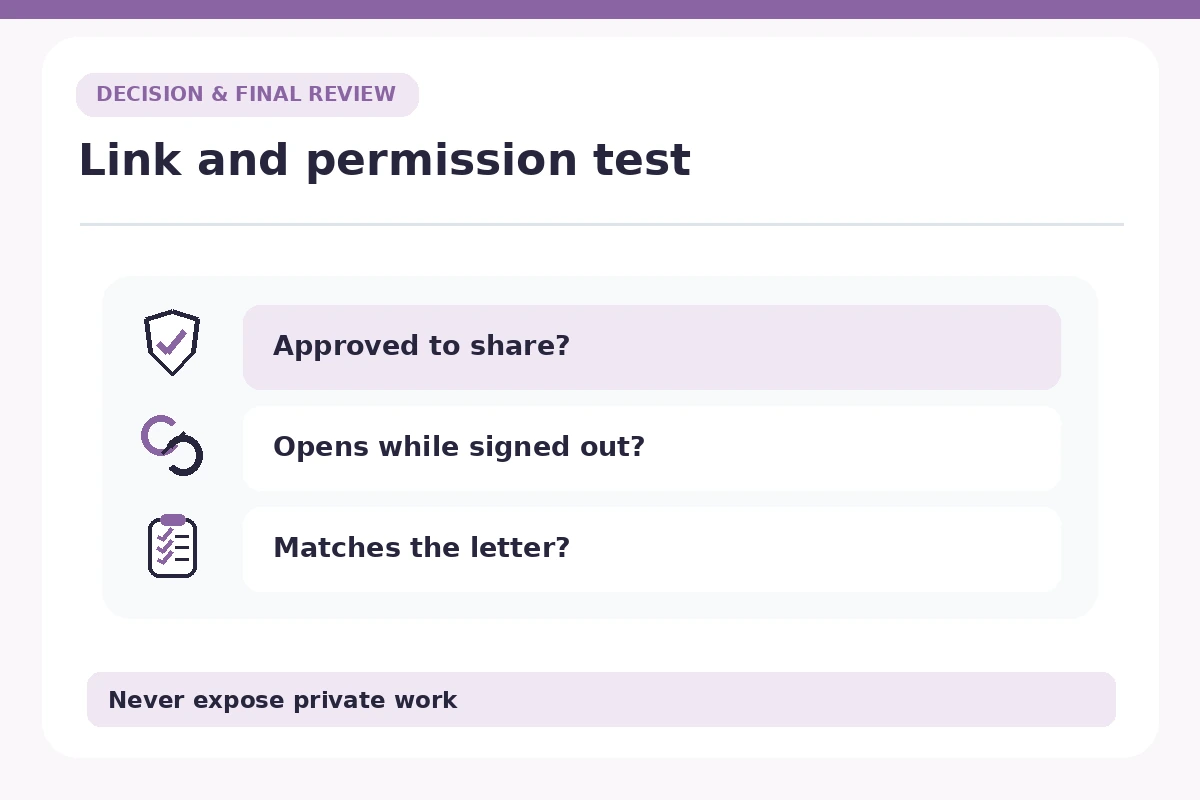
Open the portfolio URL in a private browsing session where you are not logged into the site. Can a visitor see the exact work sample without needing your account? Does the page load on a phone? Does the link lead to the intended project rather than a generic homepage or old draft? Check the visible project title, your description, and any downloads. A file that works only in your editor does not provide usable evidence for the recipient.
If a share link contains a long token or exposes personal information, consider an appropriate public page instead. Confirm that the employer’s portal permits external URLs; some application systems provide a designated portfolio field. If the site requests a PDF instead, prepare an authorized, clearly labeled export. Do not promise that every applicant tracking system will follow a link. The purpose of testing is accessibility and accuracy, not an invented technical guarantee.
Illustrative paragraph with a focused project link
Hypothetical letter excerpt: ‘Your content operations position emphasizes clear handoffs and accurate documentation. In a course project I designed a simple procedure guide and revised its examples after feedback from classmates. A public version of the guide appears in my portfolio, with a note explaining my individual contributions.’ Add a real URL only after checking that it belongs to you, loads correctly, and contains material you are permitted to share. Do not copy the scenario as a factual employment claim.
The paragraph does three different jobs: it identifies a requirement, connects an actual task to it, and gives an optional route to supporting evidence. The link should not become the whole pitch; the letter needs to stand on its own if the employer does not click. Keep the surrounding prose concise. Avoid phrases such as ‘award-winning’ or ‘industry-leading’ unless those claims are verifiable and relevant to the employer.
Make the sample and application agree
Before submission, check that the same portfolio project has compatible descriptions on your resume, cover letter, and public page. The project dates, authorship, and tools should not change from one document to another. If the portfolio page is old, update it before including the link. Compare the employer’s instructions against your final file format and attachment choices. Some positions evaluate portfolios during a later stage; an unrequested link is not always necessary.
Keep a private list of the samples you shared for each role and any restrictions on their use. If a project later becomes private, update or remove the link in future applications; do not assume you can edit an application already sent. The standard is simple: relevant work, truthful credit, safe sharing, and a functioning path for the reviewer. This is more useful than adding every project you have ever completed or treating visual polish as proof of performance.
How We Research and Verify This Guidance
We compared the distinctions in this article with public guidance published by US career-service organizations and CareerOneStop. We checked specific statements about cover-letter structure, job targeting, supporting evidence, and submission practices rather than using unverified templates. All applicant and employer scenarios above are illustrative. Requirements may differ by hiring organization, platform, or profession, so follow the real vacancy instructions and verify personal facts against your own records.
This guide provides general US-oriented job-search writing information, not a promise of an employer response or an application-system outcome. We do not know any reader’s individual work history and do not imply that described samples are real applicants or endorsed hiring results.
Source: UCDP career guidance — UC Davis portfolio advice about work samples, functioning links, individual contribution and team credit.
Source: UCD career guidance — UC Davis guidance on how a cover letter connects to the resume, relevant examples, and contact details.
Source: BERKELEY career guidance — UC Berkeley guidance on connecting specific experience to employer needs and careful writing.
Source: HARVARD career guidance — Harvard career guidance on truthful examples, concise middle paragraphs, and document checks.
For information about site funding and relationships, read the affiliate disclosure. The informational examples in this article do not represent paid endorsements or confirmed hiring outcomes.
More Resume and Cover Letter Guides
Include it near the sentence that describes the relevant project, or in the contact header if appropriate. Follow any dedicated portfolio field in the application.
Only if sharing is permitted and all applicable confidentiality rules are met. When that is uncertain, create a safe public demonstration or use a different sample.
Clearly explain your own contribution and credit collaborators where appropriate. Do not imply sole ownership of a collective result.
Yes. Identify what the sample demonstrates so the letter remains meaningful even if the reviewer never opens the link.
Open the exact link while signed out, check mobile readability, confirm the correct project loads, and review permissions before submitting.