
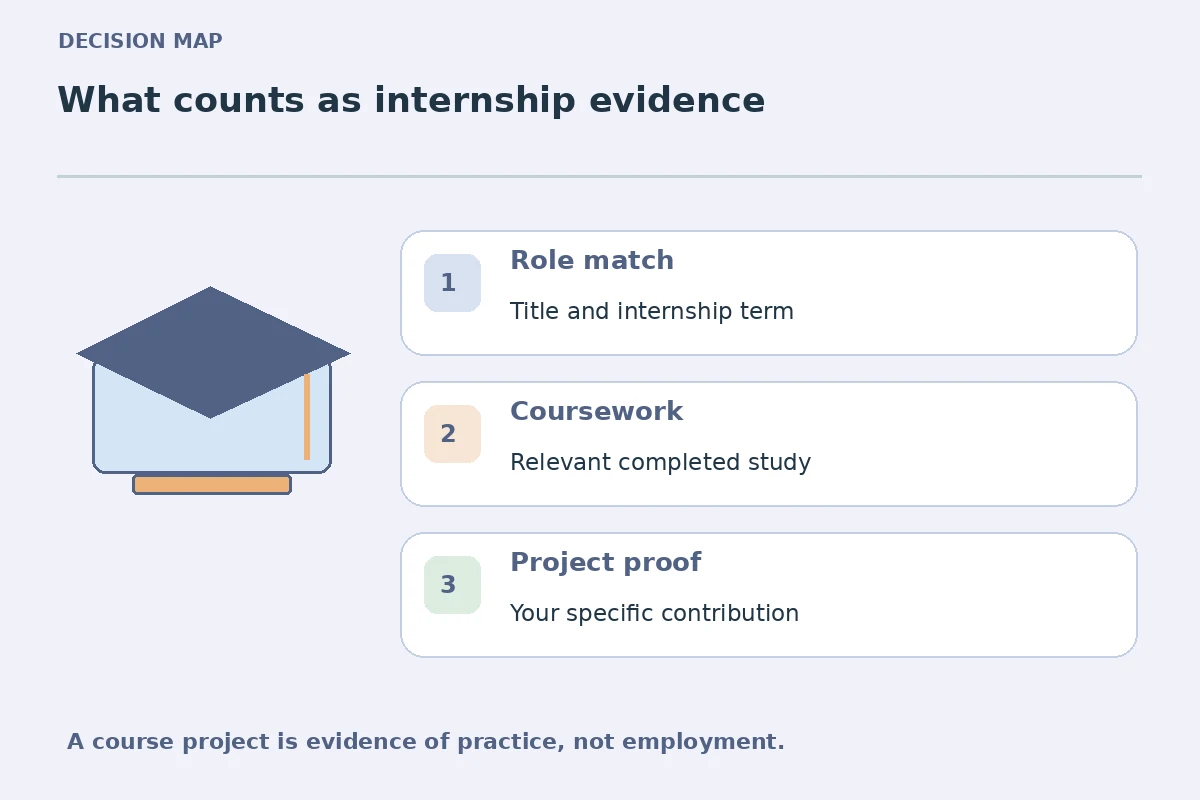
Start an internship cover letter by naming the internship and one real piece of evidence from coursework, a supervised placement, a project, or community work. You do not need to pretend that a class exercise was a paid job. An opening such as ‘I am applying for the Data Operations Internship; in a class project I checked and documented data quality’ has more substance than ‘I have no experience but work hard.’ Before writing, verify the employer’s stated skill and eligibility requirements. A coursework example is a bridge to the role, not proof that you have held the professional title.
Read internship eligibility before choosing an opener
Internship postings can have different eligibility rules, academic enrollment requirements, work conditions and start dates. Begin by noting the precise title, team, application deadline, preferred skills and required documents. If the posting asks for a current student in a particular program, do not imply you meet the requirement without checking. Some internships are designed for beginners; others demand substantial technical preparation. Your opening should mirror a requirement you can actually demonstrate, not a keyword that merely sounds impressive. When a posting includes special application questions, provide those answers in the designated fields rather than hiding them in the cover letter alone.
Translate a class task into an honest contribution
The University of Illinois Chicago recommends that internship applicants identify their degree or area of study and connect skills to the role with real examples. Think of a class assignment as a task with inputs, your actions, and a checkable output. You might have used a spreadsheet to reconcile two lists, written a brief research summary, or tested a simple website for navigation errors. Say what you personally created or reviewed and how you checked it. If you used a demonstration dataset, label it as such instead of suggesting it contained employer information. Do not promote a teacher’s final grade into an independently audited business result.
Use the role title before your course list
A common student draft begins with a long autobiography: year of study, every course taken, clubs and personal interests. The hiring team first needs to know which internship you want. Place that role in the first sentence, followed by a brief reason a particular class or project connects to it. Academic credentials may be relevant, but an exhaustive list belongs in the resume. A concise opening is easier to scan because the specific evidence is visible immediately. If your relevant evidence is a volunteer activity rather than coursework, name the activity and what you accomplished without calling it a formal internship.
Choose an example you can explain in an interview
Before including a project, ask whether you could show the output or explain its method if invited to discuss it. A good example might be keeping versioned notes while your group organized a student event. Your role could have been tracking registrations or sharing schedule changes, not approving venue contracts. The opening need not contain the entire story. It can introduce the work, while the body explains tools, collaboration and limitations. Do not add an impressive-sounding metric you did not record. If the sample is under a class or employer confidentiality rule, talk about the workflow without sharing protected files.
Compare a vague opener with a project-based version
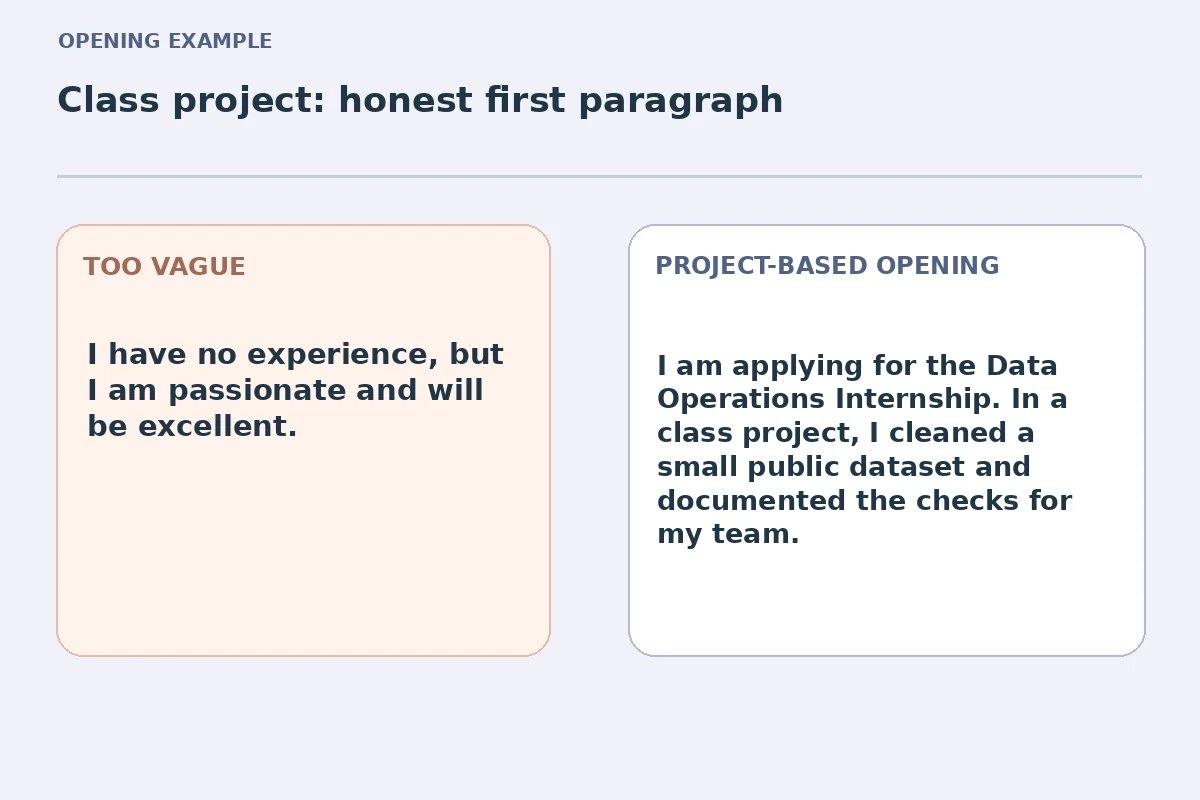
Weak illustration: ‘I am a passionate student with no real-world experience and excellent leadership abilities.’ Better illustration: ‘I am applying for the Data Operations Internship. In a class project, I checked missing values in a public dataset, recorded cleaning steps and shared a reproducible summary with classmates.’ This example is hypothetical, and candidates must swap in their own task. The second version works because it names the internship, source of experience, action and bounded output. It does not promise professional certification, autonomous production access, or a fabricated improvement percentage. If you only observed a process, state observation rather than taking credit for execution.
Mention the employer for a concrete reason
Employers receive many generic claims about being innovative or world-class. Instead, use a role description or a confirmed public project to explain what you hope to learn and where your existing experience fits. A software testing internship could emphasize documented bug reproduction; an outreach internship could emphasize verified event records. Avoid flattering the company based on rumors or copying a promotional slogan into the opening. A clear interest statement is appropriate, but it cannot replace evidence. If the employer’s mission is unfamiliar, read its official description and choose one genuine connection, or simply focus on the advertised work.
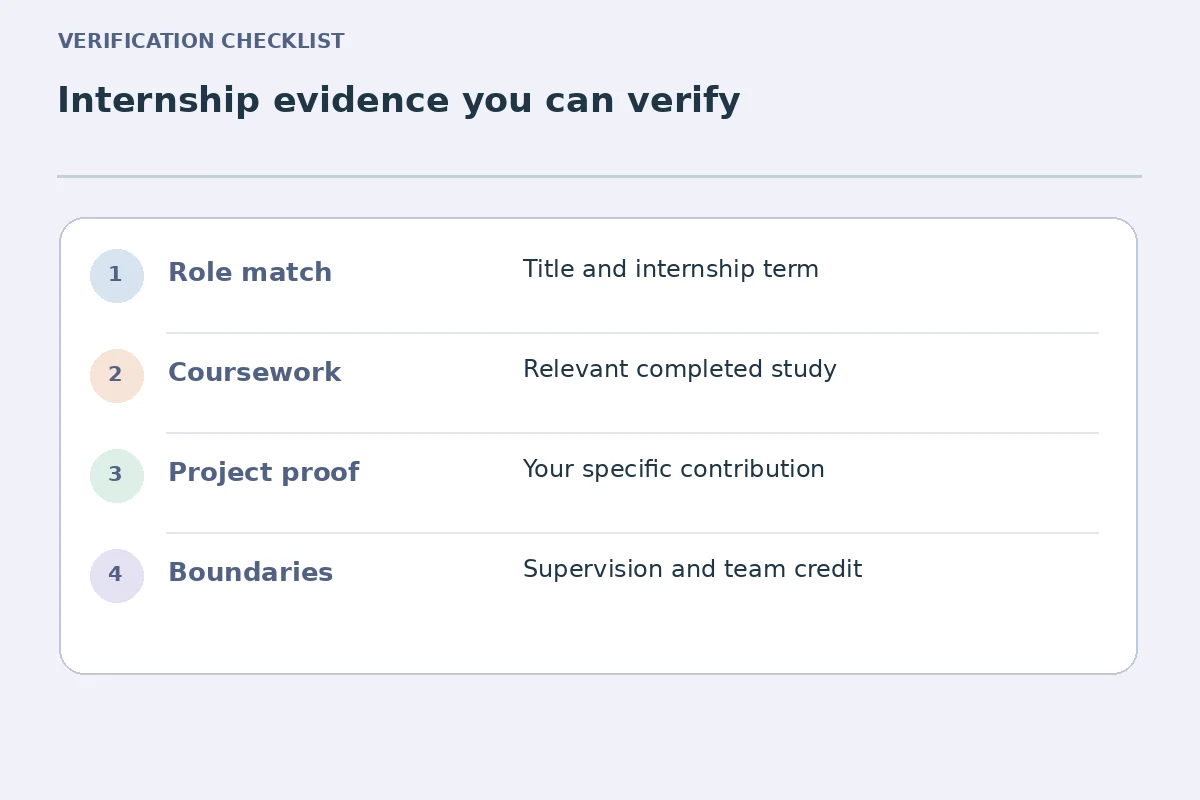
| Check | Evidence needed |
|---|---|
| Role match | Title and internship term |
| Coursework | Relevant completed study |
| Project proof | Your specific contribution |
| Boundaries | Supervision and team credit |
Keep student projects and credentials accurately labeled
Some student applicants have a professional certification in progress or a university requirement they have not completed. Do not claim the credential as earned. Likewise, supervised placements should not be described as independent client service. When writing about coding, laboratory work, child care, patient contact or financial records, distinguish practice conditions from professional authorization. You can say ‘under faculty supervision’ or ‘in a course simulation’ when those are the real facts. The first paragraph is not the place for lengthy disclaimers, but it should avoid wording that changes the meaning of the experience. Keep the same title and date details across your letter and resume.
Proofread the first paragraph against the posting
Before submitting, compare the exact internship title, department and requested documents with your draft. Make sure the example actually addresses a listed duty rather than a generic skill. Check whether your project was individual or group work, whether the supervisor’s name is necessary, and whether the result is documented. Remove claims such as ‘expert’ when you have only introductory experience. The remaining paragraphs can expand on methods, reliability, and what you hope to contribute within internship scope. Keep a copy of the final draft so your interview examples remain consistent with the story the employer first read.
How We Research Cover Letter Opening Advice
JobAsk checked the following original government or university guidance on November 17, 2026: University of Illinois Chicago recommends that internship applicants name the internship, academic program, and relevant experience and substantiate skills with examples. University of Michigan advises naming the role and motivation in the first paragraph, using authentic evidence from work or academic experiences, and using a professional salutation. University of Illinois advises a customized opening naming the role and relevant qualification, instead of mass-produced cover-letter introductions. CareerOneStop recommends a position-specific first paragraph and permits an email-body cover letter when the employer requests an emailed resume. We compared the actual cover-letter and role requirements described in these sources with the distinct first-paragraph problem addressed here; neither the illustrations nor sample wording represents a real vacancy, applicant outcome, school, or employer communication. For every sample, verify the specific job posting, eligibility rules, contact details, document format, and genuine personal qualifications. Where a source describes a typical process, the actual employer instructions take priority. We do not guarantee interviews, ATS outcomes, licensing, employment offers or responses to messages. For potential commercial relationships, read our affiliate disclosure.
More Resume and Cover Letter Guides
Yes, when the course or project is related to the posted internship. Name the work and your actual contribution instead of treating classroom practice as employment.
You need not open with an apology. State the internship and a relevant project, training activity, or volunteer task you can describe truthfully.
Describe your share of the work and credit the team. Do not claim that you designed, supervised, or validated parts owned by other people.
Only if the employer asks for it or it is particularly relevant and accurate. Usually, a role-specific project contributes more than a generic GPA claim.
Say what you have actually practiced and how, and distinguish beginner familiarity from independent professional proficiency.