
To list CPR or BLS certification on a resume, use the exact course or provider-card name, issuing organization, and current status shown by your records. For roles that require it, make the credential easy to find under Certifications or Licenses and Certifications. A CPR class, a completed online module, and an issued Basic Life Support (BLS) Provider eCard are not interchangeable. Do not add a current expiration date from memory, call yourself an instructor because you took a provider course, or claim that a card is valid if it has expired.
Identify which course credential you actually hold
Start by looking at the card or approved digital record. “Heartsaver CPR AED” and “BLS Provider” refer to different course products, so copying a friend’s credential wording can misstate your training. Use the title that appears on your official documentation and name the correct training organization or authorized issuer. An employer may request a particular provider type, skills component, or recognized issuer; the resume line alone does not prove the course meets every employer’s requirement.
If the document is a course completion card, describe it as such. If you only enrolled or watched training material, do not turn that into “certified.” AHA explains that, for its HeartCode BLS blended learning route, an online component alone is not the same as earning the course completion card: a hands-on skills session is also required. Check your actual course and provider rather than extrapolating the AHA structure to every training company.
Write a credential line the employer can verify
A concise entry can read “BLS Provider — American Heart Association, current through [month year]” if those statements match the actual eCard. Another may read “Heartsaver CPR AED — [issuer], completed [month year]” with validity shown as applicable. The bracketed wording is a writing model; replace it with your real details and do not copy the date from an example. Keep course names and capitalization faithful to the document.
Illustrative line: “BLS Provider eCard — American Heart Association | Valid through June 2028.” This is fictitious and should never be pasted unchanged. A resume typically does not need your eCard number or a public verification code. If an employer requests evidence, provide it via the employer’s authorized credential-check procedure rather than broadcasting sensitive account or card information on a public resume.

Confirm the issuing organization and authenticity
The American Heart Association offers an eCard system that employers or cardholders can use to check issued AHA course credentials. Its guidance also directs cardholders to contact the issuing Training Center for corrections and questions. Do not claim an AHA card merely because another training business used a red heart symbol in its advertising. An organization’s identity should come from the actual issued document, not a search result.
When an employer lists an approved-provider requirement, compare it to your current card and ask for clarification if the wording is unfamiliar. Do not assume a course will qualify for a regulated role, clinical assignment, or employer contract simply because CPR instruction is broadly useful. Training providers and workplaces can have different acceptance and skills requirements; the safest application provides an accurate credential rather than an unsupported equivalency claim.
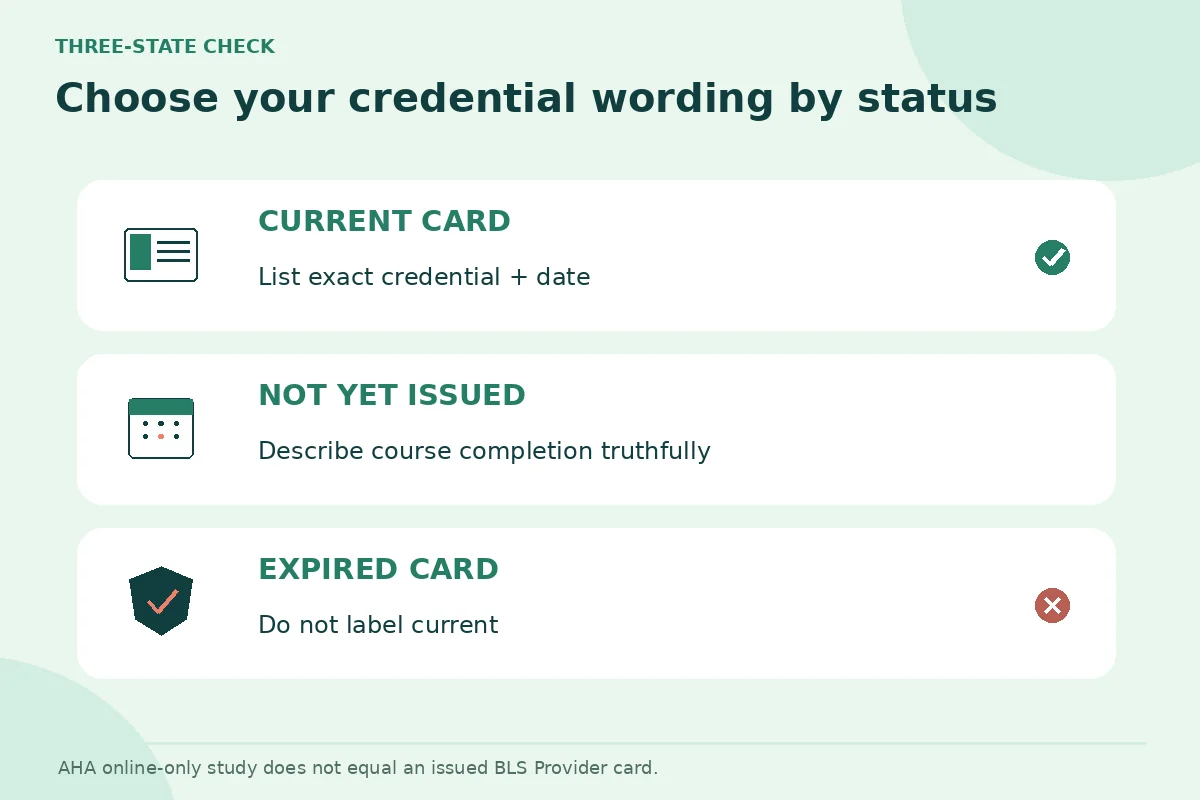
Distinguish current, pending, and expired status
Check the valid-through or expiration date on your own provider documentation. AHA states its course completion cards have a two-year validity period; that specific fact should not be automatically applied to another issuer or course. If your card has expired, it is misleading to list it as an active credential. You may omit it or describe historical training plainly if the role makes that useful, but do not use a past card to satisfy a current hiring requirement.
If you successfully finished a course but have not yet received the card, follow the Training Center’s instructions and avoid implying you have verified evidence in hand. AHA notes a period for Training Centers to issue cards after successful completion; until the record is available, distinguish course completion from possession of the document. If you have only booked renewal training, describe it as scheduled training when relevant, never as a renewed card.
Put CPR or BLS where its importance warrants
For a healthcare, childcare, fitness, safety support or other posting that explicitly requires current CPR or BLS, place the credential near the top in a clearly labeled Certifications section. If the job has no related requirement, a brief credentials line may be enough or may not belong at all. Keep employment experience separate; possessing a CPR card does not by itself prove you performed patient care, emergency response, or supervised medical tasks.
A resume is a selection of relevant evidence, not a permanent inventory of every class you attended. If you hold multiple valid provider credentials, list the distinct exact titles when each adds value and avoid double-counting two records for one training event. When in doubt, prioritize the credential the vacancy actually names and preserve space for examples of work skills you can substantiate.
Avoid turning training into professional authority
A provider course can teach response skills, but a resume should not imply it grants a professional healthcare license or authority to perform procedures outside a job role. “CPR-trained” and “licensed nurse” are not adjacent rungs on a universal credential ladder. Follow your employer’s emergency procedures and the permitted scope of your position. The resume can state your current completion record; it should not make broad legal, clinical or state-licensure claims.
Do not use “CPR instructor” unless you hold the applicable current instructor credential. Nor should an unverified workshop be labeled as a BLS Provider card. If your position required annual workplace refreshers in addition to formal provider renewal, list them accurately as professional development where relevant. Exactness prevents a reader from drawing unwarranted conclusions from impressive-looking acronyms.
Handle credential checks and online forms safely
Some applications ask you to upload a card or enter an expiration date, while others simply ask whether you have a current approved credential. Answer the question as written and use the employer’s legitimate secure process. Do not post a scan with your full personal details on a publicly accessible resume page. Keep a private copy of the current credential to compare against submitted application fields.
Check that issuer, completion date, valid-through date and credential title match across your resume and the official card. If your card is missing or contains an error, contact the issuer or Training Center. In the AHA system, cardholders may be able to view or verify eCards using its official tools. Do not create a replacement card image or manually alter a digital credential as a shortcut.

Run a short renewal-date maintenance routine
Before every application that requires current CPR/BLS, check the card directly and compare the expiration date with the job’s likely start or onboarding requirements. If renewal is due, schedule the appropriate course and clarify whether the employer needs evidence before application, offer, or start date. The employer makes that determination; do not promise eligibility based on a generic blog rule.
When a new course completion card is issued, update both resume and professional profiles, and delete outdated current-status labels from files you reuse. The goal is a truthful, easily verified line supported by a valid document. That is more helpful to the employer than a long list of acronyms or a confident statement you cannot verify.
How We Research and Review Resume Advice
We compare occupation-specific or issuer documentation with public university career-office recommendations and read education and credential wording closely. We separate general resume guidance from the exact rules of a hiring organization, school, state licensing agency or training provider. Illustrative bullets and dates in this article are fictional writing models, not documented job outcomes or endorsements. Our examples are reviewed to avoid invented performance metrics, false qualifications and inappropriate sharing of private information. See the affiliate disclosure; this information does not imply an approved commercial relationship.
Primary References for These Recommendations
Official and institutional references checked November 4, 2026: Reference 1 — AHA explains course completion card authenticity, issuer details, eCard verification and validity.. Reference 2 — AHA describes course card issuance and renewal timing.. Reference 3 — AHA BLS information distinguishes online learning from the skills session needed for a completion card.. Reference 4 — CareerOneStop advises a separate certifications section for job-critical credentials..
More Resume and Cover Letter Guides
Use a separate Certifications section when the posting treats it as a key requirement; otherwise Education may be appropriate.
Not necessarily. Use the exact issued course/card name rather than treating different courses as interchangeable.
Do not claim the provider card unless you completed the applicable required components and have evidence of completion.
Often useful for a required credential if accurate. Verify the date on the actual issuer record rather than estimating it.
Contact the issuing Training Center or use the official AHA eCard help and verification procedures; do not make a replacement yourself.