
A customer service resignation letter should give a specific last day and a professional, calm notice. What matters next is whether customers with unresolved cases are left with the right owner, correct promised dates, and no privacy exposure. Do not mark tickets solved to make your queue look empty or promise a callback after your system access ends. Use the short letter below and an active-case transfer plan that separates normal follow-ups from urgent escalations.
Determine Your Notice Route and Remaining Coverage
Check the center’s notice procedure, employment agreement, shift schedule and escalation contacts. Tell the appropriate supervisor or HR contact first. If your team uses rotating coverage or a shared queue, your last scheduled working shift and administrative employment end date may need confirmation; do not assume they are interchangeable. If you expect to be unavailable during your notice period, flag any approved leave and coverage questions before assigning future callbacks.
Write down which service channels you currently handle: phone, live chat, email, social messages or a specialist queue. The Bureau of Labor Statistics describes representatives as resolving questions, recording contacts and referring difficult cases to supervisors. Those activities explain why a queue handoff must preserve context, not just count ticket totals. Your supervisor should decide who will cover each channel after departure.
Use a Concise Customer Service Resignation Message
Illustrative message: “Subject: Resignation notice — [Name]. Dear [Supervisor], I am writing to resign from my customer service position, with [month date] as my proposed final working day. I will document unresolved customer requests and help transfer scheduled callbacks and escalations using our approved case system. Please let me know which queues and training materials you would like me to prioritize. Thank you for the opportunity to support the team. Sincerely, [Name].”
Keep customers out of the resignation letter. Never attach screenshots from the help desk or paste account numbers to prove how much work remains. A short note is enough to confirm your intention; operational details belong in a restricted ticket list. If you are leaving after a difficult customer interaction, describe the issue factually in the authorized case record instead of writing personal criticism into your notice.

Classify Tickets by Status, Promises, and Escalation
Make a list inside the ticketing system of unresolved cases, including ticket ID, present status, next promised action, deadline, assigned team, and any escalation level. A case awaiting the customer’s reply is different from a case where the company owes a response. Label those separately so the new owner does not accidentally send a duplicate answer or miss a deadline. Keep the customer’s personal data inside controlled systems; use reference IDs rather than names in broad team notes.
For example, a hypothetical shipping-issue ticket could say “Customer supplied new tracking information; replacement not yet authorized; supervisor decision due Thursday; queue owner unassigned.” This is more actionable than “Customer unhappy.” It also avoids falsely promising a refund. If an issue touches account security, payment disputes or a safety-critical complaint, escalate according to the employer’s established policy immediately, not only on your final day.
| Case state | What to record | Transition action |
|---|---|---|
| Waiting for customer | Last request and response rule | Leave in correct queue |
| Promised callback | Date + owner | Reassign before last shift |
| Pending approval | Decision-maker + deadline | Escalate to supervisor |
| Access-sensitive issue | Restricted case reference | Use secure channel |

Transfer Callbacks Without Inventing a Resolution
Callbacks need an owner and timing. Identify any message where you said “I will call you Friday” and notify your supervisor if Friday falls after your last shift. The team may assign the call to another representative, send a permitted update, or adjust the timeline with the customer. Do not set personal reminders to access employer systems after leaving. Track escalation approvals separately from simple informational questions, because a frontline agent may not authorize a refund, fee waiver, account change or credit.
If a customer asks to keep talking only to you, respond without promising access you will not have: “Your case will remain with the service team. I will ensure the notes and next steps are updated so a colleague can continue through our normal channel.” This is a suggested script, not a guarantee that a specific person or service outcome is available. The manager should approve customer-facing announcements where required.
Keep Private Account Details Inside Approved Systems
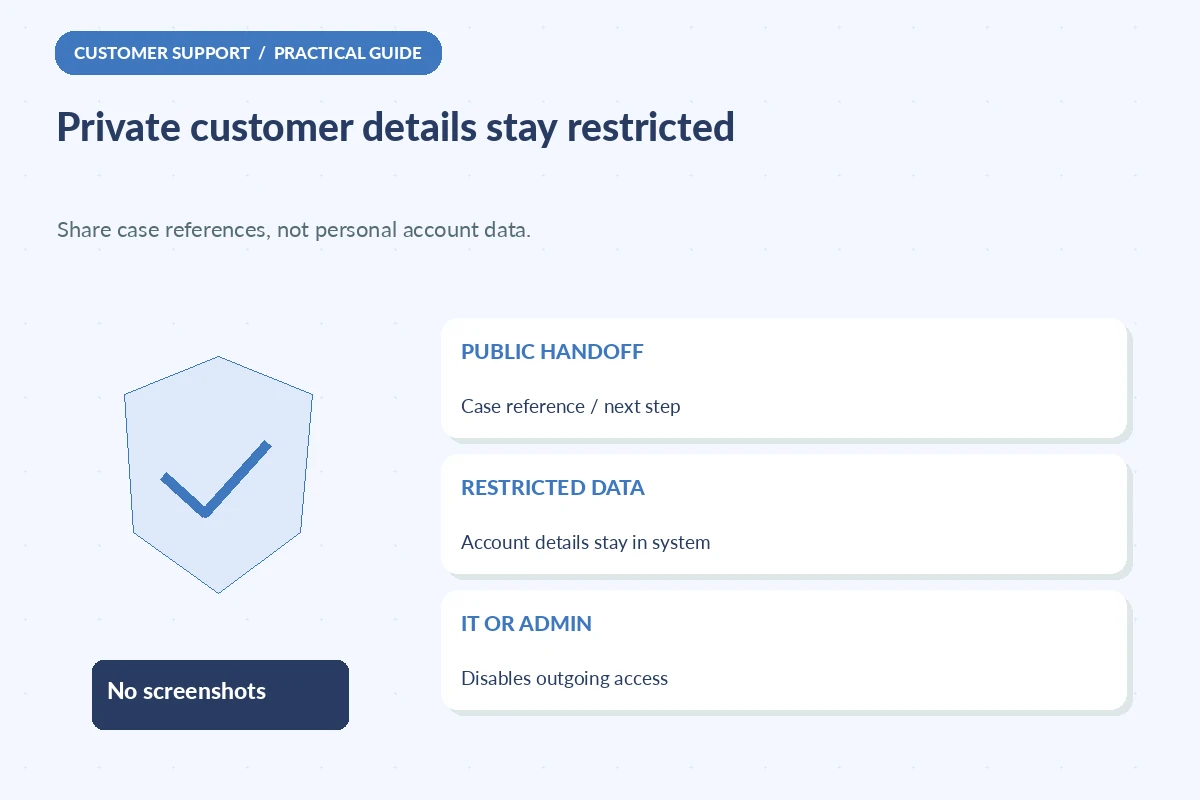
Customer support records can contain addresses, purchase histories, payment discussions and sensitive complaints. The Federal Trade Commission advises companies to restrict access and to ensure departing staff no longer retain credentials. Your part is to stop using customer records outside assigned work, return equipment and tell the administrator which shared resources require reassignment. Do not forward the queue to your personal email or create screenshots on an unmanaged phone.
For a reusable team note, write the process instead of exporting customer examples: “Billing change requests require supervisor approval; use the escalation route defined in [internal policy].” If a new team member needs a case example for training, use a redacted example approved by your employer. Keep passwords out of the handoff document; IT should transfer access via its regular role-based method.
Close Out the Last Service Shift With an Owner Check
On the last shift, check the active list together with the supervisor or designated replacement. Verify that high-priority cases have their correct owner and that callbacks scheduled after your departure are no longer assigned only to you. Report any customer promise you cannot fulfill as planned. Then hand off headset, badge, equipment or approved work devices as directed and ensure HR knows how to reach you for routine employment matters.
Do not misreport a case as resolved simply to meet a team metric. In a service resignation, an honest open issue with the right owner is better than a misleading closure. If remaining staffing is insufficient, make that visible to management rather than assuming responsibility for service after you leave. Keep the final email short, and save the substantive transition inside the authorized case environment.
Before you sign out for the final time, ask your supervisor to review one routine follow-up, one pending approval and one escalated case from the queue. That small audit tests whether statuses, instructions and permissions are clear. If a case is assigned to a general queue but has a due callback, add the appropriate owner and date through the supported workflow. Avoid suggesting that a customer should contact you privately or that you can personally resolve an issue after your account closes. The team owns continuing service; you can leave accurate context and traceable work without keeping customer identities or records.
How We Research and Maintain This Guide
We reviewed the relevant public career and occupational guidance as of 2026-11-13: U.S. Bureau of Labor Statistics Federal Trade Commission University of Houston career center University of Missouri System HR. The sample resignation note, transition grid and example records are illustrative, not promises of a particular employer policy, license requirement, compensation outcome or legal right. Check your own contract, employer rules and jurisdiction-specific requirements. JobAsk does not claim endorsement by those sources. For relationship information see our affiliate disclosure.
Explore Related Career Guides
No. The letter should establish notice and the last day; keep customer records in authorized service tools.
Tell your supervisor, assign the follow-up through the approved system and update the promise appropriately.
Only close cases that truly meet the team’s resolution rules. Reassign unresolved work instead of changing status for appearance.
Follow the employer’s authorized communication plan. It may be enough to introduce the service team or next owner without personal details.
Use your organization’s named escalation route and ensure ownership is confirmed before your access ends.