
A daycare resignation letter tells the director or designated employer contact when you intend to leave. It should not announce your plans to families first or contain details about children. The distinctive work in this setting is continuity of supervision, daily routines and approved parent communication. Use a short letter, then help the director transfer necessary information through secure center channels without changing staffing assignments or making promises you are not authorized to make.
Verify Notice Rules and Who Manages Classroom Coverage
Childcare centers use different staffing structures, licensing rules and written employment policies. Before choosing a date, review your own agreement, handbook and supervisor’s process. Discuss which shifts you are actually scheduled to work, whether the center will assign another trained adult, and which tasks need to be completed before you go. Staffing ratios and required credentials vary by jurisdiction and program; do not assume you can choose your own replacement or supervise children after you have left employment.
Tell the director or authorized supervisor before families. If a scheduled departure affects class coverage, report the exact last date promptly. A private conversation is helpful, but follow the written notice procedure when required. You do not need to explain sensitive personal reasons to every colleague or family. Give the center enough time to assess its own coverage decisions without implying that children can be left in another worker’s care without approval.
Write a Short Daycare Resignation Letter
Illustrative note: “Dear [Director], I am resigning from my position as [role] at [center]. My proposed final working day is [month date]. During my remaining shifts, I can update approved classroom routine notes and help the assigned staff member become familiar with the daily schedule. Please let me know the center’s preferred process for family communication and returning center materials. I appreciate the opportunity to work with the team and families. Sincerely, [Name].”
Keep individual child information, diagnoses, attendance details and family contact lists out of the letter. Do not claim that another teacher has accepted a role unless the director confirms it. If the center asks for a shorter or longer transition, discuss the agreed date and requirements in writing. Some settings have contractual or policy notice provisions; the example above is a writing model, not a determination of legal notice rights.

Hand Off Routines Without Exposing Child Records
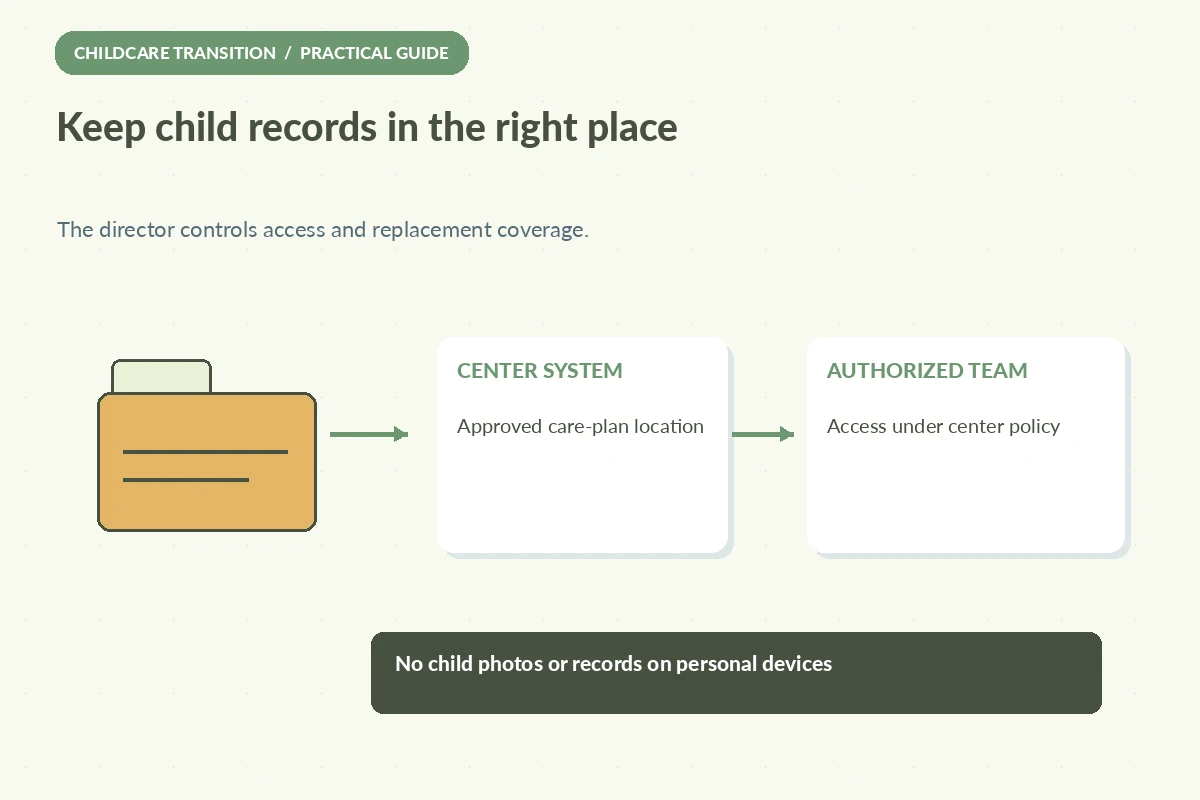
Childcare workers often manage meals, rest, daily activities, pickup procedures and age-appropriate learning routines, as described by BLS. Record only work-related details necessary for the incoming authorized caregiver and store them in the center’s secured records. Think about classroom schedules, allergies or medical instructions that the institution already maintains, authorized pickup procedures, and where to find approved care plans. Do not duplicate protected files to personal cloud storage or carry individual child photos out of the center.
Use a supervisor-approved checklist, not an informal parent group chat. For example: “Classroom schedule reviewed with assigned caregiver; approved care-plan location identified; attendance handoff handled through center system.” Never share a hypothetical child profile that resembles a real child closely enough to identify them. If a health or safeguarding issue is unresolved, escalate immediately under the applicable center policy instead of treating it as routine resignation paperwork.
| Transition item | Safe record location | Who decides |
|---|---|---|
| Daily routines | Approved classroom system | Lead educator |
| Individual care plan | Restricted child record | Authorized care team |
| Family announcement | Center communication channel | Director |
| Staff assignment | Official schedule | Center management |
Let the Director Approve Family Announcements
NAEYC emphasizes two-way communication with families and respectful professional relationships. That is not permission for a departing educator to independently email every family from a copied list. Ask who will tell families, what communication channel the center prefers and who will respond to questions about classroom coverage. A possible director-approved neutral message is “Our classroom staffing is changing after [date]; the center will share the updated contact and schedule.” Avoid promising that the new caregiver has already been hired if that is not confirmed.
If parents ask you directly about leaving, stay within the employer’s guidance. You can acknowledge that the center will provide an update without disclosing staff disputes, internal staffing notes or another child’s details. If you have relationships with families outside work, respect the boundary between social contact and information learned through your childcare role. The center, not the departing employee, should handle formal care records and ongoing family contact permissions.
Make a Safety-Centered Classroom Transfer Checklist
Work with the director to classify what must transfer before your final shift. Immediate continuity items include scheduled routines, authorized caregiver instructions, required supervision and the reporting chain for urgent concerns. Longer-horizon items can include supplies, learning materials, classroom organization and planned activities. An incoming staff member may need to know where the current approved policy is stored rather than receive a personal summary that could become outdated.
Do not create new child-care rules while offboarding. If a policy seems unclear, ask the director to confirm it rather than improvising. Return keys, badges, center-owned electronics and approved learning materials under the required process. Keep the handoff accurate without exposing identifying information in an email thread, and do not assign a child to a person whom the employer has not authorized to provide care.

Finish the Departure Without Misleading Families
Before leaving, confirm that your supervisor has the necessary operational notes and that outstanding child or classroom concerns were escalated through the proper channels. Ask who will cover your scheduled duties and whether you should help with an authorized introduction. If no replacement has been confirmed, do not describe coverage as settled. Do not leave a personal phone number as a substitute for the center’s established family communication route.
A professional daycare departure is measured by clear notice, accurate records and preserved boundaries—not by a sentimental farewell or an unrealistic promise that every routine will remain unchanged. Follow state and employer requirements where they apply. Keep your own employment correspondence, but not private care records, when you finish. The director should know which items were completed, reassigned or raised for a decision.
As a final consistency check, compare the handoff schedule with the actual approved room coverage and the locations of required center records. An outgoing educator can explain where a child-care plan is stored, but should not replicate it in a personal notebook. Confirm that urgent concerns have been passed to an authorized lead during the current shift. Family notifications should reflect a director-approved plan; if no new caregiver is confirmed, the message should not imply otherwise. These steps protect the child, family, replacement worker and center from different kinds of misunderstanding. They are practical planning reminders, not a substitute for state childcare requirements.
How We Research and Maintain This Guide
We reviewed the relevant public career and occupational guidance as of 2026-11-13: U.S. Bureau of Labor Statistics NAEYC NAEYC University of Missouri System HR. The sample resignation note, transition grid and example records are illustrative, not promises of a particular employer policy, license requirement, compensation outcome or legal right. Check your own contract, employer rules and jurisdiction-specific requirements. JobAsk does not claim endorsement by those sources. For relationship information see our affiliate disclosure.
Explore Related Career Guides
Normally start with the director or employer’s designated process and ask how families will be told; avoid independent announcements using private contact lists.
Relevant approved routines, safety and care-plan references, remaining concerns and authorized staff contacts—stored only in center systems.
Do not assume permission. Avoid copying children’s records or images to personal devices; follow the center’s privacy procedures.
The authorized director or employer, consistent with applicable rules. The departing worker should not promise particular staffing or supervision.
Report it promptly through the established safeguarding and supervisory process; do not defer it to the last-day checklist.