
In a data analyst interview, choose one job-related strength you can prove and one genuine weakness you are actively improving. A useful answer pairs a specific task with what you personally did, what changed, and the part someone else authorized or completed. For this role, a possible strength is testing data definitions before reporting; a possible development area is explaining technical caveats too late. These are ideas to test against your own experience, not traits to claim automatically.
The examples below are hypothetical, not stories you should memorize as your own. First compare the employer’s posting with your actual responsibilities. Choose a real a reconciliation note or checked query or describe its method safely; keep access to source data and decisions made by stakeholders confidential or within authorized decision-making. Interviewers may ask what happened after your action, so prepare the answer in a way you can defend without private data or invented numbers.
Select a strength at the stage you actually own
Analytical strength can mean accurate SQL joins, careful source validation, explaining uncertainty, or translating a stakeholder question into a clear metric. These strengths are not identical. O*NET describes business intelligence tasks that include reports, data consistency checks and documentation, which are relevant examples of workplace analysis; a particular data analyst posting may differ. Choose the step where your work is strongest.
If your experience is primarily spreadsheet cleaning, do not call yourself a production data engineer. If you have presented a dashboard but did not define its underlying metric, explain the reporting work you owned. An interviewer can ask the tools you used, test your reasoning and explore your exact contribution.
Show the validation chain in a strengths answer
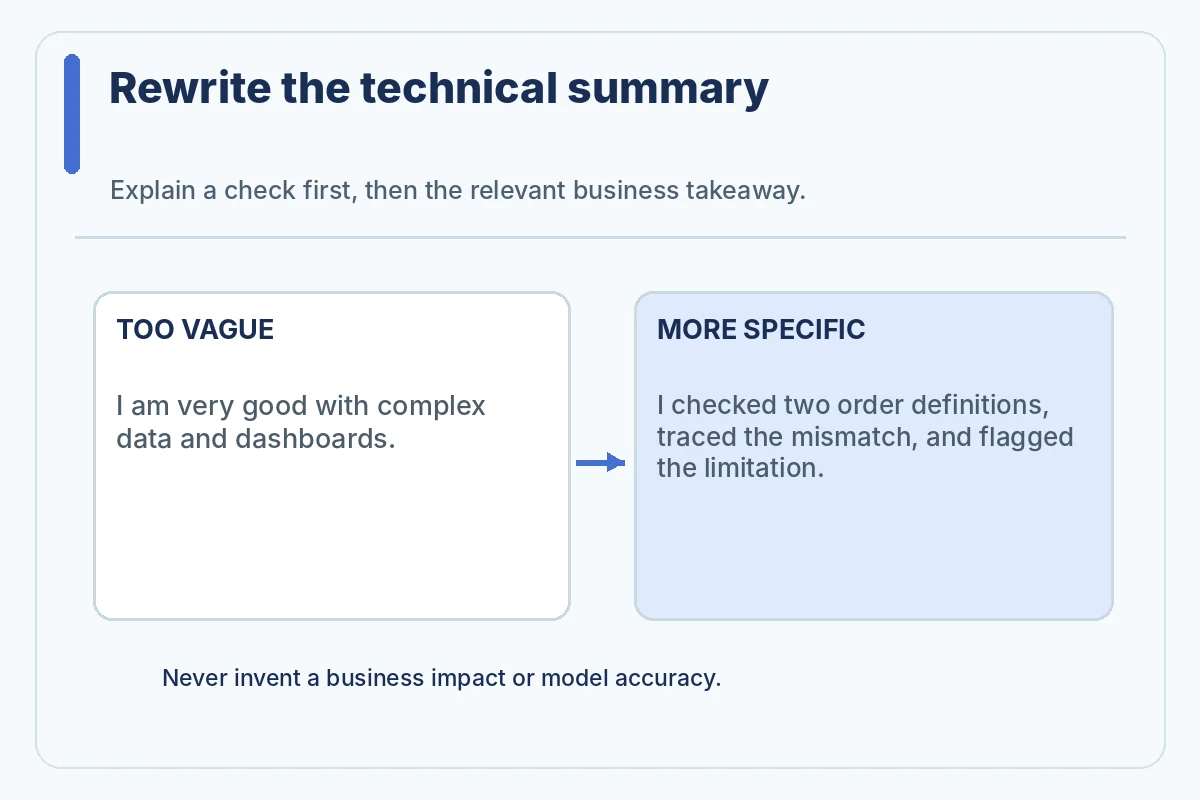
Choose one real example that starts with a question and ends with a checked output. Explain the input data, the definition you verified, your validation method, and what you communicated. A hypothetical candidate might spot a mismatch between two order counts, compare date filters and deduplication rules, and bring the discrepancy to the reporting owner before the dashboard was shared.
Avoid claiming the business gained revenue because you corrected a filter unless that consequence was independently measured. “I prevented a misleading comparison in a draft report” can be a substantial result when it is truthful. Describe whether you personally changed the query or instead documented the issue for another analyst to correct.

Choose a weakness with an active learning loop
One plausible improvement area is giving stakeholders too much technical detail before stating the decision-relevant takeaway. Another is overreliance on manual spreadsheet checks when repeatable validation would help. The chosen example must be real: what confusion, missed step, or unnecessary work did you observe? Then describe a specific response, such as opening reports with the metric definition and a caveat, or creating a reproducible validation checklist.
Do not choose fabricating data, ignoring privacy rules, or manipulating results as a casual weakness. If an error affected reporting, explain how you reported and corrected it with the authorized owner. “I now always double-check” is weaker than an actual verification method with a clear trigger.
Do not blur analysis, engineering, and business approval
Data analysts may extract data, calculate metrics, prepare dashboards, and explain findings; permissions and sign-off vary by employer. Having read-only warehouse access is not the same as owning an ETL pipeline. Presenting a recommendation is not the same as the manager choosing to act on it. The interview answer should distinguish these handoffs clearly.
Draft three versions of a result statement: “I identified the inconsistency,” “I revised the report after approval,” and “The owner used the revised report in a meeting.” Use only the versions your evidence supports. That discipline also prevents overclaiming model accuracy, attribution or causal impact from an observational comparison.

Prepare a safe technical artifact to demonstrate reasoning
A public synthetic dataset or personally created spreadsheet is enough to walk through your method. Document the source or state that the data is fictional, define one metric, show a deliberately introduced duplicate or missing value, and explain your verification check. A simple query example can demonstrate a join condition, expected row counts and a reconciliation check.
Never include raw employer data, client identifiers, personal information or proprietary schema in a public portfolio. If you cannot share work samples, describe the process at a high level and the questions you would ask a data owner. Be ready to explain failure cases rather than only showing the final chart.
Use class and portfolio projects with correct labels
An entry-level applicant can draw on a course project, volunteer analysis or a self-directed dataset. The evidence is still valuable if the scope is honest. State whether the question came from a real stakeholder or you invented it for practice. Say whether code was run in a personal notebook rather than a production environment and whether anyone reviewed the findings.
You can show how you compared two definitions of a KPI and corrected your calculation even if no business action followed. Avoid calling a practice notebook an end-to-end enterprise analytics platform. Interviewers can value a well-explained check more than a collection of tool names that you cannot use fluently.
Practice an understandable answer for a mixed panel
A hiring manager may focus on the decision the analysis supported while a technical interviewer may probe types, join keys, missing values and data lineage. Keep one concise story with two layers: a plain-language explanation and details you can provide on request. Describe uncertainty and why it matters instead of trying to sound infallible.
For the weakness answer, a straightforward form is: “I previously delayed a plain-language summary; I learned to lead with the question, definition, and finding, then provide technical checks.” Use that only if it matches your actual experience. Keep the result measurable only when you can substantiate the measure.
Use the interviewer’s questions to test role fit
Ask who owns metric definitions, how reports are reviewed, what data quality checks are expected, and whether analysts have authority to change published dashboards. The answers clarify where your strengths would be used and what support exists for your growth area. They also reveal whether a job title hides primarily reporting, modeling, or data-engineering work.
Before the interview, create a one-page evidence map with question, dataset, method, check, finding, reviewer and limitation. If you cannot fill the reviewer or business-outcome cells, leave them blank rather than inventing them. Accuracy about uncertainty is part of analytical credibility.
An Example Answer You Must Adapt to Your Own Experience
Hypothetical example: I noticed that an order count changed across two reports. I compared the date filter and definition of a completed order, documented the difference, and showed the corrected comparison to the project lead. The lead decided which measure to publish. This is a made-up situation to illustrate a responsible answer. Use your own real situation, responsibilities, limits and result when speaking to an employer. If you never did the action, do not borrow the example as your work history.
Before the interview, write two short drafts: a strength story centered on testing data definitions before reporting and a weakness story centered on explaining technical caveats too late. For each, mark the specific action, the available evidence, who else participated and any result you can confirm. Read each aloud. Replace jargon with clear verbs, and remove any number you cannot substantiate. An honest limitation with a real change in method is better than an untested claim of perfection.
How We Research and Verify This Guide
We compared job-relevant interview guidance with occupational descriptions and current search results on November 2, 2026. The U.S. Office of Personnel Management explains how interview questions can be tied to job competencies and how situation, action and result fit a behavioral example. Occupational references describe common tasks, not mandatory duties for every employer. The scenarios in this article are fictional, not verified candidate outcomes, hiring predictions or guaranteed interview scripts. The website’s relationship policy is available in our affiliate disclosure.
OPM Structured Interview Guidance: OPM explains job-related interview questions and the Situation/Task, Action, Result answer structure. Source reviewed November 2, 2026; always verify the particular job posting and employer procedure.
Official Occupational Reference: O*NET describes related business intelligence work: reports, data consistency checks and documentation. Source reviewed November 2, 2026; always verify the particular job posting and employer procedure.
OPM Structured Interview Guidance: OPM explains structured interviews and assessment of job-related competencies. Source reviewed November 2, 2026; always verify the particular job posting and employer procedure.
More Interview Preparation Guides
Yes when you can demonstrate the queries, validation steps and type of data you used. Listing SQL alone does not establish competence.
It can be an honest improvement area when you explain the actual communication problem and how you changed your summaries.
Only with permission and proper removal of private data and internal designs. A synthetic practice example is safer for a public portfolio.
Yes. Explain how you identified, reported and corrected it and how your verification process changed, without minimizing a serious error.
Use those projects transparently. Describe the question, data, method, validation and limitations without claiming employer deployment.