
In a graphic designer interview, choose one job-related strength you can prove and one genuine weakness you are actively improving. A useful answer pairs a specific task with what you personally did, what changed, and the part someone else authorized or completed. For this role, a possible strength is turning a brief into legible, reviewed designs; a possible development area is sharing early concepts later than needed. These are ideas to test against your own experience, not traits to claim automatically.
The examples below are hypothetical, not stories you should memorize as your own. First compare the employer’s posting with your actual responsibilities. Choose a real an approved before-and-after mockup with revision notes or describe its method safely; keep client permissions, licensed assets and final creative approval confidential or within authorized decision-making. Interviewers may ask what happened after your action, so prepare the answer in a way you can defend without private data or invented numbers.
Select a strength visible in your portfolio process
Graphic designers create layouts and visual concepts, incorporate feedback, and check work before publication, as BLS describes. In an interview, “I am creative” is too vague. Choose an observable behavior: extracting priorities from a brief, testing hierarchy, revising for accessibility, organizing working files, or preparing a clean handoff. Link it to a specific permitted portfolio sample and your role.
A design with attractive colors is not sufficient proof of effective communication. Explain the audience, medium, constraints and why you emphasized particular information. If another person supplied the brief, copy, research or brand system, give them proper credit. The interviewer is evaluating your reasoning, not only the appearance of the final image.
Walk through one real design decision
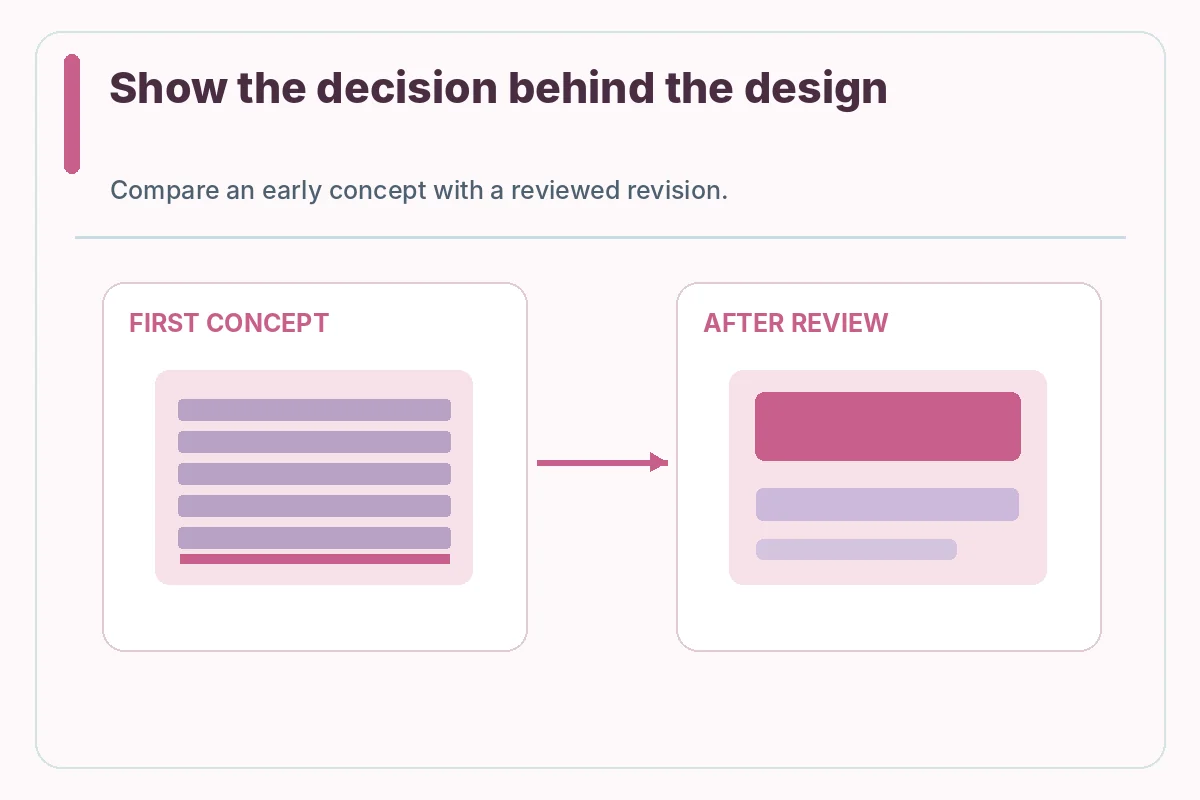
A strong sample answer might describe receiving a poster brief with too many competing messages, sketching two arrangements, testing whether the main action remained readable on a phone, and discussing trade-offs with the reviewer. Explain what you changed and who approved the final work. A clean “before/after” sequence helps the interviewer see your judgment.
If the piece was a class project, label it a class project. If it was done with a team, say which elements you produced. Do not claim a rise in conversions, downloads or sales unless those outcomes were actually measured and attributable to your contribution. Improved readability may be evidenced by a documented review rather than a numeric claim.
Name an improvement area rooted in production workflow
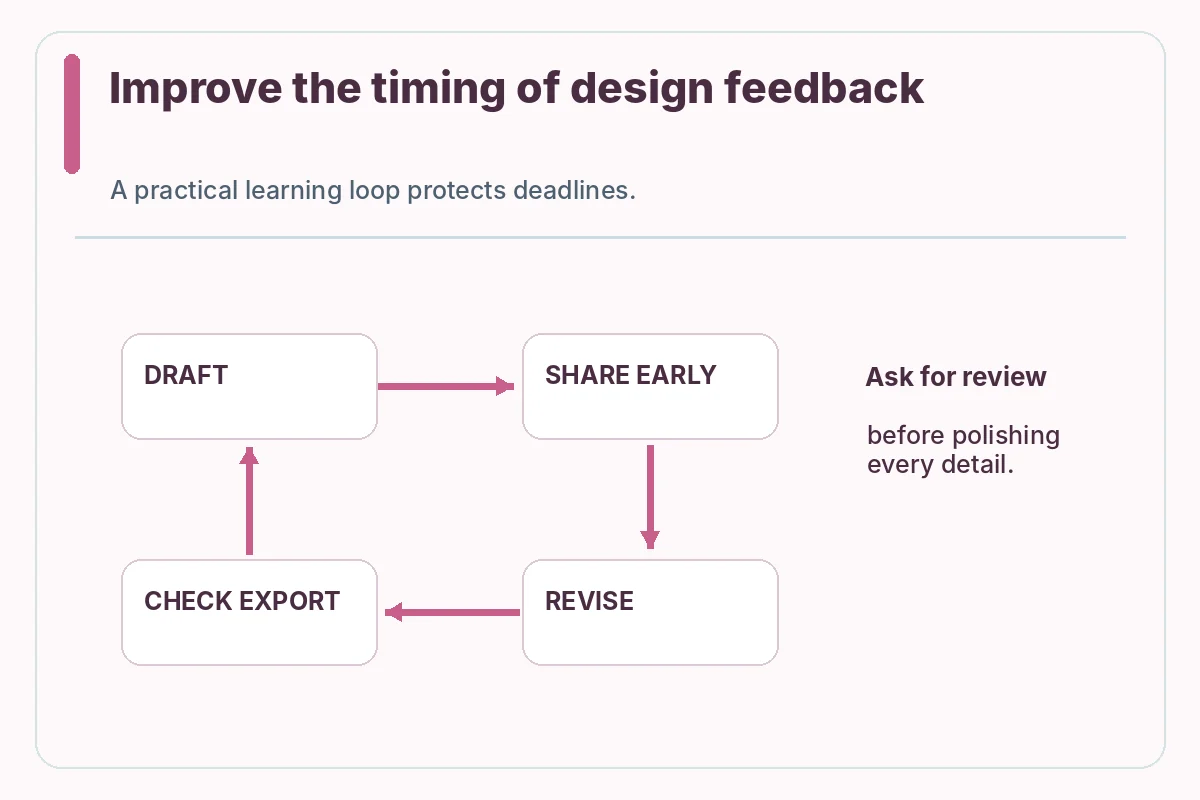
One honest design weakness might be holding initial ideas too long before sharing for feedback, which increases the chance of rework. Another might be underestimating time needed for export testing across formats. Choose only a situation that actually happened. Describe how you changed the workflow: an earlier concept review, a versioned checklist, or testing the actual output size before the final deadline.
Do not claim you always meet deadlines if you cannot back it up. Similarly, do not treat using unlicensed artwork or ignoring accessibility as an innocuous weakness. If a review caught an issue, explain how it was corrected and how you now check it, with appropriate respect for the team’s approval process.
Separate your design work from stakeholder sign-off
Designers may propose layouts and revisions, but brand owners, art directors or clients often approve final use. Distinguish what you created from what was authorized. Saying “I launched the campaign” can exaggerate your role if you only delivered artwork. Instead say you prepared files, tested export settings, documented changes, and submitted them for approval.
Visual storytelling is stronger with a revision record: brief, proposal, feedback, change, final review. You can summarize this without disclosing confidential comments or publishing proprietary files. Mention when you chose between options yourself and when you followed a stakeholder decision.

Use portfolio evidence without borrowing protected work
Bring only artifacts you are permitted to show. If an employer or client owns the creative material, request approval or demonstrate the same design reasoning with a new fictional brief. Label mock brands as invented and avoid imitation that appears to be a real client endorsement. Show the size and channel the design was made for, and describe how you verified legibility, contrast and export quality.
In interviews, be ready to identify stock assets and collaborative contributions if relevant. Your strength may be careful typography and layout rather than illustration. A designer who knows what they created is more credible than one who presents every polished image as solo work.
Connect the strength to a specific design environment
A packaging role, editorial layout role and social content role can require different checks. Match your sample to the kind of constraints the job posting describes: print bleed and proofing, responsive layouts, multiple aspect ratios, or handoff to developers. If you lack a required production workflow, admit it and show the adjacent method you know.
Do not assume a portfolio of static banners proves advanced motion design or user research. You can explain how you would learn a new tool, but avoid promising production proficiency without practice. The same honest scoping helps when answering questions about feedback from marketing, product and legal teams.
Practice strengths and weaknesses with a design narrative
For a strength, describe the brief, your strongest design choice, the check or review that supported it, and the final outcome you can verify. For a weakness, choose a distinct area such as earlier alignment on concepts, state what it cost or risked, and explain the specific process change. Neither answer needs a heroic story.
Practice in plain language before showing the screen. If you use a portfolio screenshot, make sure its small text is legible and that it does not reveal private comments. The interviewer should be able to understand the decision even without knowing your preferred software package.
Ask about approvals, design systems and revision rounds
Useful questions for a design interview include who owns creative briefs, whether a design system exists, who has final approval, how changes are requested, and what happens when feedback arrives after a deadline. Answers help you judge whether the workflow fits your strengths and whether the employer supports your growth area.
Build a small preparation card for each portfolio piece: audience, constraint, your contribution, options considered, reviewers, changes and confirmed result. Remove any unverifiable promotional claims. This technique demonstrates both design craft and reliable collaboration.
An Example Answer You Must Adapt to Your Own Experience
Hypothetical example: A project brief had a crowded information hierarchy. I drafted two layout directions, checked readability at the intended size, explained the trade-offs to the art director, and revised the chosen option after feedback. The art director approved the final design. This is a made-up situation to illustrate a responsible answer. Use your own real situation, responsibilities, limits and result when speaking to an employer. If you never did the action, do not borrow the example as your work history.
Before the interview, write two short drafts: a strength story centered on turning a brief into legible, reviewed designs and a weakness story centered on sharing early concepts later than needed. For each, mark the specific action, the available evidence, who else participated and any result you can confirm. Read each aloud. Replace jargon with clear verbs, and remove any number you cannot substantiate. An honest limitation with a real change in method is better than an untested claim of perfection.
How We Research and Verify This Guide
We compared job-relevant interview guidance with occupational descriptions and current search results on November 2, 2026. The U.S. Office of Personnel Management explains how interview questions can be tied to job competencies and how situation, action and result fit a behavioral example. Occupational references describe common tasks, not mandatory duties for every employer. The scenarios in this article are fictional, not verified candidate outcomes, hiring predictions or guaranteed interview scripts. The website’s relationship policy is available in our affiliate disclosure.
OPM Structured Interview Guidance: OPM explains job-related interview questions and the Situation/Task, Action, Result answer structure. Source reviewed November 2, 2026; always verify the particular job posting and employer procedure.
Official Occupational Reference: BLS describes graphic design work, stakeholder reviews, layout, changes and prepublication checks. Source reviewed November 2, 2026; always verify the particular job posting and employer procedure.
OPM Structured Interview Guidance: OPM explains structured interviews and assessment of job-related competencies. Source reviewed November 2, 2026; always verify the particular job posting and employer procedure.
More Interview Preparation Guides
Only when connected to specific work: a brief, a design choice, a check, and an outcome you can explain.
Yes if you discuss a real challenge and a change in process, such as obtaining an early concept review instead of waiting until the deadline.
No. Obtain permission or create a clearly labeled practice piece that demonstrates the same skill without copying protected assets.
Not necessarily. State whether you designed, approved, published, or measured the work and identify who owned the other steps.
Yes if you accurately describe its status, your contribution, and what remains to be approved or tested.