
A data entry clerk resume objective should explain which records you can enter or check, what tool or workflow you have used, and how your evidence supports accurate work. You do not need to manufacture a ‘99.9% accuracy’ claim to sound credible. This opening is especially useful if you have school projects, office support, retail recordkeeping or a career change rather than a long data-entry history. Name the job you want, one directly relevant skill and a concrete example you can verify. A resume objective is not a substitute for a real work history.
Start with data quality rather than vague speed
O*NET describes data entry work as compiling and verifying material, comparing records to original documents, recording activity and reporting errors. These are useful anchors for a resume objective. Speed can matter, but an unsupported claim such as ‘the fastest worker’ says little about the quality of the information entered. Think about the types of source records you have actually handled: purchase orders, sign-up forms, spreadsheet rows, product details or classroom datasets. Can you explain what you compared, how you identified mismatches and what happened when information was missing? That explanation is stronger than a polished adjective without evidence.
Write a first-job objective from genuine projects
Illustrative objective: ‘Business student seeking a data entry clerk role; practiced spreadsheet entry, source-to-row checks and discrepancy notes in a documented coursework project.’ If you completed such a project, it can show attention to detail. If you did not, do not copy the sentence as a factual claim. A volunteer registration roster or a household inventory exercise can also supply evidence when described honestly. For sensitive records, remove names, personal identifiers and screenshots from any sample. Make clear whether an example was an assignment, volunteer work or paid work. The opening should orient the recruiter, while the project section proves what you did.
Use measured speed only when you know its basis
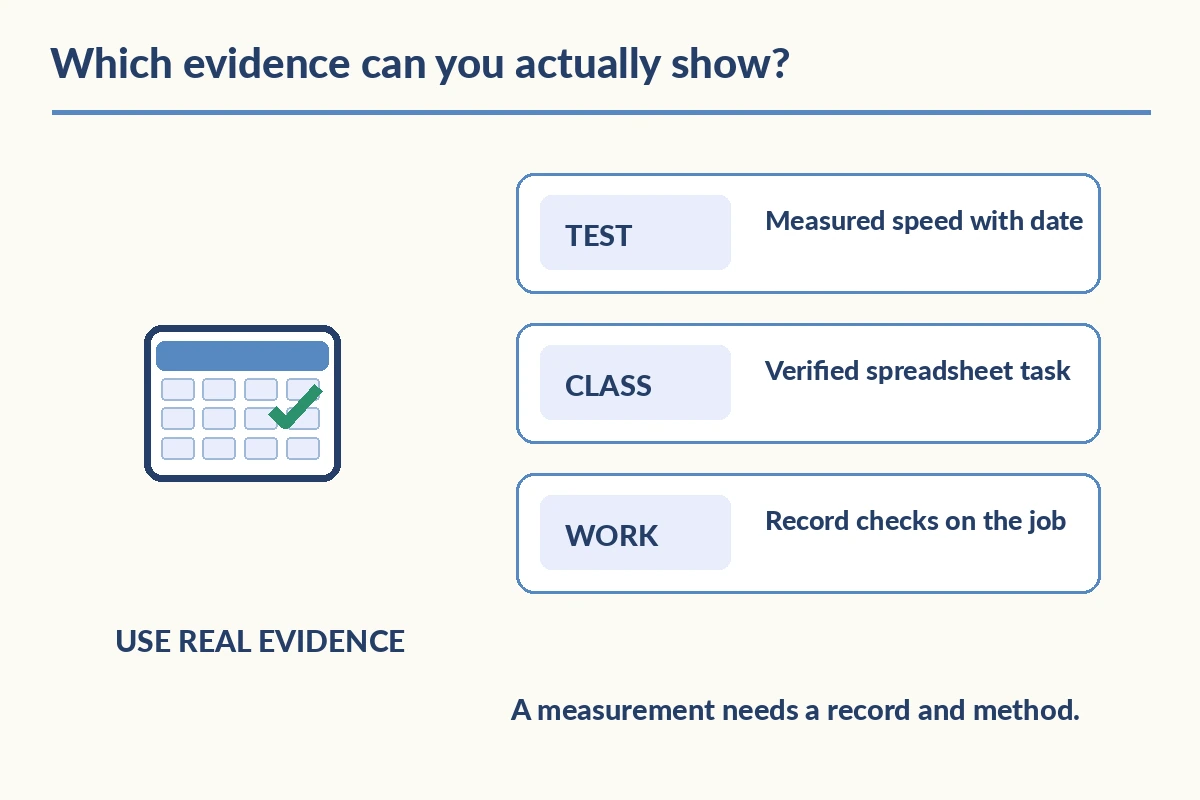
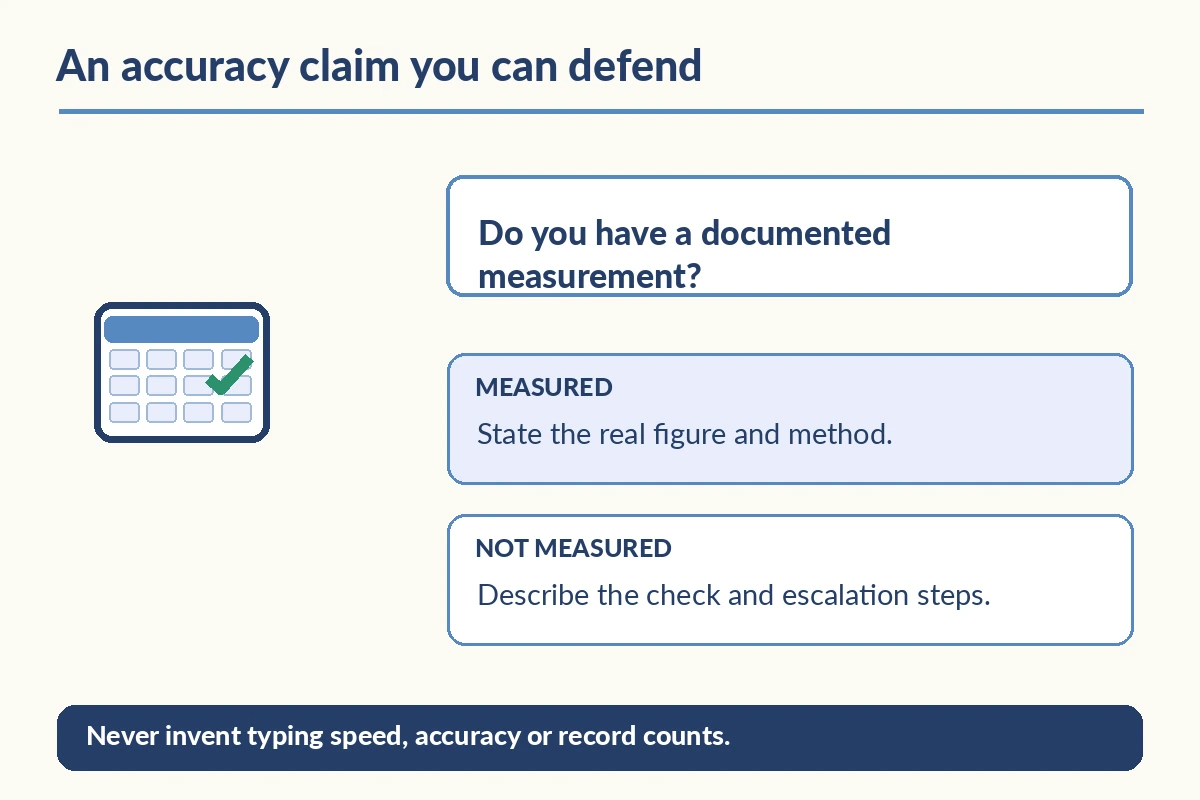
Typing words per minute, ten-key keystrokes per hour or error rates can be relevant to some openings, but only when the measurement was genuinely performed and can be explained. Record what was tested, under what conditions and when. Do not borrow a website example’s rate, invent a daily count, or calculate an accuracy percentage from an informal feeling that you made few mistakes. If you have never taken a reliable test, lead with a source-check process instead. For example, ‘checked spreadsheet entries against original forms and flagged incomplete fields for review’ can be useful without any fabricated statistic.
Separate data entry from changing the source record
A key task is recognizing that a visible mismatch does not automatically give you permission to alter an authoritative document. An employee may enter approved information, flag uncertain text and follow an organization’s correction process. If you worked in a school, clinic, bank or employer office, confidentiality and access rules matter. Your objective should not claim that you ‘corrected all customer records’ if you only identified issues for a supervisor. Use accurate verbs such as ‘entered,’ ‘cross-checked,’ ‘logged’ and ‘escalated.’ Their meanings are easier to verify in an interview than a broad statement about managing databases.
Choose the most relevant record type
A healthcare registration role may require attention to patient details and privacy, an order-entry role may focus on item codes and invoices, and a research assistant may work with structured questionnaires. These are not interchangeable records or authorizations. Match the target posting’s vocabulary only when you have performed related work. If you have cashier experience, you can truthfully describe comparing receipts with daily reports. Do not claim clinical coding or database administration because you worked with a register. The objective should use one narrow evidence theme, while a skills section below can list tools you used directly, such as spreadsheets or an actual order system.
| Starting point | How to frame the objective | Evidence to show |
|---|---|---|
| Measured typing test | State actual result and date | Saved test or training result |
| Course spreadsheet project | Name source checks and logs | Project description and files |
| Retail or office work | Describe record type and corrections | Actual documented job duties |

Write a one-sentence example for a career changer
A retail worker transitioning to records processing might write, if accurate: ‘Retail associate moving into data entry, with experience checking stock records against delivery slips and documenting differences for supervisor review.’ This does not invent office work, and it gives the employer a clear skill bridge. A front-desk applicant might cite appointment updates and careful records handling, without implying access to sensitive information beyond their permission. A job-specific opening is more convincing than ‘hardworking professional seeking a challenging opportunity.’ Keep your wording natural; copying a famous resume example can leave you with claims that do not belong to you.
Make the objective and the resume agree
When you write ‘accurate spreadsheet checking’ in the objective, prove it with a project or job bullet directly below. Describe the size and complexity only if you know them. For example, an authentic class spreadsheet containing assigned records can support a bullet explaining how you identified missing fields and submitted corrections. Do not make up a record volume for a portfolio exercise. If you name Excel, a customer relationship management tool or a database, be prepared to explain which functions you actually used. A recruiter should see consistency between the two-sentence introduction and the evidence on the page.
Check remote data entry postings for fraud
Some at-home data entry offers are genuine, but the FTC has documented scams that use this familiar job title to collect money or sensitive details. A strong objective will not protect you from a fake recruiter. Verify the employer through an official site, review the role, and beware of demands for upfront payment, checks that must be redistributed or unsolicited requests for bank information. Do not send identity documents to a contact you have not independently verified. A legitimate application should not require you to claim arbitrary accuracy numbers. Your resume can show skill while you still assess whether the opportunity itself is real.
Tailor accuracy claims to the actual evidence
Before applying, read each objective phrase literally. If it says ‘records audit,’ did you audit records under an approved process or merely check classroom entries? If it says ‘high-volume,’ can you state the volume and timeframe without guessing? If it says ‘confidential,’ did you handle protected information under organizational rules, or did your school project use public sample data? Change misleading verbs to precise ones. Clarify what you reviewed and who authorized corrections. A modest accurate statement can be valuable because data entry work itself depends on noticing inconsistency rather than hiding it.
Turn the objective into a short application plan
Choose a real posting and highlight three requirements: record type, software or entry workflow, and checking responsibilities. Select a matching example from paid work, school or volunteering, then write a one- or two-sentence objective. Add the source project and two factual bullets below it. Remove any invented typing test, accuracy rate or software credential. Finally, verify that the employer is real and that no fee is required to apply. This process produces an objective that is useful to a recruiter and defensible in a practical interview, without implying that a particular score guarantees hiring.
How We Research These Resume Objective Examples
We checked these primary occupation, regulator or consumer-guidance sources on November 16, 2026: O*NET lists data entry keyers tasks such as comparing source documents, correcting or escalating errors, and keeping logs. The FTC identifies fake at-home data entry opportunities and warning signs such as requests for payment or bank details. O*NET details record processing, organizing files and documenting work in data entry. All example objectives are hypothetical and must be adapted only to a candidate’s real experience. Credentials, permission boundaries and hiring requirements differ by job and location. JobAsk does not guarantee interviews or placement. Read our affiliate disclosure.
More Resume and Cover Letter Guides
No. Include speed only if genuinely measured and relevant. A verifiable record-check process can be more useful.
Yes, if you really completed it and label it a school project, not paid professional experience.
Only when you have a real, defensible measurement and can explain how it was calculated.
Describe only the changes you were authorized to make. Escalating errors is different from changing protected source data.
No. Verify employers independently and avoid any recruiter demanding payment or premature sensitive financial information.