
If an employer has made a revised offer after you negotiated and it still does not meet your requirements, compare the actual updated terms with your must-haves. When your decision is final, thank the hiring contact for considering your requests and explicitly decline the position. Avoid adding a new bargaining number or vague “maybe later” language unless you truly intend to continue negotiating.
Identify which offer is actually on the table
Negotiation can create a confusing trail of original numbers, informal phone discussions, and proposed revisions. Write down the initial offer and the most recent employer-confirmed terms in separate columns. Include role, pay structure, start date, working arrangement, benefits under discussion, and any scope changes. A recruiter’s “We may be able to improve that” is not the same as a written revised offer. Mark each item as confirmed, proposed, or unresolved. This prevents declining a version that the employer never formally offered or treating a tentative comment as a binding commitment.
You can ask for a brief written summary of the revised terms while still considering them. CareerOneStop advises examining the full offer and leaving a negotiation politely when agreement cannot be reached. If your decision depends on a changed condition, ask the authorized contact rather than colleagues. Conversely, if no revision could make you accept, do not prolong the process with more clarification requests. Know what has already been promised, what changed, and whether you are still negotiating before drafting your response.

Set a decision point rather than another bidding round
A candidate may decline because the latest terms still leave an important gap, because the role itself is not right, or because priorities have changed. You do not have to keep negotiating simply because an employer improved the offer. Choose your must-haves privately, compare them with the documented revision, and decide whether you are accepting, making one more counterproposal, or declining. Those are three different messages. Sending a “final decline” that also demands more compensation can make the recruiter unsure whether the position remains under consideration.
For a fictional example, the original offer might provide a fixed in-office schedule, and the revision might allow one remote day weekly. If the candidate needs a substantially different arrangement, the question is not whether the employer made a meaningful effort; it is whether the final offered terms fit. You can acknowledge the effort and still decline. Avoid promising that you would accept a future version unless you genuinely mean it. You can preserve professional goodwill without suggesting the employer must keep making offers.
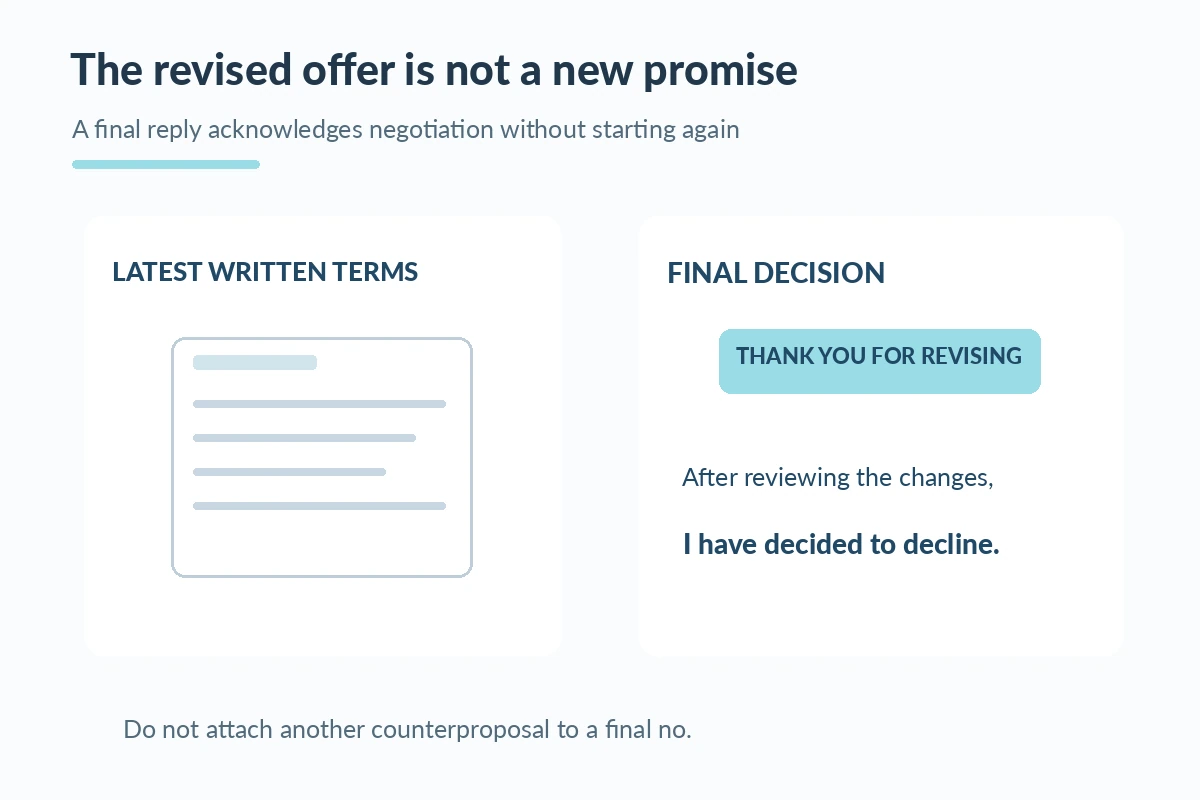
Write a final decline that recognizes the revised offer
Illustrative email: “Subject: Decision on Program Analyst Offer. Dear Casey, thank you for taking the time to review my questions and for sending the revised terms for the Program Analyst role. After considering the updated offer, I have decided to decline the position. I appreciate your flexibility and the opportunity to meet the team. I wish you success in filling the role. Best regards, Taylor.” This names the most recent offer and states the decision without negotiating further. Replace all fictional details with the real organization, role and contact.
Do not list every difference between the first proposal and the final one unless the employer specifically asks and you want to provide feedback. A short sentence such as “The arrangement is not the right fit for my plans” is sufficient; even that reason is optional. Do not apologize excessively, criticize the recruiter for not meeting a number, or thank them by promising future acceptance. The purpose of this message is to conclude a professional exchange, not win the negotiation after deciding against the job.
Avoid misunderstandings about timelines and acceptance
The response should go to the person who sent the revised offer or is responsible for the hiring decision. If discussions happened by phone, a brief written confirmation prevents confusion: “As discussed, I will not be accepting the revised offer.” Send it once you have actually decided and before any stated response deadline when possible. If an employer asks whether you would reconsider, either say the decision is final or state the precise condition you would genuinely need, but do not mix the two positions.
If you accepted an earlier offer and then started negotiating changes, the situation is more complicated than declining an unaccepted offer. Do not assume that a new email alone eliminates any obligations created by an acceptance or signed agreement. Review your own documents and seek qualified advice if needed. Similarly, do not treat a counterproposal that you sent as if it were an employer-confirmed revised offer. Keeping those facts distinct makes communication clearer and avoids turning a simple editorial example into unsupported contract advice.
| Decision item | What to verify or do |
|---|---|
| Original offer | Record exactly what was initially written. |
| Revised offer | Identify only employer-confirmed changes. |
| Unresolved item | Ask once only if the answer could alter your decision. |
| Final decision | Decline clearly without attaching another counterproposal. |
Document the outcome and move on professionally
Save the original offer, any confirmed revision, and the final decline in one application record. Mark the entry declined, not “negotiating,” and stop using earlier draft emails that contain stale proposed terms. Your notes can identify the requirement you learned mattered most, which may help you assess future offers earlier. For example, a guaranteed schedule or particular development opportunity can be a legitimate threshold without requiring a recruiter to agree to it. Keep the record factual and private.
In future negotiations, identify a reasonable decision deadline and ask what can actually be revised before promising an answer. Be specific about which terms matter and take care not to accept verbally just to be polite. UW–Madison and MIT career guidance emphasize prompt, clear, appreciative communication when declining. You cannot guarantee that the same employer will make you another offer or retain the position. What you can do is avoid ambiguity, close the process courteously, and use the experience to sharpen your assessment of the next opportunity.

How We Research Job Offer Decisions
We reviewed original career-service and government guidance for the specific offer terms and communication question covered here: Career Video. Careeronestop. Mit. Wisconsin. These sources support respectful declines and specific offer-review factors; they do not establish that any fictional employer policy, compensation outcome, or candidate account is real. The examples are hypothetical and must be adapted to the actual written offer and contact. Employment rules may depend on location and circumstances; this article does not offer individual legal advice. See the affiliate disclosure. No referral or paid partnership is asserted.
Related Workplace Guides
Yes. Thank the employer for considering the request and clearly state your final choice.
No. Your final decline can be brief without disclosing private negotiation limits.
Request a written summary if you are still evaluating; do not assume an informal comment is confirmed.
Not when your decision is final. Separate continued negotiation from a definite rejection.
Review the actual acceptance or signed terms and obtain appropriate advice; this template assumes no prior acceptance.