
Before declining a warehouse supervisor job offer, confirm what the job actually requires: assigned shifts, handoff responsibilities, authority to stop unsafe work, equipment-training expectations and the manager to whom incidents are escalated. Once you know the terms and have decided they do not fit, send a prompt, respectful decline identifying the exact position. You are not required to accuse a workplace of unsafe practices or provide a personal explanation. If the offer is merely vague about authority or training, ask a specific question first; a missing detail is not automatic proof of a violation.
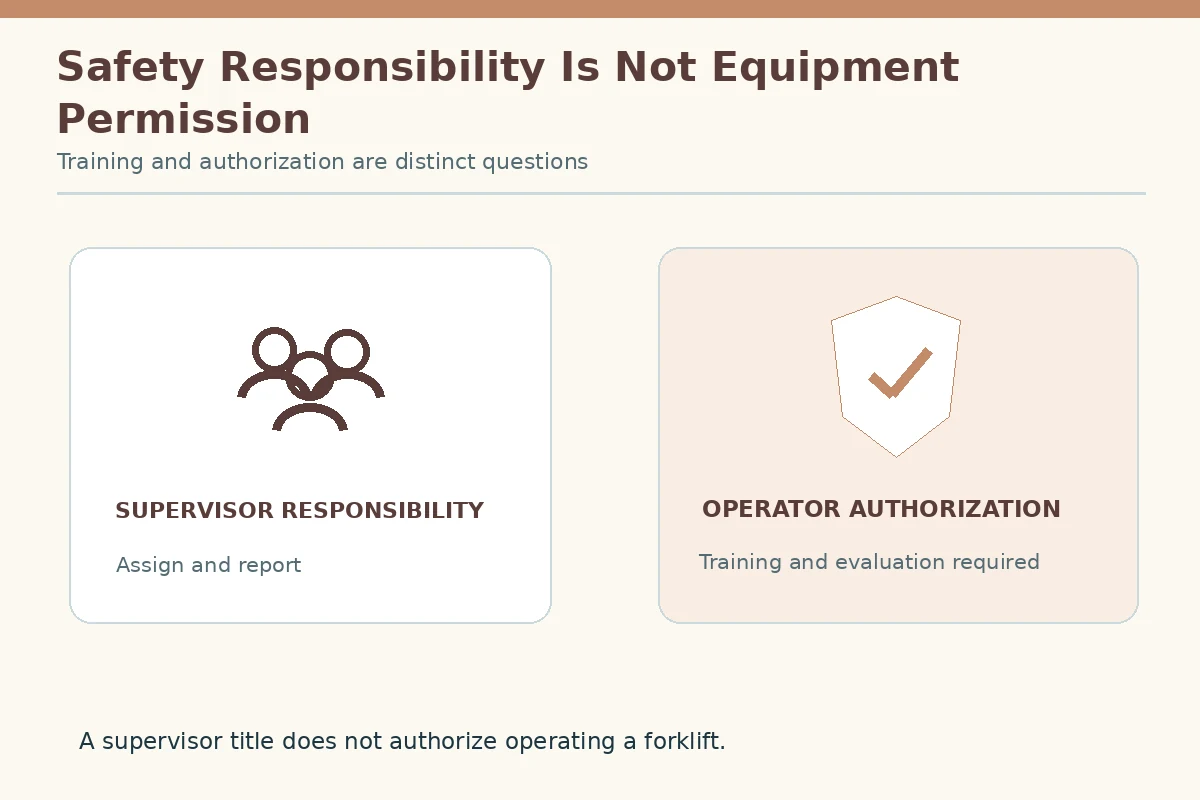
A warehouse supervisor may coordinate staff assignments, inventory handoffs and incident reporting while sharing operational duties with other leads. These activities are not interchangeable with the ability to operate every machine. OSHA explains that forklift operators require appropriate training and evaluation; supervisory status alone does not create vehicle authorization. This matters when an offer uses broad terms such as “oversee equipment” or “cover all departments.” The scope might refer to supervising authorized operators rather than driving equipment yourself. Shift coverage also has practical consequences: overnight handoffs, weekend periods, break coverage and escalation responsibilities may make an otherwise attractive job incompatible with your availability.
Map the Real Shift Handoff
Build a shift-and-authority map. On the left, list the people and tasks you would supervise. In the center, list what requires your training or written approval. On the right, list what is escalated to a site manager or trained specialist. Add a schedule strip for the actual start and end of a shift, handoff overlap and any on-call periods. Evaluate the employer’s confirmed expectations rather than the title “supervisor.” If the role requires you to perform tasks for which training will be provided, ask about the sequence; if it expects unsupported immediate work, decide whether you are comfortable accepting under those conditions.

Four Steps to Evaluate and Decline This Offer
Step 1: Verify the location, shift and position title
Check the facility, department, reporting line and whether the offer is for a supervisor, lead or coordinator role. Request the weekly schedule and whether rotations, weekend coverage or mandatory overlap occur. Ask when a supervisor is expected on site before the shift begins and after it ends; a 9-hour presence cannot be inferred from an 8-hour shift label. Compare the employer’s offer, not assumptions from other warehouses. This creates a factual basis for a decision without criticizing local practices you have not observed.
Important boundary: Do not use invented shift times or imply a guaranteed schedule without the employer’s confirmation.
Step 2: Separate overseeing work from personally operating equipment
Clarify which tasks require machine training, which are managed by certified operators and who documents a safety concern. For example, a supervisor may coordinate a forklift-area restriction while a trained operator performs the actual operation. OSHA’s warehousing guidance addresses authorized forklift operation and workplace-specific training. Ask what training the employer provides, how competency is assessed and who approves operators for a vehicle type. The question is about responsible work boundaries, not a demand to bypass training.
Important boundary: Never claim that a supervisory title authorizes driving a forklift or instructing workers to disregard safety procedures.
Step 3: Assess escalation and handoff ownership
Ask how unresolved inventory discrepancies, unsafe aisles, missing labor coverage and urgent incidents reach the appropriate manager. Review who owns decisions at shift change, whether there is a documented handoff, and which issues require immediate escalation. A job offer may describe responsibility for a team but not grant authority for staffing or safety changes; distinguish what you can decide from what you report. If those boundaries remain unacceptable after clarification, it is reasonable to decline without writing a site inspection report.
Important boundary: Do not treat an unverified concern as a proven employer violation or instruct staff on safety matters before joining.
Step 4: Provide a respectful final decision
Once the position is not a fit, send the decline to the official hiring contact before the stated deadline. Mention the role, express appreciation and explicitly say that you will not accept. A short explanation such as “the required shift coverage does not work for me” is optional. If the employer makes a revised offer with different duties, evaluate it as a new set of terms rather than assuming it changes your earlier decision automatically. Preserve the final notice, and do not proceed with induction documents after declining.
Important boundary: Do not promise to cover a trial shift or delay the notice in hopes the employer will change the offer without being asked.
Decision Matrix: Clarify, Compare, or Decline
| Offer detail | Candidate action | Evidence to check |
|---|---|---|
| Shift overlap is undefined | Ask for the real handoff schedule | Roster or hiring confirmation |
| Equipment duties are broad | Clarify operator training vs supervision | Site authorization process |
| Authority and hours are not workable | Decline before the decision deadline | Final role and contact |
A Respectful Decline Email You Can Adapt
Illustrative email: “Subject: Warehouse Supervisor Offer — Decision. Hello Casey, thank you for offering me the Warehouse Supervisor position and for explaining the site’s operations. After reviewing the shift coverage and responsibilities, I have decided not to accept the offer. I appreciate the time you and the team invested in the hiring process. I wish you success in filling the role. Best regards, Avery.” This is intentionally neutral: the candidate does not claim a safety violation or suggest the employer lacks training merely because an offer detail needed clarification.

What to Do When the Offer Changes
The question of safety authority can be sensitive because candidates may feel compelled to accept a management title and handle every urgent situation themselves. In a healthy decision process, those boundaries are discussed before work begins. A supervisor may oversee people and schedules, while specialized equipment or regulated procedures require separate training. If the offer describes a formal safety role, request the duties and reporting line in writing. If you are uneasy because of personally observed conditions, you may decline without publishing allegations or sharing internal information to justify the choice.
Avoid These Communication Mistakes
Some candidates compare warehouse supervisory offers on headline pay or title alone. A practical comparison should also examine travel to the facility, shift pattern, overlap responsibilities, expected number of direct reports and training support. Do not invent an “industry standard” shift allowance or assert legal entitlement based on a generalized career article. The employer’s documents and applicable rules govern the actual arrangement. A clarification email may preserve a promising opportunity, but once you have reached a final no, prompt notice helps the warehouse plan staffing around the vacancy.
Final Checklist Before Sending
Before you send, verify the exact site and title, whom to contact, what was clarified, and whether you have already accepted. Use neutral language grounded in the written conditions. Remove any safety allegation you cannot substantiate and keep confidential operational information out of the email. Clearly state the decline, thank the employer and keep the correspondence. If you have already accepted or signed a separate agreement, seek individualized guidance before using this pre-acceptance template.
How We Research Job Offer Decisions
We checked the occupational and university career guidance on 2026-11-14. case.edu explains case Western Reserve University recommends notifying the employer of a decline promptly and says a reason is optional. www.osha.gov explains oSHA outlines warehouse safety measures and requirements for trained forklift operators. careerdevelopment.princeton.edu explains princeton recommends clarifying decision deadlines and being transparent when comparing outstanding job offers. ischool.uw.edu explains the University of Washington Information School urges prompt, considerate offer decisions and written follow-up after verbal notice. These are general professional communication frameworks, not legal advice or a determination of any actual employment contract. Examples of candidates, employers and offers are fictional. Consult your offer documents and the relevant institution if you have already accepted. See the affiliate disclosure.
Related Workplace Guides
Yes. You can decide that the actual rotation does not work for your availability. An optional brief explanation about the schedule is enough.
No. OSHA requires appropriate operator training and evaluation. Clarify whether the job involves personally operating equipment or supervising workers who are authorized.
Usually keep the decline focused on the decision. If you need to report a genuine concern, use the appropriate documented channel rather than speculative accusations in a polite job-offer reply.
You can evaluate the revised terms as a separate decision. Do not imply acceptance unless you intend to accept and follow the employer’s process.
Follow the employer’s instructions. A written confirmation creates a clearer record, especially if you first speak to the recruiter by phone.