
When a friend offers you a job or helps secure an offer, you may feel pressure to say yes. You can be grateful for the help and still decline the position. First identify who has authority over the offer, then give that person a clear decision. If appropriate, separately thank your friend without asking them to deliver your formal rejection or explain your private reasons.
Identify whether your friend is the employer or only the referral
The phrase “job offer from a friend” covers different arrangements. Your friend may own the business, manage the hiring process, recommend you to a separate company, or simply introduce you to a recruiter. Those distinctions matter because you should address the actual offer to the person authorized to receive your decision. A recommendation is not itself an employment contract or a promise you must fulfill. Look at the written offer, any recruiter email, and the role of each person before responding. Keep the personal and professional conversations straight rather than letting one substitute for the other.
If your friend runs a small business and extended the offer personally, one concise message to that friend may be both the formal and personal response. If a hiring manager elsewhere issued the offer after the referral, send the formal decline to the hiring manager or recruiter. You can then thank your friend separately for the introduction. Do not copy a friend into a private employment thread without a reason or permission. Avoid asking them to convince the company to change terms after you have already decided that you will not accept.

Decide the job question before discussing the friendship
Assess the position as you would any offer: duties, reporting relationship, schedule, location, training, pay, and how it fits your plans. A friend may know you well but may not know all the details of the position or may describe it more casually than the hiring team. Ask the official contact to confirm material terms rather than relying solely on reassurance such as “We will sort it out later.” If your concern is about working directly for a friend, consider whether your communication style and professional boundaries would fit the proposed arrangement.
You do not need to justify your decision with a personal biography. A private reason can remain private. The same respectful communication principles recommended by MIT and UW–Madison apply: express appreciation and make the decision unmistakable. Trying to soften the situation by saying “I am interested” when you are not can be more confusing than a polite no. Decide what you can truthfully say and what you want to keep confidential before drafting either message.
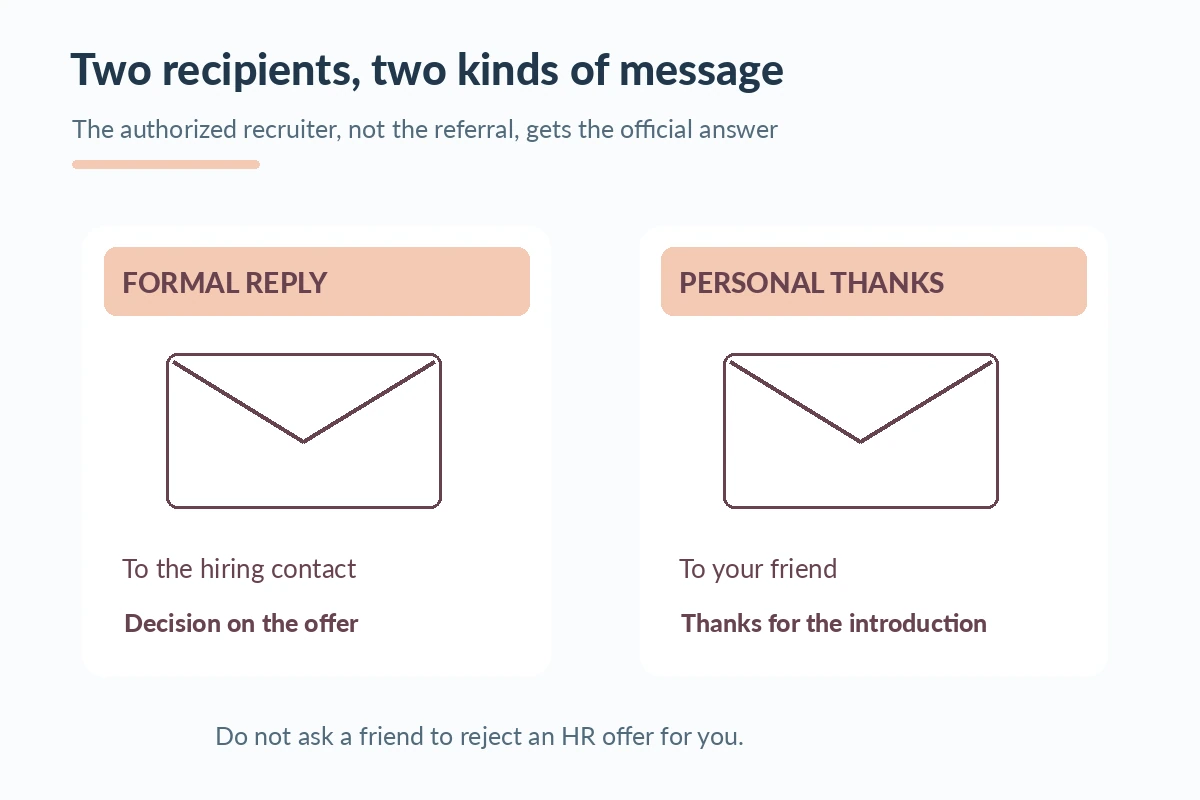
Write a professional offer response and a separate thank-you
For the hiring contact, an illustrative email is: “Subject: Decision on Office Coordinator Offer. Dear Lee, thank you for offering me the Office Coordinator position. I appreciate the time your team spent with me. After careful consideration, I have decided to decline the offer. Thank you again for the opportunity, and I wish the team success. Regards, Alex.” This message stands on its own even if the recipient has no idea about your friendship. Replace the invented name and title with the correct information.
For the friend who made the introduction, a short note could read: “Thanks again for thinking of me and putting me in touch with the team. I have let the hiring contact know I will not be taking the role. I appreciate your support.” You do not need to disclose the terms or ask the friend to advocate for your decision. If the friend is also the hiring authority, combine gratitude and decision in one clear message rather than sending an ambiguous personal note and leaving the official offer open.
Respond kindly if the friend feels disappointed
A friend may say they were looking forward to working together, or that they spent time recommending you. Acknowledge that effort without reversing the decision by accident: “I appreciate what you did for me, and I know you put time into it. I am not taking the role.” You can then move back to ordinary friendship topics. Avoid bargaining about a job you do not intend to accept, saying someone else forced you to refuse, or disclosing internal hiring information to defend yourself. A calm boundary does not require a dramatic explanation.
If the friend asks for feedback about the employer, keep your response focused on your own job fit. Do not turn a career decision into a judgment about the friend’s organization or loyalty. If you suspect the friendship depends on accepting the role, that is a personal concern best handled outside the formal recruiting email. You cannot control the other person’s reaction. What you can control is honesty, timing, respectful wording, and making sure the authorized employer contact has the final answer.
| Decision item | What to verify or do |
|---|---|
| Friend made introduction | Thank them; send the official decision to the hiring contact. |
| Friend owns the company | One clear message may be both formal response and personal thanks. |
| Offer came from HR | Do not ask your friend to reject it on your behalf. |
| Friend asks for explanation | Share only what you choose; do not invent a reason. |
Close the offer and use referrals thoughtfully later
Once the decline is sent, save the email with the offer and mark the application closed. If multiple people were involved, verify that the right recruiter received the decision; do not rely on an indirect message. Do not continue attending onboarding appointments or submitting paperwork for a position you have turned down unless the organization has a specific administrative question you need to resolve. This guide assumes the offer has not been accepted. If you signed an agreement, review that document separately rather than using a standard no-thank-you message as a substitute.
For future referrals, tell a helpful friend the kinds of roles and schedules you are genuinely considering before they introduce you. It is easier to decline an unsuitable introduction early than a completed offer late, although either decision can be handled professionally. Treat relationships as separate from job commitments: appreciation is sincere, but it does not create an obligation to take work that does not fit. No email template can guarantee a friendship remains unchanged; the goal is to minimize unnecessary confusion and respect everyone’s time.

How We Research Job Offer Decisions
We reviewed original career-service and government guidance for the specific offer terms and communication question covered here: Mit. Wisconsin. Uga. Careeronestop. These sources support respectful declines and specific offer-review factors; they do not establish that any fictional employer policy, compensation outcome, or candidate account is real. The examples are hypothetical and must be adapted to the actual written offer and contact. Employment rules may depend on location and circumstances; this article does not offer individual legal advice. See the affiliate disclosure. No referral or paid partnership is asserted.
Related Workplace Guides
No. You can appreciate the introduction while deciding that the job is not right for you.
The person authorized to handle the offer, whether that is your friend, recruiter or hiring manager.
Only when appropriate and with permission; a separate brief thank-you is often clearer.
No. A general fit explanation or no reason is acceptable in a respectful message.
If your decision is final, repeat it kindly without reopening a negotiation you do not intend to pursue.