
If a recruiter, HR coordinator, hiring manager and interview panel all contacted you during the same hiring process, you do not need to send four different refusals. Identify the person responsible for offer decisions, tell that person clearly that you are declining, and follow the employer’s stated process. An optional thank-you to someone who invested time in interviewing you can be appropriate, but it must not sound like a different decision. The goal is one accurate record and respectful closure.
Identify who owns the offer
Look at the offer letter, the last message giving a response deadline, and any instructions to accept or decline. A talent acquisition partner often coordinates the formal response, while a hiring manager may be the person you met most frequently. Do not assume the most senior interviewer is the correct administrator. If a staffing agency formally represents you, verify whether the agency or employer receives the decision; keep the existing submission and consent arrangements in mind.
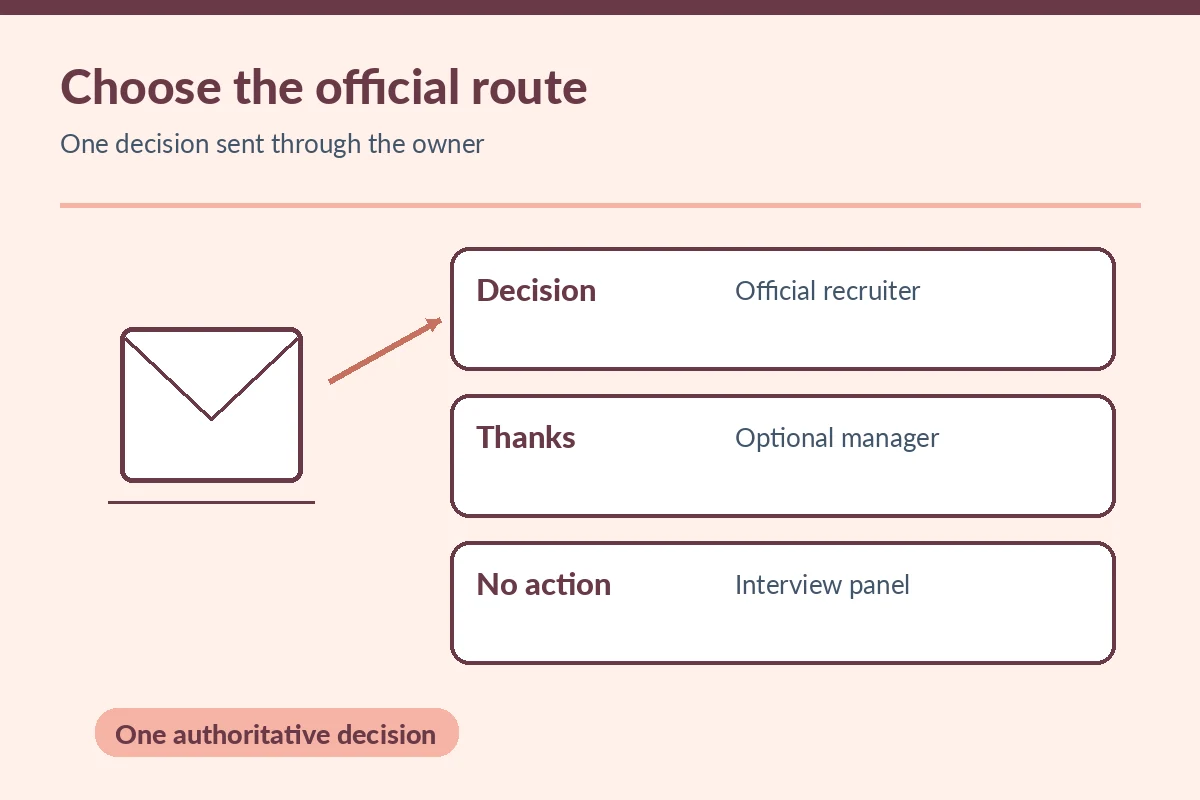
Make a simple contact map: one offer owner, any person who must be copied according to instructions, and other people who are only interview participants. The map should be based on actual communications, not guesses about company hierarchy. If the instructions conflict, ask the official recruiter or HR channel which route to use. A correct decision delivered through one authorized route is better than a flurry of contradictory messages.
Use one authoritative decline message
Write a short email that identifies the exact role and organization, thanks the team and states the final decision without ambiguity. Send it to the person who owns the offer and use the submission method specified by the employer. If a portal is required, complete the matching withdrawal step. Save a copy of the email and portal acknowledgment, but avoid repeatedly uploading documents or forwarding personal data to new addresses merely because someone was copied earlier.
A neutral subject such as ‘Decision — [Role]’ helps a busy recruiter locate the correct requisition. Do not use ‘maybe another time’ as the only decision sentence. You can express that you appreciated a conversation, but ‘I have decided to decline the offer’ must remain unmistakable. Refrain from inventing an alternative offer or naming other employers.

Decide whether a separate courtesy note is useful
A hiring manager who spent substantial time explaining the team may appreciate a short thank-you after the official recruiter has been informed. Such a note can say ‘I have let [recruiting team] know that I will not be accepting the [Role] offer. Thank you for the thoughtful conversations.’ It should not invite the manager to override HR or suggest you are still deciding. If the interviewer had no direct contact with you, a separate message is unnecessary.
Be selective about who hears your private reasons. A panel member does not need to know your benefits or schedule concerns just because they asked you questions during an interview. Do not add everyone to a large reply-all chain if the offer materials instructed you to contact one owner. Professional courtesy is most useful when it reduces uncertainty, not when it creates an extra administrative task.
Handle messages that cross in transit
Suppose you emailed the recruiter this morning and the hiring manager asks for a confirmation call that afternoon. Respond factually: ‘Thank you for reaching out. I sent my decision to [official recruiting contact] today and have declined the offer.’ If the manager appears unaware of the message, you can forward the original communication internally through verified company addresses rather than drafting a different explanation. Avoid stating that HR acknowledged the message if it has not.
If two staff members provide contradictory deadlines or instructions, preserve both messages and request a single clarification from the offer owner. You need not adjudicate internal responsibilities or accuse anyone of a process failure. A clean chronology of the actual offer and response will make a misunderstanding easier to resolve. Do not claim that a sent email necessarily means the HR system has been updated.
Use coordinated but not identical scripts
Illustrative official reply: Hello [Recruiter], thank you for offering me the [Role] position. I have decided to decline the offer. I appreciate the time you and the team invested in my candidacy, and I wish you success with the search. Best, [Name]. Optional courtesy note: Hello [Manager], I wanted to thank you for the conversation about [specific real topic]. I have informed the recruiting team of my decision not to accept. I appreciated meeting you and the team.
These two messages serve different purposes. The first is the record of the decision; the second is thanks, not a second negotiation. If you choose to send only the first, that is ordinarily sufficient. Do not promise future availability or referrals unless you genuinely mean them. Never share other applicants’ information or assume a manager is authorized to discuss compensation details for future openings.

Close the record without chasing everyone
After one acknowledgment, mark the opportunity declined in your application tracker, along with the job title and date. If a second contact sends an automated onboarding invitation, politely indicate that the offer has already been declined and ask for the invitation to be withdrawn. Avoid clicking unusual links or sending new identity documents until you independently confirm the request is legitimate. Official HR procedures take precedence over generalized email templates.
The practical test is whether one responsible contact can understand what happened without reconstructing a dozen message threads. If the decision is clear, the route official and the records consistent, further courtesy emails are optional. Career-center guidance generally supports timely and respectful decline communications; it does not require you to contact every participant in a multi-stage interview personally.
How We Research Job Offer Decisions
We review primary university career-service materials about offer communications, deadlines and decision factors. We compare those sources with the specific scenario here and flag where employer documents or individualized advice—not general templates—are needed. Every sample message is fictional and meant to be adapted to the actual hiring process; it is not a real offer, employer reply, legal determination, or guaranteed outcome.
Sources checked November 11, 2026: careers.wisc.edu — UW–Madison advises communicating a decision promptly, clearly, and respectfully without excessive explanation.; career.uconn.edu — UConn career guidance calls for thanking the employer, stating a decline clearly, and keeping reasons brief.; careers.northeastern.edu — Northeastern recommends timely, courteous declines and cautions candidates about reversing commitments.; ischool.uw.edu — University of Washington recommends notifying the recruiter promptly and following a verbal notice with written thanks.. Please also read the JobAsk affiliate disclosure before using any external service linked by this site.
Related Workplace Guides
Tell the person who owns the offer process first. A separate courtesy note to the hiring manager is optional unless the employer gives different instructions.
Usually that adds unnecessary recipients. Use the official decision channel; the panel does not need private reasons or a separate administrative response.
Ask the recruiting or HR contact to confirm the authorized route. Keep the original messages rather than guessing.
State that you informed the official contact and repeat the same final decision. Do not invent an acknowledgment or change your stated reason.
There is no requirement. Only connect where a genuine professional relationship exists and the contact is comfortable with it.