
You can decline a job offer because the role does not support your current career direction even if the company, salary and colleagues seem appealing. Start by comparing the work actually described in the offer with the skills and responsibilities you want to build. Ask clarifying questions if development opportunities are important and still uncertain. If the mismatch remains, communicate a final decision without criticizing the team or pretending that a promotion was guaranteed. Career fit is a personal assessment, not a verdict on the employer.
Separate the actual position from an imagined next role
Review the job description and written offer for daily responsibilities, reporting line, learning expectations and the immediate scope of the role. For instance, a person seeking hands-on analysis may find an administrative coordination job interesting yet not suited to their next step. That does not make the job inferior; it makes the role different from the candidate’s present goal. Work from job duties, not a title alone or a casual statement that ‘there is room to grow.’
List the work you would perform during the initial months and label any proposed future duties separately. If a manager mentions a possible later promotion, treat that as a possibility rather than a promised position. University career centers include professional development and opportunities for advancement among factors to consider when evaluating offers; they do not guarantee either one for a particular job.
Define an achievable development priority
Write down one or two skills you want to gain from the next role and how you would know you had practiced them. Good priorities describe work that can be observed: preparing reports, coordinating stakeholders, analyzing data or developing instructional content. Weak priorities are vague promises about becoming a leader quickly. Avoid inventing projected promotion dates, training budgets or a guaranteed internal move. Those would require employer-specific evidence.
A useful comparison has columns for documented duties, relevant learning opportunities, unresolved questions and personal importance. Your decision should not depend on a fictional score or other applicants’ priorities. A candidate might choose a role with limited advancement because the immediate tasks are valuable; another candidate might decline the same offer to pursue a different track. Neither choice produces a predictable future outcome.

Ask one concrete question before refusing
If the fit depends on a missing fact, ask it while the offer is still open. Examples: ‘How does this team assign process-improvement projects to new hires?’ or ‘Which training activities are part of the current role rather than future opportunities?’ The interviewer may answer with typical practices, but you should distinguish a description of past team activity from a written commitment to you. Ask the official contact when a term affects the offer itself.
Do not keep requesting speculative future promises after you have already decided to decline. One clear question can prevent a decision based on a misunderstanding, but it cannot transform an entry-level coordination position into a guaranteed specialist role. If you hear conflicting information about duties, confirm the current scope in writing. A changed job description is a separate issue from personal long-term fit.

Write an answer that closes the discussion
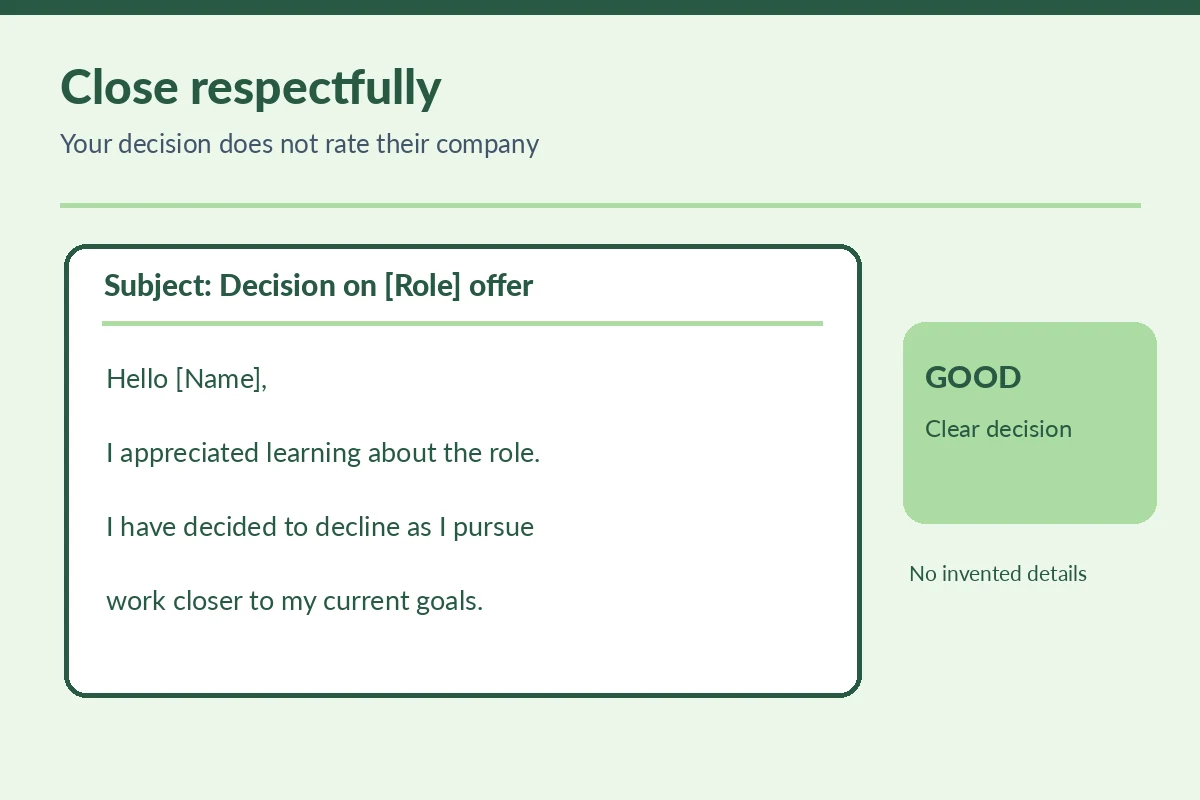
Illustrative email: Hello [Name], thank you for the offer to join the [Team] as [Role]. I appreciated learning about the work and meeting everyone. After reflecting on my current career direction, I have decided to decline the offer and pursue opportunities more closely aligned with the responsibilities I am seeking. Thank you for your time and consideration, and I wish the team continued success. Best, [Your Name]. No promotion prediction or employer criticism is needed.
If you would rather keep the reason private, the sentence ‘I have decided not to accept the position after careful consideration’ is a complete alternative. Be sincere about any praise: mention a real conversation or aspect of the role you learned about, not a claim that the company has an amazing culture based on one interview. Do not insist that the employer should change the job for you unless you actually want to discuss a revised offer.
Avoid turning a career decision into feedback on people
It is rarely useful to write that the team is unambitious, the manager will never develop staff, or the company has no future based only on limited interview information. Those claims exceed what you know and can be unnecessarily hurtful. Describe your own priorities instead: ‘I am focusing on roles that involve more direct research work.’ Do not ask an interviewer to justify their career path or defend the employer’s organizational choices after you have declined.
If the employer asks for feedback, you may share a factual distinction, such as that the current role emphasizes service scheduling while your goal is technical documentation. Keep it brief and avoid quoting private interviews or criticizing individual employees. Offering feedback is optional. What matters operationally is that the official recruiting contact receives an unambiguous decision within the offer deadline.
Turn the mismatch into a better future search
Update your job-search notes with two lists: tasks you want to perform and requirements you should check earlier next time. Revise your interview questions to ask about the current role before broad career ladders. If you accepted an offer already, do not use this article to justify backing out without considering the commitments you made. Review your agreements and seek individualized guidance when needed; a polite email does not erase an existing commitment.
Future opportunities can change, and an employer might contact you later about a different role. That is possible but not promised. A respectful decline preserves clarity and may leave room for a later conversation, but should not be framed as a strategy to make the employer chase you. The durable lesson is to judge an offer against documented work and your current goals, then respond honestly and promptly.
How We Research Job Offer Decisions
We review primary university career-service materials about offer communications, deadlines and decision factors. We compare those sources with the specific scenario here and flag where employer documents or individualized advice—not general templates—are needed. Every sample message is fictional and meant to be adapted to the actual hiring process; it is not a real offer, employer reply, legal determination, or guaranteed outcome.
Sources checked November 11, 2026: career.ucsb.edu — UC Santa Barbara Career Services recommends reviewing written offer terms and asking for a clear decision deadline.; www-cf.mtu.edu — Michigan Tech lists benefits, training and advancement among factors to review when evaluating an offer.; careers.northeastern.edu — Northeastern recommends timely, courteous declines and cautions candidates about reversing commitments.; career.uconn.edu — UConn career guidance calls for thanking the employer, stating a decline clearly, and keeping reasons brief.. Please also read the JobAsk affiliate disclosure before using any external service linked by this site.
Related Workplace Guides
Yes. You can choose not to accept a role that does not match your priorities. A professional note need not judge the employer or predict your future success.
Only make claims you can substantiate. It is generally clearer to explain that the current role does not match the responsibilities you are seeking.
Treat an informal possibility separately from documented current duties. Ask clarifying questions, and do not represent an uncertain promotion as a guaranteed term.
Yes. Appreciation for the people and the decision about day-to-day work are different. Thank them genuinely and state your choice.
No. Keep the response short; use your detailed goals privately to improve future job searches and interview questions.