
To decline a seasonal resort job offer, compare the position’s actual work dates with your travel arrangements and any accommodation terms before making a final decision. Then notify the hiring contact promptly, identify the seasonal position, state that you will not accept and thank the employer. You do not need to describe private travel problems or criticize the property. A seasonal offer can include several different timelines—orientation, first paid shift, last scheduled shift, check-in and check-out—so ask for missing details first if they could change your choice.
Lodging and hospitality operations often involve evenings, weekends and holidays. The Bureau of Labor Statistics notes this for lodging management roles, and a resort’s front desk, guest service or facilities positions can have their own specific coverage schedules. Do not infer shift guarantees from tourist-facing opening hours. Some seasonal employers arrange housing, while others merely provide a list of local options; the term “housing available” does not establish cost, occupancy, eligibility or duration. The exact offer letter and any separate accommodation agreement must be read on their own terms.
Two Timelines, Not One
Draw two parallel calendars. The first follows the job: orientation, first shift, busiest period, last shift and any formal end date. The second follows housing and travel: arrival window, check-in, payment if any, check-out and return travel. Mark each detail as confirmed, unresolved or incompatible. This avoids treating a start-date question as just a scheduling preference when it could also affect where you sleep or how you reach the location. If work and lodging arrangements are not compatible with your needs, you may decline without asserting that the employer has broken a rule.

Four Steps to Evaluate and Decline This Offer
Step 1: Read the role and full seasonal window
Confirm whether the offer is for guest services, food service, operations or another department. Record the employer’s stated start and end dates, the orientation day, required training and any earlier arrival expectation. Seasonal work is not automatically one fixed schedule: ask about weekends, holidays and variable shifts. Confirm the property’s location and the actual decision deadline. Compare these details with your availability and obligations without assuming that a verbal date range controls every aspect of the arrangement.
Important boundary: Do not assume a flexible end date or guaranteed days off unless the hiring team confirms them.
Step 2: Clarify employer-provided housing separately
If the employer mentions housing, ask whether it is guaranteed or subject to availability, whether an agreement is separate, who may occupy it and when access begins and ends. Ask about the price and any deposit only through official written terms; do not invent legal rights or automatic refunds. You may need to evaluate roommate arrangements, accessibility or commuting distance without giving personal details to the recruiter. If you cannot accept the lodging terms, a brief decline can simply say that the overall arrangement does not work for you.
Important boundary: Never pay a personal account for “guaranteed housing” without independently verifying the employer and the written arrangement.

Step 3: Compare travel to orientation and shift coverage
Map the realistic arrival route, required check-in timing and how you would reach shifts, including early mornings or late-night coverage if stated. Transport may be supplied, optional or entirely your responsibility. Ask if orientation must occur in person and whether dates can change. If a change request might solve the mismatch, raise it before deciding. If it cannot, decline the offer rather than accepting with a plan to arrive late or leave before the season ends.
Important boundary: Do not represent employer-provided travel, parking or shuttle service as a benefit without confirmation.
Step 4: Send the seasonal decline and update your plans
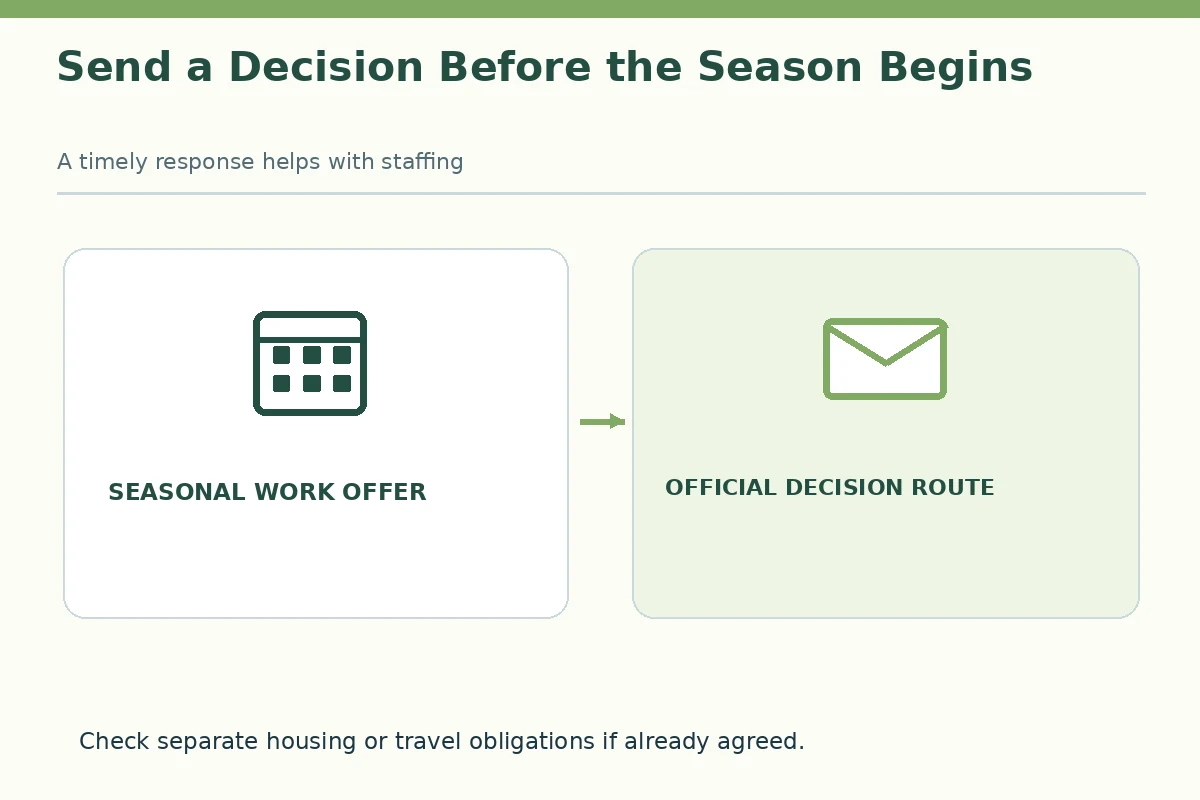
Use the official recruiting channel and reference the specific seasonal role and proposed period. Say clearly that you are declining, express thanks and stop any pending onboarding arrangements through the appropriate process. If housing was tentatively reserved, ask the responsible contact whether separate cancellation steps apply without assuming that a polite email cancels every agreement. Notify anyone who provided a reference only if relevant and avoid transmitting travel documents in a decline response.
Important boundary: Do not assume an email releases you from a separately accepted agreement or automatically refunds a deposit.
Decision Matrix: Clarify, Compare, or Decline
| Offer detail | Candidate action | Evidence to check |
|---|---|---|
| Season start and housing check-in differ | Clarify both dates before deciding | Written job and lodging terms |
| Travel support is mentioned vaguely | Ask who supplies transport and when | Official offer details |
| Overall arrangement is not workable | Decline and check separate reservations | Correct hiring and housing contacts |
A Respectful Decline Email You Can Adapt
Illustrative email: “Subject: Guest Services Seasonal Offer — Decision. Hello Dana, thank you for offering me the seasonal Guest Services position at your resort. After reviewing the season dates and accommodation arrangements, I have decided not to accept the offer. I appreciate the time the hiring team spent answering my questions and wish the property a successful season. Sincerely, Riley.” The fictional example is intentionally short. Use the actual department and role, and mention housing only if you want to explain the decision.
What to Do When the Offer Changes
A common confusion is believing a job acceptance and a housing reservation are the same document. They might be connected operationally, but they can also have separate terms, deadlines or contacts. Before you decline, review any documents you have actually signed. If you have only received an offer, a standard decline may be appropriate. If you already accepted employment or entered a housing contract, seek individualized guidance about the specific terms and communicate promptly. This article cannot determine the legal effect of an agreement it has not seen.
Avoid These Communication Mistakes
Candidates may worry that refusing a seasonal role damages a future relationship with the resort. Courtesy helps, but no email guarantees that another season will have an opening. If you truly admire the employer, you can express appreciation without asking them to reserve the role indefinitely. Timely notice is especially valuable when a team is coordinating arrival dates, housing assignments and guest-facing shifts. Keep the message factual and do not invent a medical, family or transportation emergency to make the refusal seem more acceptable.
Final Checklist Before Sending
Check the job title, season dates, whether a separate lodging arrangement exists, the official decision contact and your acceptance status. Do not include personal itinerary details in a routine refusal. If you need clarification, ask before giving your final response; if the answer is no, state it clearly and professionally. Preserve the offer and any separate accommodation correspondence for your records, and avoid promising availability you cannot provide.
How We Research Job Offer Decisions
We checked the occupational and university career guidance on 2026-11-14. case.edu explains case Western Reserve University recommends notifying the employer of a decline promptly and says a reason is optional. www.bls.gov explains the Bureau of Labor Statistics describes lodging operations and shift coverage, including evenings, weekends and holidays. careerdevelopment.princeton.edu explains princeton recommends clarifying decision deadlines and being transparent when comparing outstanding job offers. ischool.uw.edu explains the University of Washington Information School urges prompt, considerate offer decisions and written follow-up after verbal notice. These are general professional communication frameworks, not legal advice or a determination of any actual employment contract. Examples of candidates, employers and offers are fictional. Consult your offer documents and the relevant institution if you have already accepted. See the affiliate disclosure.
Related Workplace Guides
Only if it helps you communicate accurately. A brief statement that the overall arrangement does not fit is enough; you do not need to disclose private housing preferences.
No. Orientation, first shift, check-in and check-out can differ. Confirm each in writing from the appropriate employer or housing contact.
Review the specific lodging agreement and ask the authorized contact about any cancellation procedure. A general decline email does not prove a refund right.
Yes, if the employer cannot offer workable terms and you have not accepted. Tell them promptly instead of leaving your decision open.
Follow the stated offer process. A call may be considerate for an urgent staffing deadline, with written confirmation when appropriate.