
Make the stay-or-move decision before writing
If you have decided to remain with your current employer instead of taking an external offer, you can decline the outside role directly and respectfully. You do not need to negotiate against an invented counteroffer or give the recruiter a detailed account of your internal conversations. Start by checking whether your choice is final, which offer you are declining, and whether you have already accepted anything. If you are still comparing the two paths, ask about the offer deadline rather than sending a decline you may immediately regret.
Separate your personal choice from a counteroffer story
Remaining in your current position does not automatically mean you received a pay increase, promotion, or written retention deal. Say “I have decided to remain in my current role” only if true. Do not tell the prospective employer “my company matched your offer” unless that actually happened and you have chosen to disclose it. Even when a retention conversation took place, you may prefer not to share confidential compensation or organizational details. A factual decision is stronger than a strategically dramatic story that could be contradicted later.

Verify the external offer is still unaccepted
This guide assumes you have not already accepted the outside position. Review your emails, offer portal, signed documents, and verbal commitments before replying. If you formally accepted and later decided to stay, the issue is not a routine offer decline; professional and possibly contractual consequences need consideration. University career centers repeatedly discourage backing out of accepted offers and advise timely communication if a commitment cannot be honored. Do not assume that a candidate can reverse every type of acceptance with no consequence or that a single generic email settles the matter.
Send a short, honest final response
Illustrative email: Subject: Offer decision — Client Success Specialist. “Hello Avery, Thank you for offering me the Client Success Specialist position. I appreciated meeting the team and learning how the role supports your customers. After careful consideration, I have decided to remain with my current employer and must decline your offer. Thank you for your time and for the opportunity to be considered.
I wish the team the best with its search. Regards, Jamie.” This is a hypothetical example. Replace all details with verified facts and remove any personal compliment you cannot honestly make.

Choose the contact who can update the offer
Reply to the recruiter, hiring manager, or designated offer address specified in the message. If a talent system requires a decline action, complete it as instructed and preserve the written response. A note to an interviewer who has no access to the candidate file may not close the official offer. Avoid forwarding the offer to your current employer as evidence in a negotiation unless you have deliberately chosen to share it and are permitted to do so. The two employers do not need to be placed in direct competition for you to communicate a final choice.
Respond quickly after you decide to stay
Do not keep an external offer open as leverage once your decision is settled. The prospective employer may be waiting to contact other candidates or make onboarding plans. You can be prompt without being abrupt: thank them and clearly decline. If the official deadline has passed, acknowledge that you are responding late rather than pretending to be on time.
Do not ask the recruiter to keep the position reserved while you explore an undefined future. A polite decline respects the employer’s hiring work and your own need for closure.
If the recruiter asks what would change your mind
A hiring manager might offer revised duties, schedule, or compensation. If your decision is final, avoid opening a new negotiation simply to be polite. Say “I appreciate your willingness to explore options, but I have made my decision to remain in my current role.” If you genuinely want to reconsider, ask for the amended terms in writing and do not claim commitment to either side until you have made a new decision. This is different from using the other offer solely to demand a raise at your present employer.
Protect confidential details from both workplaces
The prospective employer does not need internal strategy, private manager conversations, or sensitive documents from your present workplace. Likewise, your current manager does not necessarily need the other company’s internal interview notes. Do not share confidential offers, client information, or employee data casually. If you say a particular team or company culture influenced your choice, stay accurate and avoid negative comparisons that are unnecessary to declining. The offer response is professional correspondence, not a public explanation of your reasons for staying.
Avoid turning the decline into an unverified retention story
Imagine a worker who interviews externally, discusses career development with their current manager, and then decides to stay. The candidate may feel pressured to tell the outside recruiter that the present company offered a promotion, even when no promotion occurred. That embellishment adds nothing necessary to a respectful refusal. A truthful reply is simply “I have decided to remain in my current role, so I must decline.” If a recruiter asks whether pay was the deciding factor, the candidate can say “I weighed several considerations and have made my decision.” If the employee has promised not to share confidential information, that boundary still matters. A professional relationship does not require using one organization’s private discussions as negotiation material with another.
Close the loop and maintain a realistic relationship
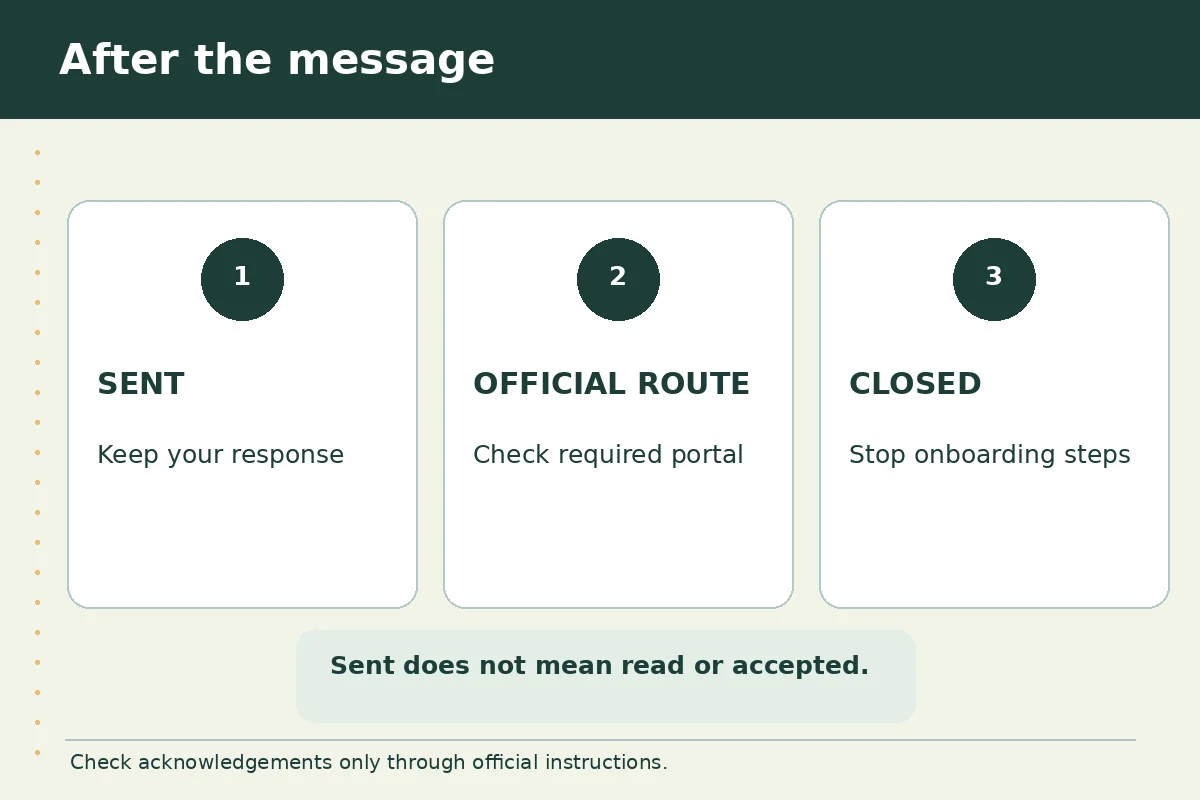
After sending the reply, save the dated message and check the official portal if applicable. One gracious closing is enough; you cannot promise future openings, referrals, or a renewed application. If the recruiter replies with a courteous acknowledgement, a brief thank-you is optional, not an invitation to keep negotiating. You may stay connected in a normal professional way if both sides wish, but do not suggest an active application remains pending. Verify that your decision is consistent across calls, messages, and online status before treating the process as closed.
How We Research and Verify Offer Guidance
We reviewed primary university career-center or official program guidance on how to respond to offers, including capd.mit.edu, career.uconn.edu, online.usc.edu. We checked the cited pages on November 3, 2026. Each source supports communication practices, not a guarantee about an employer, a contract, or a particular school policy. We also compared this topic with existing JobAsk offer articles to keep the advice focused on this specific decision.
All message examples on this page are hypothetical and must be adapted to the real role, organization, and decision. The guidance is educational rather than legal or individualized career advice. For relationships and site policies, read our affiliate disclosure. No referral arrangement or paid endorsement is implied by the examples or the linked sources.
Related Workplace Guides
You may say so if true, or simply state that you are declining after consideration. No detailed discussion of your current workplace is required.
No. Do not invent one, and do not disclose compensation or promotion discussions unless you intentionally choose to share verified facts.
If your choice is final, politely repeat it. If you reconsider, review the revised written terms before making a new commitment.
A prompt, accurate, respectful note helps. It does not guarantee future opportunities, and you should not imply an open application.
Treat that as a separate issue. Review your commitments, seek appropriate advice when needed, and contact the employer promptly rather than using a simple pre-acceptance template.