
If a recruiter approaches you about a job you have not applied to and the role is not a fit, you can simply decline. Thank them for the specific message, state that you are not pursuing this opportunity, and decide whether you genuinely want contact about future roles. This is not the same as rejecting a formal job offer, withdrawing a submitted application, or canceling an accepted interview. You are not required to disclose your current employer, personal circumstances, or reasons for saying no. Do not respond at all to suspicious recruitment messages; first distinguish a legitimate professional approach from a potential scam.
Confirm you are declining outreach, not an existing commitment
A recruiter may send a cold email or professional-network message saying a position could match your background. If you never applied and did not agree to a screening call, you are declining an invitation to learn more. A formal job offer comes later in an employer process and may require different communication and review of written terms. An already scheduled interview also requires a clear cancellation through the agreed recruiting channel. Match your message to the actual stage so neither side thinks you are withdrawing from something you never entered.
If the approach identifies a role and reputable recruiter, a short answer can close the conversation professionally. A vague message that asks you to reply to an unknown number or send personal information does not deserve the same treatment. FTC guidance warns that fraudulent recruiters can appear convincing. Independent verification matters when you are uncertain; a polite refusal should not become a reason to click an unknown link or disclose personal data.

Choose one boundary that reflects your actual preference
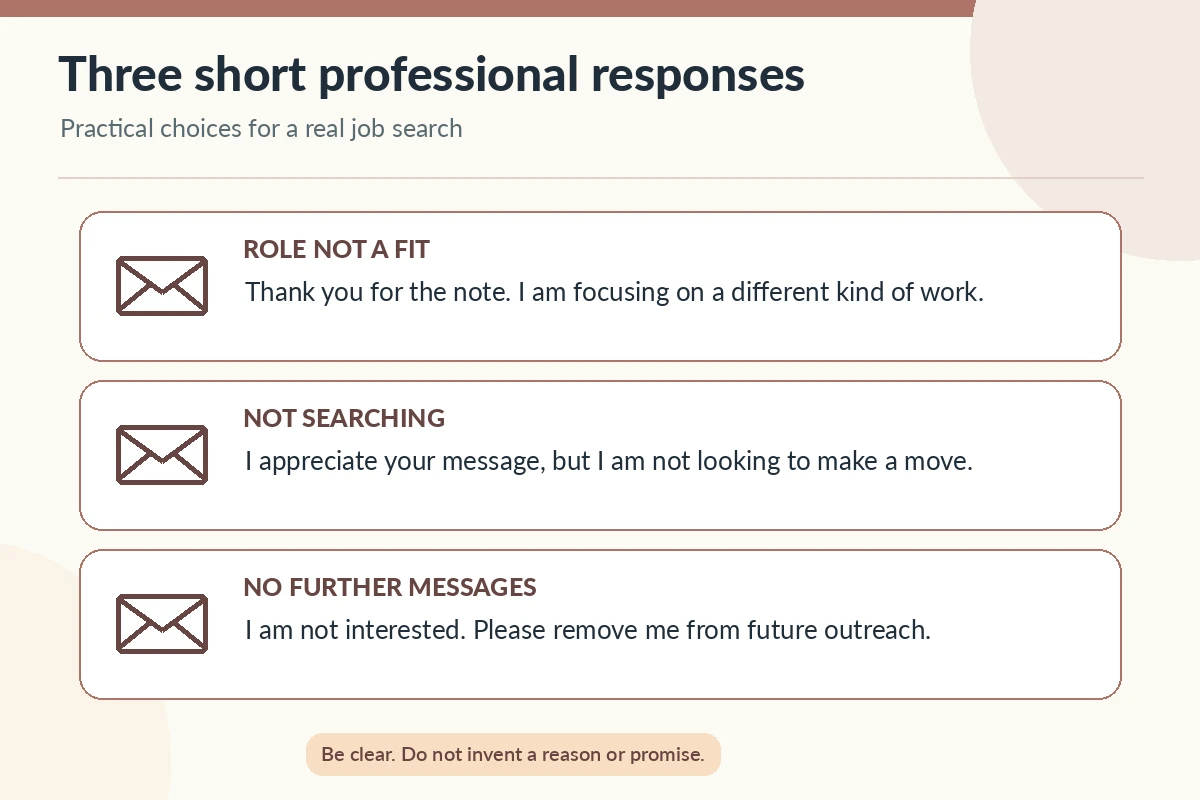
There are three practical outcomes. First, the position itself is wrong, but you would welcome future outreach in a defined area. Second, you are not looking now, but you might reconsider later. Third, you want no more recruiting messages from that contact. Decide which is true before writing; offering future contact just to sound friendly can generate follow-up you do not want. If you prefer not to explain, ‘I am not considering new opportunities at this time’ is sufficient.
Staffing Advisors provides examples of concise declines keyed to career fit or timing. Your own version should avoid made-up praise, exaggerated apology, or detailed criticism of a stranger’s job. Do not tell the recruiter you would love to speak next month unless you mean it. A professional boundary can be warm and final. The decision is yours, and leaving out private reasons is not rude or deceptive.
Write a response matched to the situation
For a role mismatch, a hypothetical reply is: ‘Hi Morgan, thank you for thinking of me for the Office Coordinator opening. I am focused on records and data-quality roles rather than front-desk positions, so I will not pursue this one. If a relevant records role comes up, I would be open to a brief description. Best, Jordan.’ For not searching: ‘Thank you for the note. I am not exploring a move now, so I will pass. I appreciate your consideration.’ These are invented role and person examples.
For a firm boundary: ‘Thank you for reaching out. I am not interested in this opportunity or future recruiting messages. Please remove me from this outreach list.’ You do not need to attach a resume, explain why you will not change employers, or negotiate details. State one decision clearly; a long essay invites a debate you were not seeking. Avoid ‘maybe’ when the real answer is no.
Reply only through a genuine, appropriate channel
For a verified business contact with a detailed role, responding in the original professional thread is simple. If the message came through a professional network you use, reply there rather than moving the conversation to an unexpected app. If it arrived by random text or from an unverified sender claiming that you are ‘selected,’ do not send an acknowledgment solely to be polite. You can block or report suspicious outreach and separately verify any company of interest through its official website.
A recruiter who keeps emailing after a clear no may not have recorded your preference correctly. You can restate the no-contact request once, or use the appropriate unsubscribe, platform controls or blocking features. You are not obligated to keep responding. Save your own brief record if ongoing contact is troublesome, but avoid publicly posting the person’s private information. Do not click an untrusted unsubscribe link in a clearly fraudulent message.
Refer a colleague only with explicit permission
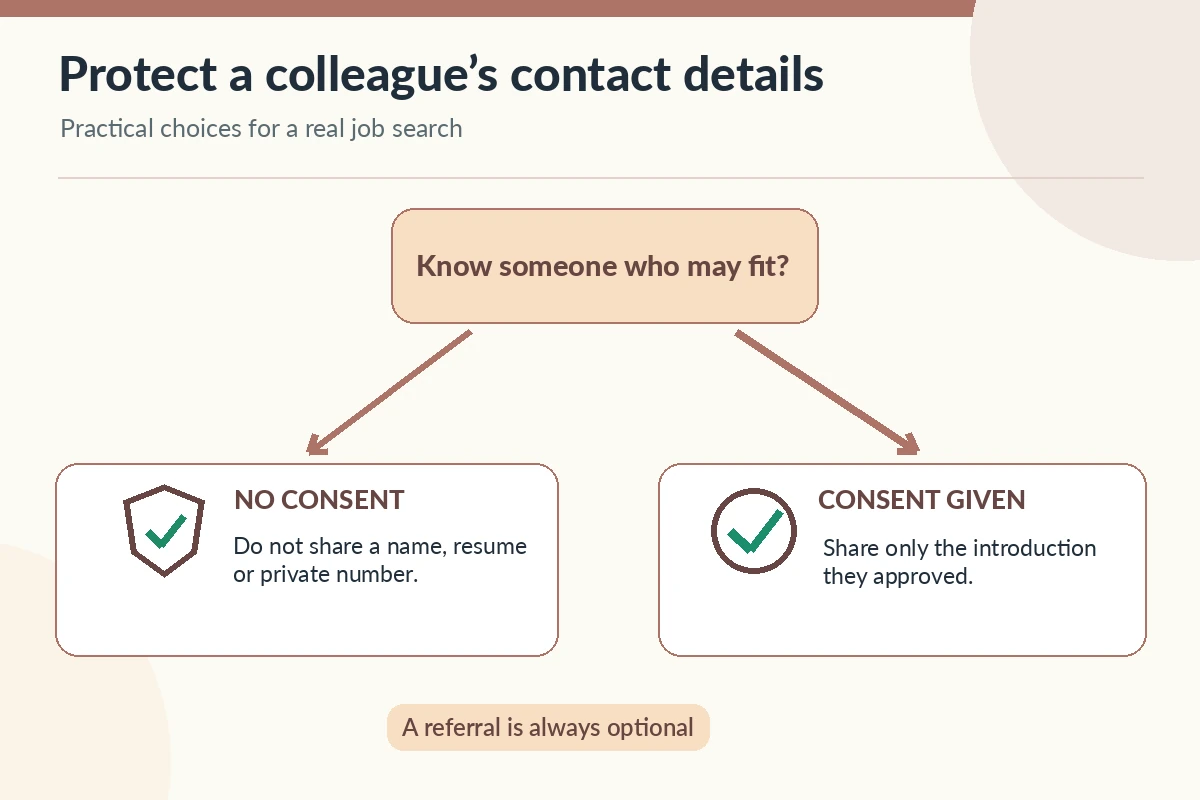
A recruiter may ask whether you know another candidate. Do not send a coworker’s resume, phone number, email address, or profile details without asking that person first. It is fine to decline the referral request or to offer to pass along a public job description privately so the colleague can decide whether to contact the recruiter. A professional response can say, ‘I am not pursuing the role and cannot make a referral at this time.’ No further explanation is needed.
If someone you know agrees to an introduction, confirm the recruiter and the role first, then share only the contact information the person authorized. Do not imply that your colleague has applied, is qualified, or wants to be submitted to a client unless you actually know that. A referral is a separate, consent-based action—not a condition of declining your own opportunity. You can preserve a connection without trading another person’s information.
Close the thread without promising anything
After the response, archive the message and move on. If you invited future outreach for a specific role family, keep a private note of the preference so you can reassess it if the recruiter contacts you again. If you said no contact, you need not maintain a networking relationship. Professional tone matters, but no reply guarantees future opportunities, and you do not owe a stranger an ongoing exchange about your plans.
Harvard FAS networking guidance emphasizes clarity, appropriate context and respectful communication. Applied here, those principles mean a simple yes-or-no boundary rather than a disguised request for a job. Continue with the job-search channels you actually choose. If a recruiter later offers a different legitimate role, you can evaluate it afresh; declining this approach does not obligate either side to keep in touch.
How We Research Recruiter Outreach Guidance
We compared career-center and recruiting-industry guidance with current FTC consumer-protection information where relevant, and wrote practical decision rules for this distinct outreach situation. Sources reviewed: Staffing Advisors recruiter-response guide; Harvard FAS networking email guidance; FTC advice on recruitment impersonation; Harvard FAS networking guide. People, dates, job titles and reference numbers in example messages are hypothetical and do not represent current vacancies. This content is general job-search guidance, not a legal guarantee or a promise of employer response. For commercial relationships and links see the JobAsk affiliate disclosure.
Related Job Search Guides
For a verified professional outreach, thank them, state that you are not pursuing the specific role, and optionally say what kinds of roles you would consider later. Keep the message brief.
No. A first recruiter approach is an invitation to discuss a role, while an employment offer comes after more formal steps. If you already have an offer or scheduled interview, use the appropriate distinct response.
No. A short statement that the timing or position is not right is enough. You do not have to disclose your current employer or personal circumstances.
Yes. Request removal from future outreach clearly. If the message is suspicious, avoid replying or clicking its links and instead use blocking or reporting controls.
Only if that friend is interested and has explicitly consented to an introduction. Never share their resume or contact information as a favor without permission.