
An informational interview with a recruiter is a career-research conversation about role families and how a company’s hiring process operates. It is not a screening call unless the recruiter explicitly says a specific vacancy is under consideration. Ask which jobs the recruiter supports, what applicant evidence is commonly requested, and where candidates can see official postings. Do not ask them to reveal other applicants’ information or to promise a shortcut around the regular process.
Recruiters are useful sources on job titles, application stages and how position requirements are presented. They may be less familiar with a specialist team’s day-to-day technical decisions. The U.S. Society for Human Resource Management describes informational interviews with recruiters or peers as a way to explore careers, not a guarantee of job opportunities. Approach the conversation with a narrow question and respect a recruiter who can answer only public or general process questions.
Identify the Recruiter’s Actual Coverage
Before requesting time, identify whether the person recruits for your field, an employer you are researching, or a staffing firm. A technical recruiter may know engineering role families but not clinic credentialing; a campus recruiter may speak mainly about internships and graduate programs. Read the organization’s published careers page first. This prevents you from using 20 minutes to ask questions whose answers appear in the position listing.
An effective opening is: “I am trying to understand the difference between operations analyst and reporting coordinator roles at your organization.” That invites the recruiter to clarify titles and hiring signals, not to endorse your application. If they cover a different function, thank them and ask whether there is a public team contact or resource. Do not request a private address, confidential hiring plan or an introduction the recruiter has not volunteered to make.
| Conversation topic | Useful question | Appropriate takeaway |
|---|---|---|
| Role titles | Which roles does your team recruit for? | Look up published job families |
| Evidence | Which examples clarify a skill? | Gather truthful project or work proof |
| Process | Where are stages explained? | Follow official careers portal |
| Decision owner | Who assesses specialized job skills? | Ask role team in a separate conversation |

Ask About Screening Without Requesting Private Criteria
Ask: “Which experience types make an applicant’s background easy to evaluate for this job family: coursework, documented project work, paid tasks or industry credentials?” Follow with, “Which parts of the posting are usually minimum requirements and which are preferences?” A recruiter can sometimes clarify how the published description is used, but they cannot change qualification rules on the spot. Confirm anything material against the actual listing and employer instructions.
Process questions are often more useful than asking for a trick to pass a screen. You might ask which stages tend to involve portfolio review, recruiter discussion, technical assessment or team interview, while acknowledging that steps vary by posting. Do not request test questions, unpublished scoring rubrics, candidate notes or personal contacts of evaluators. Distinguish general process information from any promise about your specific candidacy.
Keep the Conversation Outside the Hiring Decision
A short call can change character if the recruiter asks whether you want to apply for an actual position. Clarify: “Are we discussing general career pathways, or is this now a conversation about a specific published role?” If the answer is the latter, request the job link, job identification, and official next steps. Do not treat an offhand comment that your background sounds relevant as an offer or even as a formal referral.
Some recruiters cannot discuss individual applicant decisions outside an official process. They may also have confidentiality obligations around openings, staffing plans and other candidates. Keep your questions centered on publicly described expectations and skills you can demonstrate. If you need an accessibility accommodation during a formal process, use the employer’s stated route. Do not ask an informational contact to handle sensitive documents over a personal messaging account.
Send an Honest Request and Prepare Your Questions
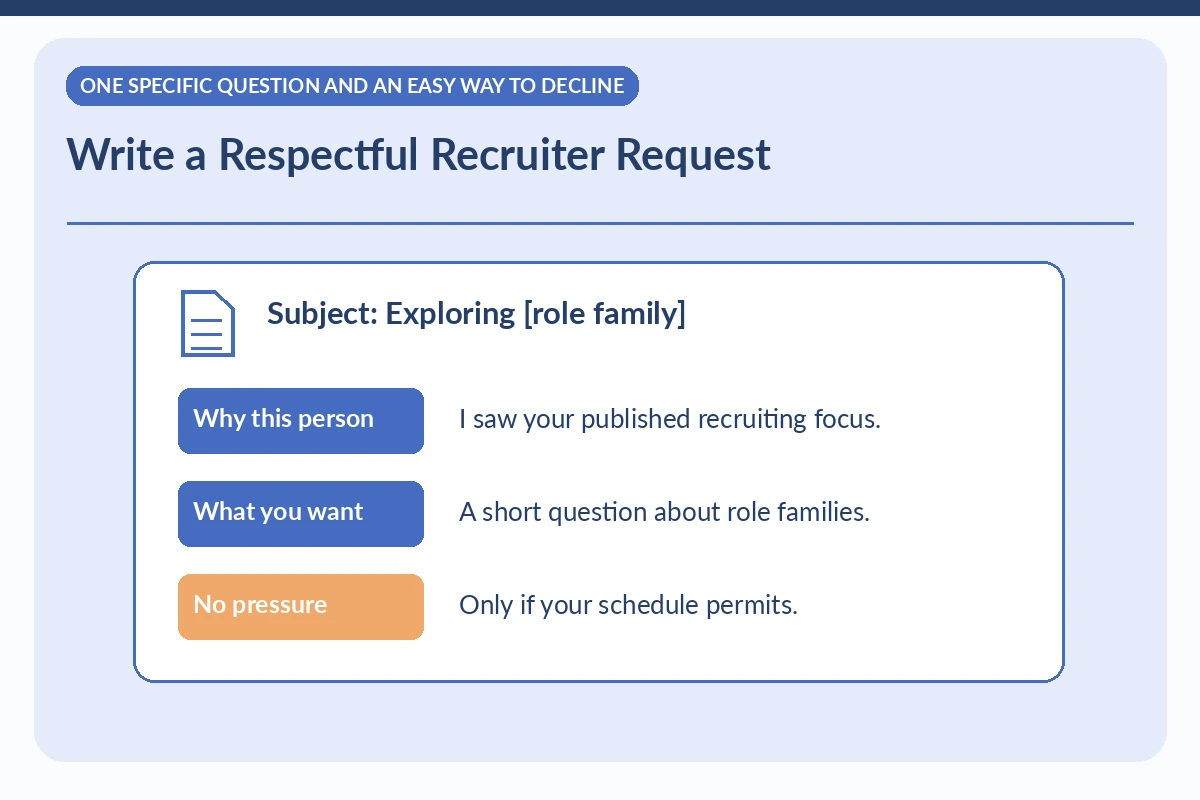
Illustrative message, not an actual correspondence: Illustrative note: “Hello [Name], I am exploring [role family] and saw that you support recruitment for [organization or function]. Would you be open to a 15-minute informational conversation about common role titles and the publicly described application steps? I am not asking you to assess my candidacy or provide an unpublished opening. If your schedule is full, I understand. Thank you, [Your Name].” Be truthful about how you found the person.
Prepare four questions, not a lengthy interrogation: one about role distinctions, one about required evidence, one about normal application stages, and one about a public resource to read next. Tell the recruiter in a sentence what you have already researched. Listen for terms you can verify in current postings, and ask for definitions when a title or team acronym is unfamiliar. End when your agreed time expires, even if your resume remains unreviewed.
Turn General Advice Into Application Evidence
After the conversation, update a simple role-evidence map. If the recruiter explains that operations reporting jobs emphasize data checks, find a way to document your actual spreadsheet or audit experience. If the role family values writing samples, gather permitted work or student artifacts. Never backfill a nonexistent certificate or invent employment outcomes because someone said a skill is helpful. A recruiter’s broad advice does not prove what every hiring manager will ask.
Check current positions independently for location, duties, credentials, work authorization, and submission instructions. Do not assume a historical process description still applies. If the recruiter shares a public careers URL, use it rather than emailing highly sensitive personal information. When comparing several employers, record which facts came from an official posting and which are just exploratory comments. That distinction makes your search notes reliable.

Handle Invitations to Apply Without Confusion
If a recruiter explicitly invites a formal application, thank them and follow the official process. You can mention the informational conversation if appropriate, but avoid implying sponsorship or a guaranteed interview. If no opening exists, send a brief thank-you and return to your search plan. An informational interview has succeeded when you can recognize relevant role titles and submit a more accurate application later.
Evaluate the contact’s advice carefully: can you identify the exact skill it clarified, a public listing that supports it, and a safe next action? If not, you may need a second conversation with someone actually doing the work. Recruiters explain pathways and processes; team members explain specific daily workflows. Use both perspectives without expecting either one to waive selection standards.
How We Research Informational Interview Guidance
Sources checked on 2026-11-15: www.shrm.org (Recruiter or peer informational interviews can explain career paths and interviewing without promising openings.); careers.usc.edu (Specific, low-pressure outreach and preparation for career conversations.); careers.umbc.edu (Open-ended questions, agreed meeting length, and note-based follow-up.). These sources support general career-conversation practices or occupational facts, not promises about any individual employer, recruiter, legal practice or business. Every proposed conversation and example is hypothetical. No relationship with an interviewer or service provider is claimed. Review Affiliate Disclosure.
Related Job Search Guides
Yes, but only when the recruiter clearly moves to a specific formal recruitment conversation. Confirm the posting and next steps instead of assuming the transition happened.
Not as a default. Ask about the usual evidence recruiters look for; share your resume only if the recruiter requests it through an appropriate channel.
Ask about published stages and the types of evaluation, but not confidential questions, scoring details, or other candidates’ results.
Thank them and ask for public resources or the correct job family. Avoid demanding an internal introduction.
No. Follow the posted application instructions unless the employer provides an official alternative in writing.