
An electrician apprentice resume objective should identify the apprenticeship or helper position you are applying for and give one honest reason you can work and learn safely: completed coursework, reliable construction experience, organized tool handling or documented supervised electrical lab practice. Do not call yourself a licensed electrician just because you finished an introductory class. The objective is most useful when you have limited trade experience and want the employer or apprenticeship sponsor to see the connection between your preparation and the requirements of the role.
Find out whether the role is an apprenticeship
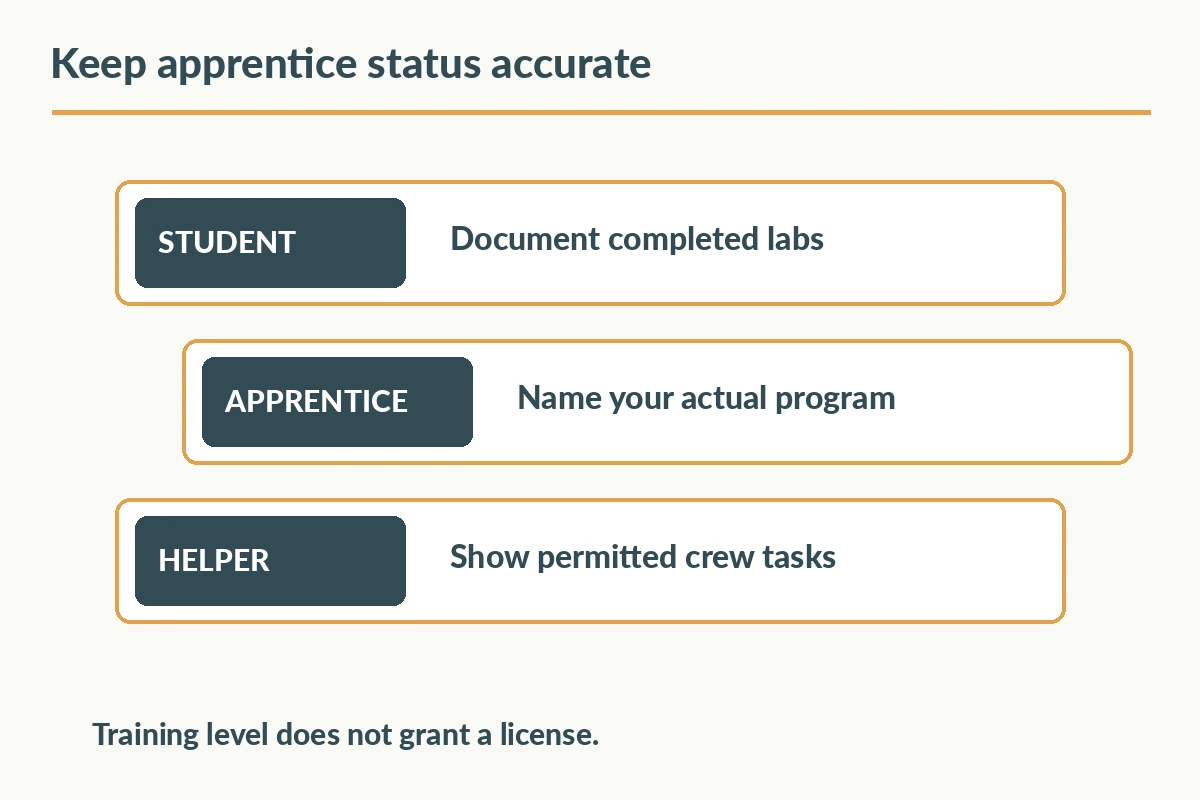
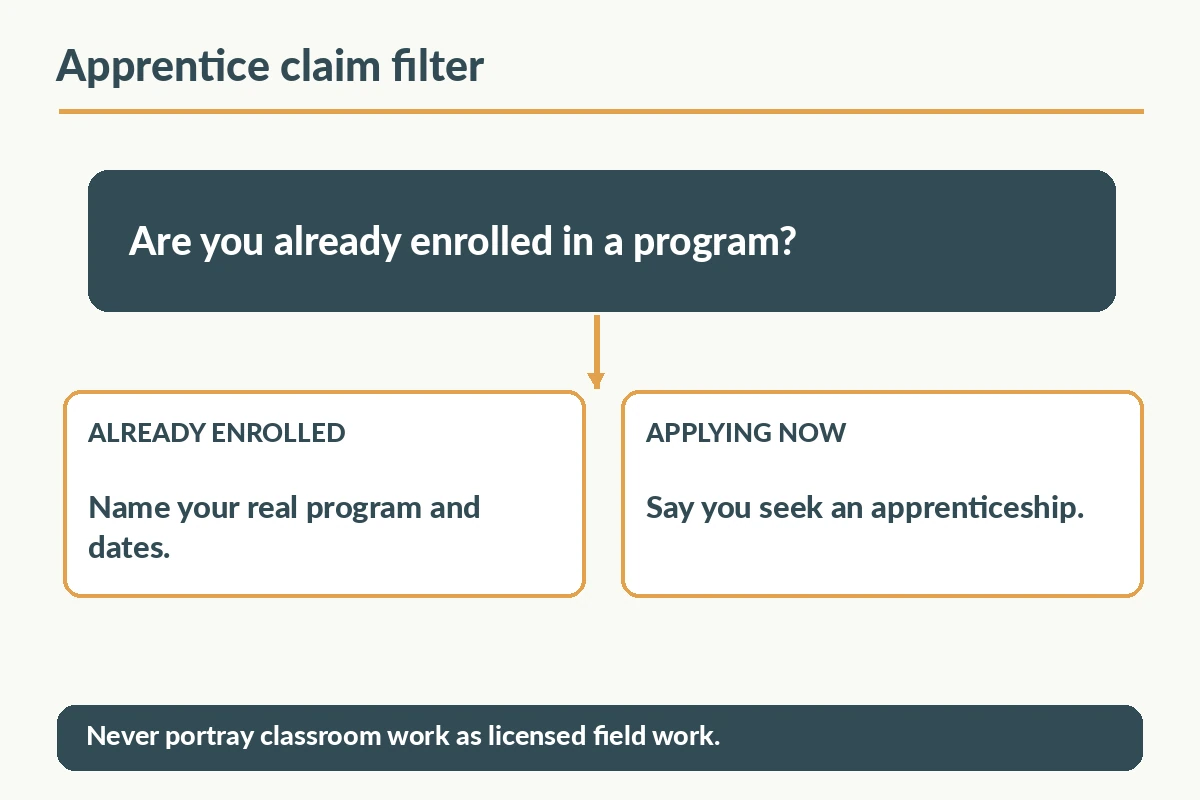
‘Electrician apprentice,’ ‘electrical helper’ and ‘pre-apprenticeship student’ can represent different employment and training arrangements. Read the actual posting for registration, sponsor, eligibility, driving requirements and local license or trainee-card rules. BLS identifies apprenticeships as a common entry route to electrician work and notes that licensing requirements are widespread. An apprenticeship is not merely an informal promise that someone will teach you on the job. If an employer offers helper work rather than a registered program, describe it as helper work. The objective should name the role on the vacancy rather than suggesting that your status changed when you sent an application.
Open with a real skill and a specific goal
A workable opening names your current evidence and the training opportunity. Example for a documented classroom student: ‘Electrical trades student seeking an electrician apprenticeship; brings completed circuit labs, careful tool inventory and a record of following instructor safety procedures.’ Example for a construction career changer: ‘Construction helper pursuing an electrician apprenticeship; brings jobsite housekeeping, materials tracking and experience following crew instructions.’ These examples are hypothetical. They become valid on your resume only when they accurately describe your experience. Avoid saying ‘master electrician skills’ or ‘independent wiring expert’ when you have only practiced with de-energized training equipment.
Separate introductory training from field permissions
A course may teach circuit terminology, reading simple diagrams or working with training boards. It does not automatically authorize energized work or satisfy a state’s licensing requirements. If you have helped at a construction site, describe your permitted responsibilities without implying that you installed or connected electrical systems independently. Supervisors and apprenticeship programs assign tasks based on qualifications, training and local rules. Keep the objective focused on learning under supervision and contributing through safety, preparation and documentation. A statement such as ‘ready to wire any panel’ is an avoidable red flag because it ignores how restricted work is controlled.
Use trades experience without disguising its origin
Warehouse stocking, carpentry assistance, landscaping, facility support and school projects can show dependable habits relevant to an electrical crew. Identify the actual activity: staging parts, maintaining a work area, reading basic measurements or reporting missing materials. Then connect it to the target job’s expectations without relabeling it as electrical installation. If a project used a training board or mock setup, label it. An apprenticeship reviewer can reasonably value your ability to arrive prepared, handle tools responsibly and accept corrections. That evidence is more credible than an objective filled with unsupported electrical trade terms.
Let the job posting choose your emphasis
A commercial installation apprentice may need comfort with ladders, drawings and coordinated crew schedules; a residential helper posting may emphasize materials, cleanup and customer communication; a maintenance apprentice may mention documentation and identifying issues for review. Only include facts you actually possess. If an advertisement requires a driver’s license, trainee registration or completed safety course, verify each requirement rather than promising you can obtain it instantly. The same core objective can be rewritten to foreground one relevant experience for each job. Do not copy terminology from a program’s marketing page into your resume unless you understand it.
| Starting point | How to frame the objective | Evidence to show |
|---|---|---|
| Pre-apprenticeship student | Course modules and lab exercises | School or training record |
| Registered apprentice | Actual program and permitted duties | Program participation proof |
| Construction career changer | Jobsite habits and crew support | Genuine prior job bullets |

Put training records beneath the objective
List technical school enrollment or completion, actual safety coursework and any registered apprenticeship participation in a dedicated section. State the issuer and date for a course or credential if you can verify them. Do not list OSHA as a license or claim an unspecified ‘OSHA certification’ where the actual record is a particular outreach-training card. Include a few bullets about safety practices, planning, or supervised tasks. Quantities should come from your genuine attendance or work records, not a generic benchmark found online. This supporting evidence makes a one-sentence objective trustworthy and helps the employer see what needs to be taught.
Avoid unsafe promises and exaggerated independence
Some inexperienced applicants write that they can troubleshoot live panels or complete wiring alone to appear ready. That language is not a useful shortcut. Electrical work involves risk, and duties depend on training, supervision and local authorization. Emphasize following lockout and site procedures as learned or practiced, identifying unfamiliar conditions, and asking for a qualified person’s direction. Do not describe a training demonstration as licensed field work. If an employer requests independent electrician credentials in a supposedly entry-level role, ask what it expects of the apprentice before applying; the mismatch may mean it is not truly a beginner position.
Compare the program and the real opportunity
Apprenticeship.gov offers a job finder, but each listed opening still has its own employer and application process. Read the sponsor’s application instructions and confirm whether the program is currently recruiting. Save requirements about education, assessments, documentation and travel. For an objective, you do not need to mention the sponsor’s reputation or imply selection before acceptance. Use the official program’s language for the occupation title and your own words for the evidence. A broad claim to be ‘passionate about electricity’ is less persuasive than having completed a relevant class, helped organize a safe work area and followed a documented schedule.
Build two evidence-based resume bullets
After the objective, support it with at least two bullets from real experience. One can show safety and organization: for example, ‘Tracked hand tools and flagged missing equipment during instructor-led workshop sessions’ when accurate. Another can show your ability to learn and communicate: ‘Read basic circuit diagrams in a classroom module and checked completed practice work with an instructor.’ These are illustrative, not ready-made facts about you. Match verbs to your actual responsibility. ‘Assisted,’ ‘documented’ and ‘reported’ convey different levels of authority than ‘approved,’ ‘tested energized circuits’ or ‘installed independently.’
Proofread the objective before sending
Check that the position title, enrollment status, tools, completed courses and claimed responsibilities match the rest of the resume. Remove a credential if you cannot produce evidence or name its issuer. Keep the opening to roughly one or two concise sentences, not a whole personal mission statement. Show interest in the actual program and a realistic contribution you can make from day one. If you are not yet in a registered apprenticeship, say you are seeking one, not that you are a registered apprentice. A precise objective supports a safer and more believable first trade application.
How We Research These Resume Objective Examples
We checked these primary occupation, regulator or consumer-guidance sources on November 16, 2026: BLS describes electricians, apprenticeship training, and the fact that many states license electricians. Apprenticeship.gov describes searching for apprenticeship openings and viewing individual employer qualifications. Apprenticeship.gov explains how the job finder links to employer applications. All example objectives are hypothetical and must be adapted only to a candidate’s real experience. Credentials, permission boundaries and hiring requirements differ by job and location. JobAsk does not guarantee interviews or placement. Read our affiliate disclosure.
More Resume and Cover Letter Guides
You can state you are seeking an apprentice position. Do not claim to hold a program status or card that has not been issued.
No. School training and licensing are different; verify state and employer rules for the exact work.
Mention relevant completed training if truthful, then give its precise name and issuer in your credentials section.
Focus on verified materials handling, accuracy, punctuality and safe crew support rather than inventing wiring experience.
Use Apprenticeship.gov and official sponsor pages, then review each application and qualification requirement.