
Entry-level supply chain analyst jobs can involve tracking shipments, comparing inventory records, investigating delays and preparing reports for planners or operations managers. They are not necessarily independent supply-chain strategy roles. O*NET describes logistics analysts as professionals who maintain logistics information, monitor shipments and analyze delivery processes; BLS describes education expectations for logisticians, a broader occupation. Use those profiles as context while reading each employer’s actual junior analyst tasks. This guide shows how to build safe evidence from sample data and interpret decision authority.
Find analyst work instead of a vague logistics title
Search for junior supply chain analyst, logistics data analyst, inventory planning assistant, transportation analyst trainee and materials analyst. Some postings primarily manage exceptions in tracking systems; others perform forecasts or inventory planning. The word analyst might mean working with spreadsheets and dashboards, or it might mean advising management about purchasing and distribution. Read the verbs: extract, clean, reconcile, visualize, recommend and approve imply different levels of responsibility.
BLS reports that logisticians typically need a bachelor’s degree, though some employers consider alternate education and experience. A junior data-support position may use a different requirement. Mark whether a posting expects SQL, spreadsheet formulas, transportation-management software, ERP access or business analysis experience. Do not classify a job as realistic solely because it says entry-level: note required tools, independent client communication and responsibility for financial or routing decisions.
Follow a shipment exception through the information chain
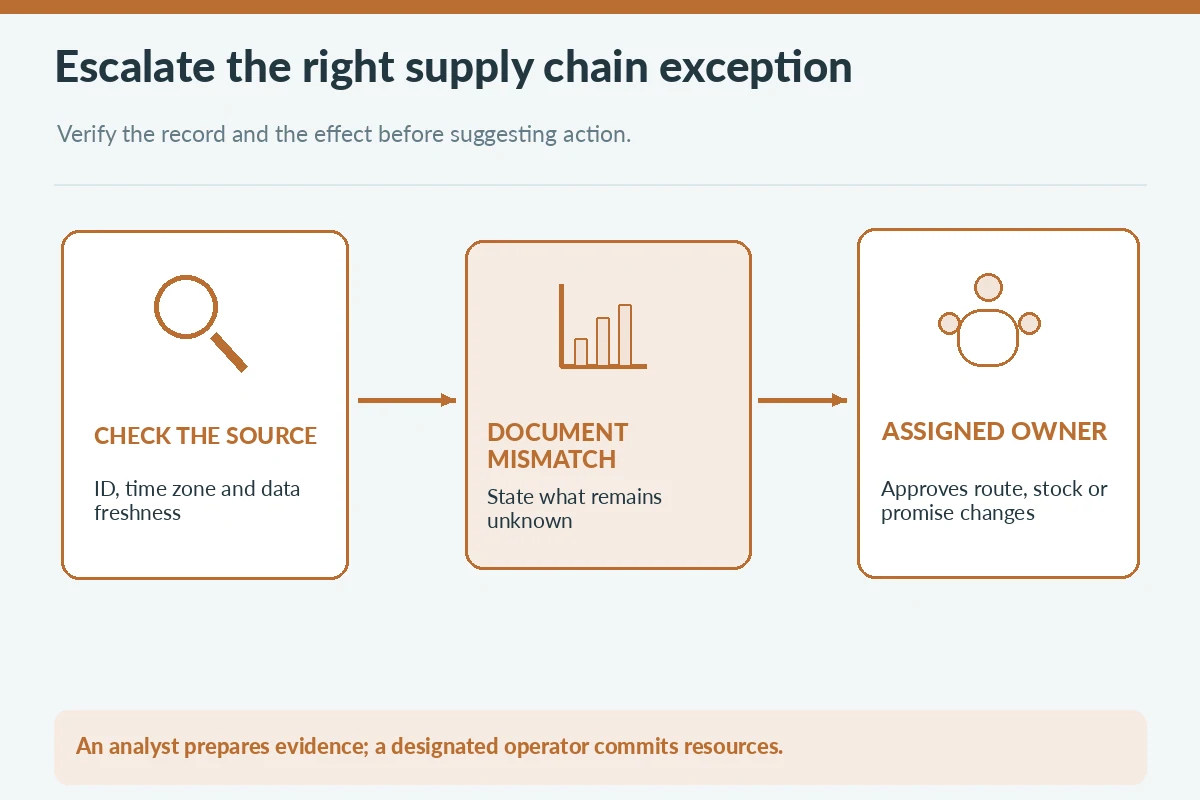
Imagine a hypothetical shipment that shows “delivered” in one dashboard but “delayed” in a carrier feed. First check shipment ID and timestamps, then look for scan updates or duplication. Record which source you used and when it refreshed. If the conflict persists, create an exception note and send it to the authorized planner or transportation coordinator. Analysts may recommend next steps, but rerouting freight, changing delivery commitments or releasing inventory typically requires assigned operational authority.
A useful practice data set includes shipment ID, planned arrival, reported arrival, status source, last update and exception owner. Use entirely invented rows. Check the difference between a late record and a late delivery before calculating a delay metric. A dashboard is not a trustworthy performance report if it mixes time zones, excludes unresolved records or treats missing data as an on-time shipment.
Show a basic analysis rather than unsupported optimization
For a portfolio, create a small fictional shipment table and describe your cleaning rules. Explain duplicate checks, missing timestamps, status definitions and how you calculated exceptions. Then summarize what you can conclude and what requires further investigation. For example: “Five records need review because delivery scans are missing” is more defensible than “I improved logistics efficiency by 40%” when there was no measured intervention.
If you have a real school project, identify the data source, individual contribution and limitations. Include a screenshot of a chart with non-sensitive sample data, not actual customer orders or driver locations. Practice explaining why a particular chart helps a dispatcher spot bottlenecks. The quality of your assumptions, labels and audit trail matters more than an impressive dashboard with no reproducible inputs.

Learn the tools at the level the posting requests
Spreadsheets are a useful starting point for comparisons, lookups, pivots and data validation. SQL may help query structured records if the employer requires it. Visualization tools can communicate trends, but they do not replace understanding what a shipment event means. Do not list a TMS or ERP platform as workplace experience just because you watched a tutorial. Mark skills as coursework or practice when that is their true source.
Prepare one practical demonstration: given a table of planned and actual dates, find unmatched IDs, count unresolved exceptions and write a two-sentence handoff. Explain how you would ask the operations team about conflicting data definitions. Some postings prioritize supply planning and forecasting; others emphasize carrier communication. Match the sample to the specific employer function rather than sending the same generic dashboard to every role.

Compare job requirements with actual training opportunities
A junior position can provide structured support for learning reporting cycles, shipment systems and exception handling. The description should clarify supervision, source-system access, who signs off reports and what an analyst may change. Ask about training on item IDs, units, time zones, lead times and system data quality. If it demands independent network optimization and budget decisions on day one, it may not be a beginner-friendly analyst role.
Record your own match honestly: verified coursework, real inventory or shipping exposure, spreadsheet projects and communication examples. In a resume, do not imply you designed a production forecasting system if you merely cleaned a classroom CSV. A specific entry such as “Validated 80 fictional shipment records in a coursework exercise and documented missing delivery scans” can be labeled as a practice project when accurate.
Separate analysis recommendations from operational commitments
Supply chain work often affects customers, vendors and budgets. A beginner can highlight an exception, investigate supporting records and propose alternatives, yet the authority to change supplier orders, delivery routes, stock allocations or customer commitments may sit elsewhere. Ask what approvals are required for record corrections and who signs off service-level reporting. Source-system permissions are not interchangeable with decision rights.
Use a decision map: verify the information; if correct and within your reporting scope, document a finding; if customer impact or a material correction is needed, escalate to the designated owner. Do not move a container or reroute a driver in a simulated article as if it were a simple analyst task. The safest evidence is a clear, auditable recommendation and a realistic handoff.
Prepare your resume and interview examples
Use truthful examples of working with structured records, cleaning inconsistent inputs, producing understandable charts and communicating uncertainties. A hypothetical resume bullet is: “Reviewed weekly inbound shipment data, flagged missing status records and prepared an exception list for the planning team.” Use it only if it describes your actual contribution. School projects are valid evidence when accurately labeled as academic work.
For an interview, practice walking through one anomaly from raw data to investigation. Explain what you know, how you checked the source, what you cannot conclude and who would authorize the next action. Ask what data systems you would use, how many teams receive your reports and how quality is reviewed. These details reveal whether the job is genuine analytical development or unsupported ownership of operational decisions.
Check legitimate openings and protect shipment data
An authentic role should have a real organization, identifiable team, defined reporting line and secure application process. FTC guidance about fake job offers applies to purported remote analytics as well as onsite work. Do not pay to receive a “starter data set,” deposit checks for equipment or share employer shipment records with an unverified recruiter. If asked for a work sample, use fictional data unless explicitly authorized.
In your tracking table include employer, analyst subfunction, software requirements, education, schedule, decision rights and follow-up date. Compare related logistics analyst, inventory assistant and materials planning roles based on tasks. A narrow shortlist with genuine training opportunities will help you show a more coherent story than applying blindly to every job containing the word supply chain.
| Role or task | What to verify | Boundary to respect |
|---|---|---|
| Data check | Shipment IDs, time zones, event source | Do not assume missing means on time |
| Exception report | Known evidence and open questions | Escalate customer impact |
| Recommendation | Document options and uncertainty | Planner approves route or allocation |
How We Research Entry-Level Job Routes
We checked the occupational scope in public O*NET and U.S. Bureau of Labor Statistics resources or the relevant credential and safety authority, then compared the topic with the supplied JobAsk WordPress post inventory and recent draft batches on 2026-11-05. Job descriptions vary by employer, location and training pathway. Illustrative projects, questions and resume lines in this article are examples, not actual employer outcomes, openings or guaranteed placement results. For information about commercial relationships, read the JobAsk affiliate disclosure.
Primary sources reviewed 2026-11-05: O*NET OnLine / U.S. Department of Labor — O*NET details logistics analyst duties, tracking and supply chain data analysis.; U.S. Bureau of Labor Statistics — BLS describes occupational education expectations and logistics functions.; Federal Trade Commission — FTC documents fake recruiting texts and payment requests; a job seeker should verify an employer independently.. These references describe occupational expectations or safety guidance, not current open vacancies or permission to perform regulated tasks.
Related Job Search Guides
Many logisticians typically need a bachelor’s degree, according to BLS; individual analyst-support postings vary and should be checked.
A fictional shipment exception tracker with clear cleaning rules and an auditable summary is better than an unexplained dashboard.
Some postings request it; others emphasize spreadsheets or business systems. Match your preparation to verified requirements.
Only if specifically authorized by the employer. A junior analyst often documents and escalates an exception rather than making an operational commitment.
Label it as coursework, name your contribution, show the data checks and avoid claiming real employer outcomes.