
Supply chain skills on a resume should explain which part of the flow you actually touched. Purchasing support, receiving, inventory records, order allocation, shipping, carrier updates and demand planning are linked, but they require different duties and permissions. An applicant who checked incoming quantities should not imply that they directed an entire distribution network. Start with the physical or informational movement you supported and the record that proves your involvement.
Anchor supply-chain skills in a product flow
The Bureau of Labor Statistics describes logisticians coordinating purchasing, transportation, inventory and warehousing, often across the product life cycle. Use that broad view to understand a vacancy, then narrow your resume to your own tasks. If your experience is a warehouse shift rather than management, a detailed and honest receiving example can be more persuasive than “global supply chain optimization.”
Distinguish receiving, inventory and planning
Receiving may involve comparing packing lists or deliveries with the purchase order, noting damaged containers, identifying missing items and routing discrepancies. Inventory support may involve updating location records, cycle-count assistance or reconciling a physical count with a system under supervision. Planning may involve forecasting demand, selecting allocation priorities or managing replenishment, tasks not automatically performed by every warehouse or purchasing assistant.
Three potential skills are receipt verification, discrepancy documentation and warehouse handoff. Each can be backed by an example. If you only entered quantities given by someone else, write “updated receipt records from approved count sheets” rather than “verified stock accuracy.” If you participated in a count, describe the actual counting method and escalation rather than promising error-free inventory.
Use concrete systems without brand inflation
Employers may mention enterprise resource planning, warehouse management systems, barcode scanners or spreadsheets. List a particular system only when you actually used it and can identify your workflow: receipt entry, item-location lookup, exception logging or shipment status. Watching a coworker use a dashboard is not the same as independently performing transactions. Coursework in a simulated system belongs under Training or Projects.
When the system name is irrelevant or confidential, a plain-language description is appropriate: “maintained receipt status in a shared inventory tracker.” Avoid claims of implementing an ERP or configuring a WMS unless you really played that role. These projects have different scope from routine transaction entry.

Explain how exceptions moved to the right team
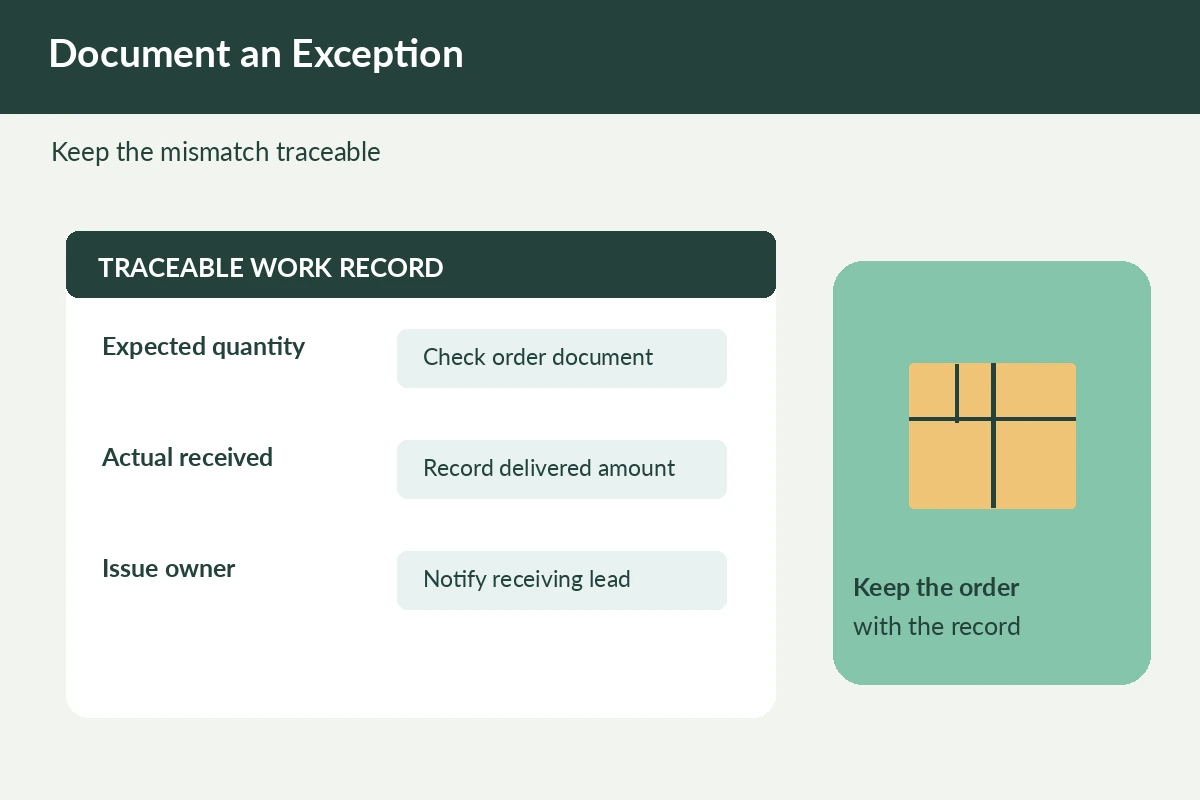
A shipment may arrive short, damaged, late or with an incorrect label. Good supply-chain work includes making the discrepancy visible and ensuring the person who can decide the next step receives accurate information. You may record the shipment number, item, expected and observed quantity, hold status and contact or department notified. Do not say you authorized return, write-off or substitution if another team member made the decision.
For example, a hypothetical bullet might read “Compared incoming cartons with approved receiving documents, recorded shortages by order reference, and escalated discrepancies to purchasing.” Another might read “Updated shipment status in the warehouse log and passed unresolved delivery notes to the next shift.” Both explain the process without inventing savings or implying logistics management authority.
Write action bullets around real handoffs
Supply chain jobs rely on handoffs among vendors, carriers, receiving staff, inventory control and customer-service teams. A compelling resume shows the specific handoff you supported. “Prepared shipment exception notes for the afternoon inventory team” is clearer than “excellent coordination.” If you communicated a carrier update, say whether you confirmed a schedule, relayed an approved estimate or changed a booking with authorization.
Choose a verb that matches the step: checked, counted, entered, reconciled under review, notified, staged, picked, tracked or routed. “Forecasted,” “optimized,” “directed” and “approved” may be accurate for some specialists but should not be borrowed by a candidate who only received materials. Limit client, vendor and product details to what can be safely shared.
Use verified counts or explain process instead
Order volume, lines picked, discrepancy rates or cycle-count accuracy can add meaning when supported by reliable data. But the number must reflect your actual contribution. A team’s weekly throughput does not become your personal accomplishment, and an approximate count should not be presented as a certified performance score. When metrics are unavailable, state the frequency, shift context or type of record only if it is true.
Compare “improved overall inventory accuracy by 40%” with “logged differences between received and ordered quantities and routed them for supervisor review.” The second is a hypothetical example of a defined contribution. Do not invent an employer result, expected volume or guaranteed delivery performance just to make a bullet look quantified.
Match your skills to the posting segment
A receiving-clerk role may emphasize packing lists, safe handling and accurate record entry. An inventory-control assistant may need count sheets, locations and discrepancies. A logistics coordinator may work with shipment updates and cross-team communication. A demand-planning role can require data analysis and forecasting that a warehouse applicant has not yet performed. Look at the verbs in the specific vacancy and choose evidence accordingly.
If equipment operation, regulated materials or worksite safety training is required, do not claim authorization from casual exposure. Being nearby when equipment operates does not mean you are trained or certified. Describe tasks within your approved scope and treat future employer training as future training.

Practice a shipment exception story
A practical interview story begins with a mismatch between an expected and observed delivery. Explain where the expected figure came from, what you verified, how the discrepancy was documented, which team received it, and what you personally did afterward. If another department approved a replacement or return, credit that team. Do not reveal confidential order data or suggest the exception was resolved if you never saw the final outcome.
Before sending the resume, align the skills section with your most useful bullet and be ready to show how each term maps to real work. It is possible to demonstrate responsibility through careful receiving and clean shift notes without pretending to be responsible for the entire supply chain.
How We Research Resume Skills
This guide was prepared for a U.S. audience using occupational task descriptions from the U.S. Bureau of Labor Statistics and O*NET alongside university career-center advice on honest, relevant experience bullets. Sources were checked on November 10, 2026. The scenarios and resume bullets are illustrative, not quotes from a real candidate or claims about a particular employer. Occupational profiles describe possible tasks across an occupation; they do not prove that a given applicant performed those tasks or held decision-making authority. Compare every resume claim with your own records, supervisor guidance, and the target vacancy. We do not promise that any applicant-tracking system or employer will accept a particular format.
Authoritative sources reviewed November 10, 2026: www.bls.gov (BLS covers product distribution, supply chain coordination, procurement, warehousing and logistics roles.) www.onetonline.org (O*NET includes logistics tasks involving materials, distribution, tracking and coordination.) careers.ucsd.edu (UC San Diego guidance on specific actions and results informs resume bullet structure.) careers.uiowa.edu (University of Iowa provides specific duties and outcomes guidance for resume writing.) These examples are educational and must be replaced with the reader’s own verified duties and results. No supplier, career service, or employer has endorsed these examples. See the JobAsk affiliate disclosure.
More Resume and Cover Letter Guides
Yes, especially when the posting values receiving, stock movement, exception records or warehouse handoffs. Describe those tasks without claiming strategic planning.
Yes, if the system was actually used and the experience is explicitly labeled coursework or a simulation.
Say that you recorded or updated counts using approved sheets; do not claim you independently verified the physical inventory.
Only when it is verifiable and clearly related to your personal work. A specific process is preferable to an unsupported metric.
No. Record the shortage and escalation unless you held formal authority to authorize replacement, return or allocation.