
An environmental internship cover letter should tell the reader whether your strongest evidence is field observation, careful data entry, mapping, research or outreach. Environmental placements vary widely: some are mainly office-based and involve tracking program objectives, while others require outdoor work, sampling support and site visits. Identify the actual duties and safety requirements in the posting. Show one specific project you completed and where an instructor or supervisor checked the result. Do not imply that a course lab made you qualified to conduct independent sampling or sign regulatory compliance reports.
Identify whether the internship is field, laboratory or office work
Environmental internship titles can hide quite different jobs. An agency may need water-quality data entry, habitat monitoring support, a literature review, GIS cleanup or education events. A university field course may be relevant to several of these but not all. Create three columns from the live posting: tasks that involve observing or collecting, tasks involving documentation and tasks requiring technical approval. Match each to a project you actually performed, and leave blank any area where you are still learning.
A Port of Corpus Christi environmental internship description, for example, discusses research, benchmarking and collecting data for program goals under environmental-management supervision. It also lists office work with occasional adverse-weather exposure. This is evidence of the range such roles can cover, not a guarantee that another internship uses the same schedule, equipment or field protocols. Research the specific employer’s mission, location and work unit so your first paragraph is relevant instead of a recycled conservation slogan.
Build a traceable example from a field or classroom project
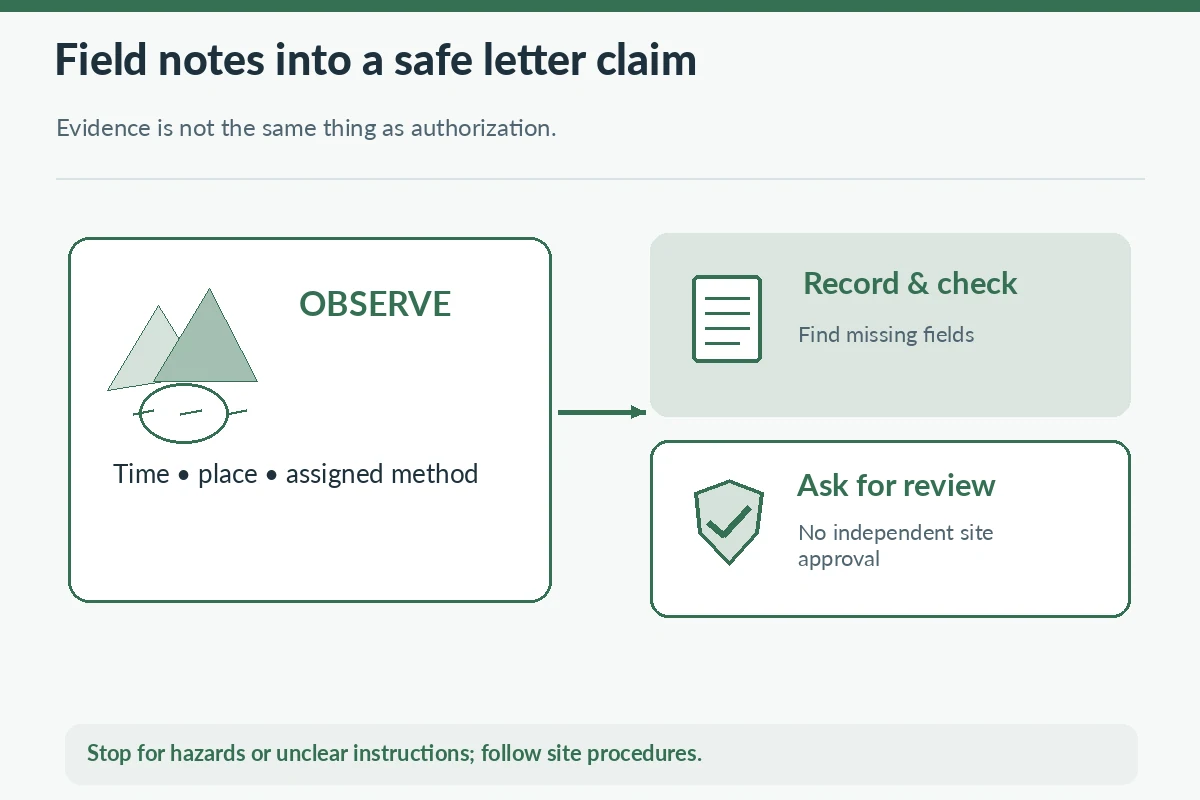
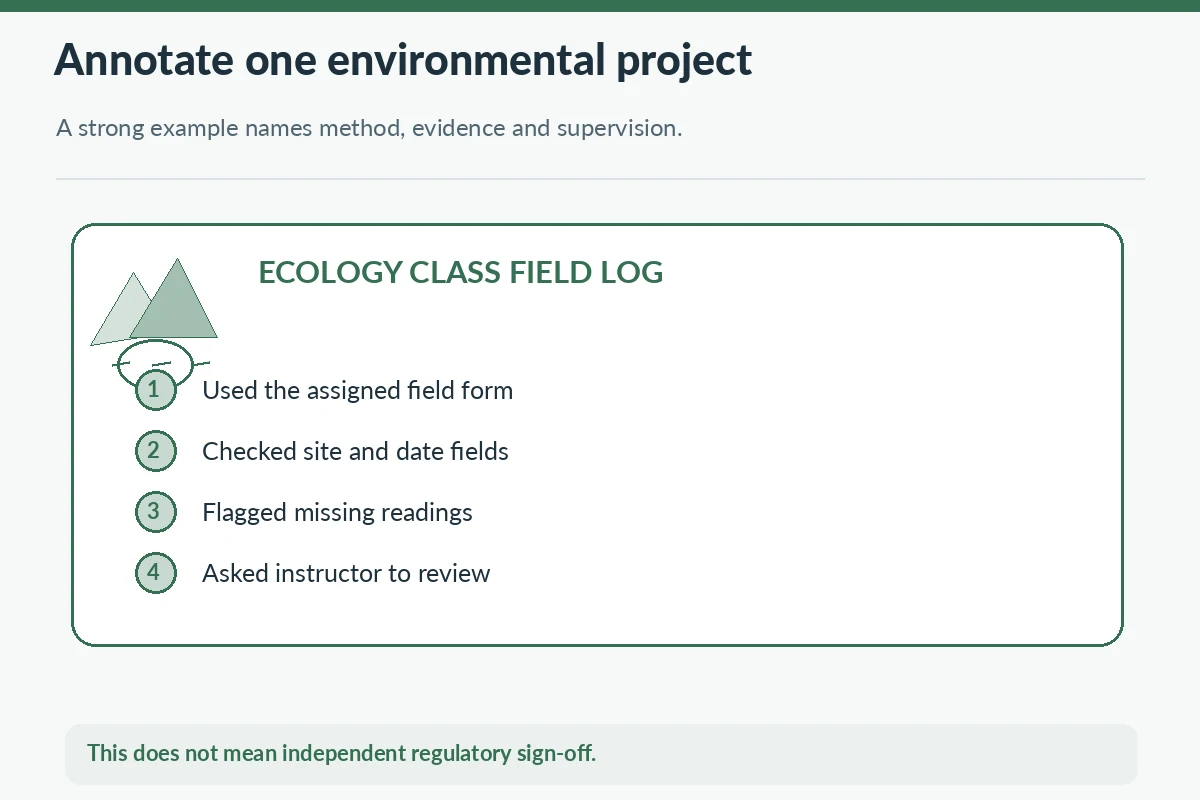
A strong student example describes a real process: record the site and date, follow the assigned observation form, enter readings consistently, check suspicious values and ask a supervisor to review. For example: ‘In an ecology lab exercise, I recorded observations on a shared template, checked entries against field notes and flagged missing location fields before our instructor reviewed the dataset.’ This demonstrates reliability without implying certified environmental monitoring or a professionally validated finding.
If you used GIS, spreadsheets or charts, say what you did with them: corrected inconsistent labels, made a map for a class presentation or organized publicly available data. A screenshot of a map is not proof that you planned the entire survey. Avoid declaring that your class project established legal compliance or environmental safety. Keep the distinction between describing evidence, analyzing it under a learning framework and making a formal operational or regulatory decision.
Be precise about sampling and site-safety limits
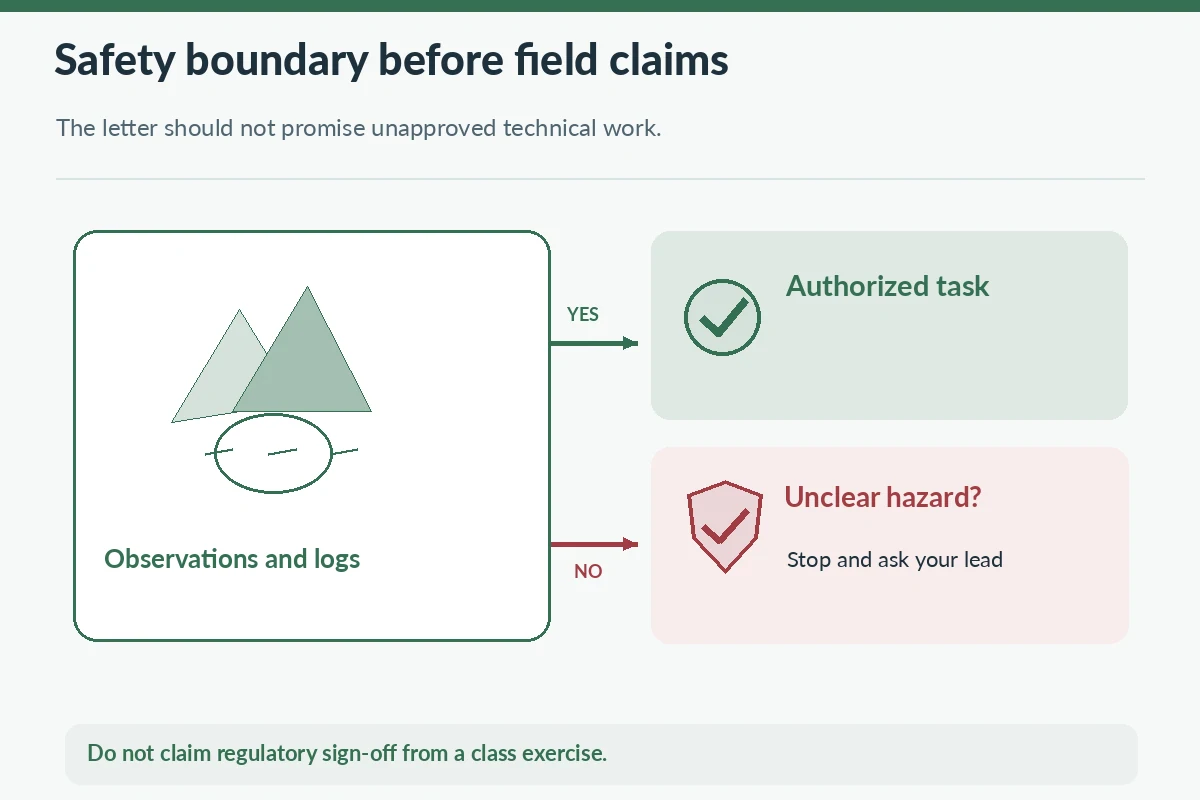
A future intern may receive training in PPE, field hazards, handling samples and reporting incidents. Unless you completed a specific documented training, do not call yourself certified in sampling safety. If your experience involved observing a trained technician, say that you observed. If you collected nonhazardous samples in an approved educational setting, name that setting and the protocol rather than projecting institutional authority. Mention your willingness to follow a supervisor’s instructions and stop work when a hazard is unclear.
Environmental jobs can involve traffic, weather, uneven ground, water or equipment. The level of exposure changes by role, so avoid promising you can perform every field task. If the posting specifies physical requirements, travel, transport or schedule commitments, assess your actual ability to meet them. Be clear about required availability without disclosing unrelated medical information. Writing responsibly about safety is a qualification in itself: show that you can report uncertainty and seek permission before starting unfamiliar work.
Write a concise project-based internship letter
Illustrative letter: Dear Environmental Internship Hiring Team, I am applying for the Environmental Intern position in your sustainability and monitoring program. I was drawn to the listed tasks of documenting environmental measures and researching program objectives. In an introductory ecology project, I collected observations using a course-approved form, entered the results into a shared spreadsheet and checked missing fields against my original notes before our instructor reviewed the work.
I also summarized two publicly available environmental reports for a classroom presentation, noting where the sources used different definitions and time periods. These were educational assignments; I have not performed independent regulatory testing. I would be excited to support your team’s recordkeeping and learn its approved field procedures while asking for guidance on unfamiliar tasks. Thank you for considering my application. Sincerely, [Applicant]. All names, skills and project details here are hypothetical; keep only the parts you can personally verify.
Explain scientific care without inventing results
An environmental letter need not claim a dramatic improvement in air or water quality. A modest observation that you detected a duplicate row or checked the source of a questionable number may be more relevant to entry-level data work. If you quote a measurement, ensure that its units, context and source are correct; never invent quantities or environmental benefits. Discuss your approach to accuracy: original note, versioned file, checked interpretation and reviewer sign-off.
Where projects used group work, state your role. ‘Our team made a biodiversity map’ does not establish that you designed the map, took every observation or interpreted the final result. Better: ‘I cleaned the location column and checked map labels while my classmates conducted the field measurements.’ Such wording permits a recruiter to assess what you can already contribute and which tasks will need training. The goal is an honest bridge from learning to supervised job tasks.
Use the employer’s workplan and your availability carefully
Read the role’s exact objectives. Some internships focus on climate adaptation, while others concern greenhouse operations, parks, environmental education or laboratory sample logistics. Refer to the mission only when you can connect it to a task from the posted workplan. Instead of saying ‘I can save the planet with my research,’ write why the organization’s method of tracking, habitat restoration or outreach interests you and name what you can reliably help document.
Environmental positions may require outdoor hours, location-specific attendance, travel or class-compatible schedules. An unrelated zoological horticulture posting, for example, lists outdoor work conditions and specific application documents; this illustrates why you must inspect the actual announcement rather than assuming every environmental placement is remote or entirely field-based. Verify any required transcripts or qualifications from the current employer instructions before attaching them.
Review confidential, location-sensitive and unpublished material
Field notes can include sensitive locations, private property information or unpublished research. A portfolio may contain a public class map, but that does not automatically authorize sharing a host organization’s data. If you want to mention a project performed for a partner, ask whether an anonymized description is acceptable. Remove site identifiers, private landowner details or images that reveal restricted access. A letter can discuss workflow without distributing the underlying files.
Verify that your evidence does not overstate laboratory accreditation, sampling certification or equipment training. Do not present an instructor’s check as an agency validation. If you have studied environmental regulations, say you completed coursework, not that you approved permits or certified compliance. An authentic statement of what you would like to learn complements, rather than substitutes for, evidence of your current skills.
Check the submitted letter against the actual posting
The finished document should answer why this environmental role, why your evidence fits and where training will be needed. Check the employer name, role title, site requirements and application format; a letter that describes remote GIS work is not useful for a field-monitoring position with required on-site duties. Keep it concise and make its language distinct from your résumé. The cover letter should explain a judgment or procedure behind one listed skill, not merely recite the word ‘organized.’
Read the file after export and remove any unrequested data, exaggerated outcomes or generic promises of independent authority. If you are applying to several environmental teams, keep a short record of the project example used for each. A careful, specific explanation of class work and safe supervision provides a more credible starting point than ungrounded claims about complex environmental analysis.
| Area | Useful evidence | What not to imply |
|---|---|---|
| Observation | Dates, notes and assigned sites | Do not imply formal certification |
| Data checks | Source files and missing values | Keep original records traceable |
| Field work | Follow approved training | Stop and seek supervisor direction |
How We Research Internship Cover Letters
We compared general career-center cover-letter guidance with role-specific institutional internship materials and the JobAsk topic inventory. We reviewed the sources listed below on 2026-11-05. Job and program descriptions illustrate tasks, not guaranteed current openings or universal eligibility. All sample letters and candidate histories in this guide are hypothetical. Follow the current official posting and protect sensitive records. For affiliations and funding transparency, see our affiliate disclosure.
Sources checked: University of Washington Career & Internship Center — A Port of Corpus Christi environmental internship example identifies research, benchmarking, data collection and supervisor oversight; its vacancy dates are not treated as an open listing.; University of Washington Career & Internship Center — UW career services recommends bridging student experience to actual internship duties.; University of Washington Career & Internship Center — A separate horticulture internship posting shows that outdoor work and application documents can be role-specific.. Verify the latest instructions for the exact internship you are considering.
More Resume and Cover Letter Guides
Yes, when the listing accepts students at your level. Describe the actual project, data checks and supervision rather than claiming professional field certification.
Yes, if relevant, but describe the specific mapping task and acknowledge that it was coursework.
Only if you actually conducted authorized inspections within your role. Otherwise describe observation, data preparation or supervised assistance.
No. Responsibilities vary from research and office data work to field visits and education. Read the specific posting.
Only if you can share it legally and with permission. Remove private or sensitive site information where necessary.