
For a federal Pathways internship, read the USAJOBS announcement before drafting a cover letter. Some postings may not request one; a polished letter does not substitute for a required résumé, transcript, questionnaire or other application item. When the announcement calls for a letter, identify its exact position and agency, connect relevant coursework or projects to listed duties, and accurately describe your current enrollment and experience. Do not claim that a letter makes you eligible or guarantees referral. USAJOBS says eligibility and application packages depend on the posting.
Read the How to Apply section before writing
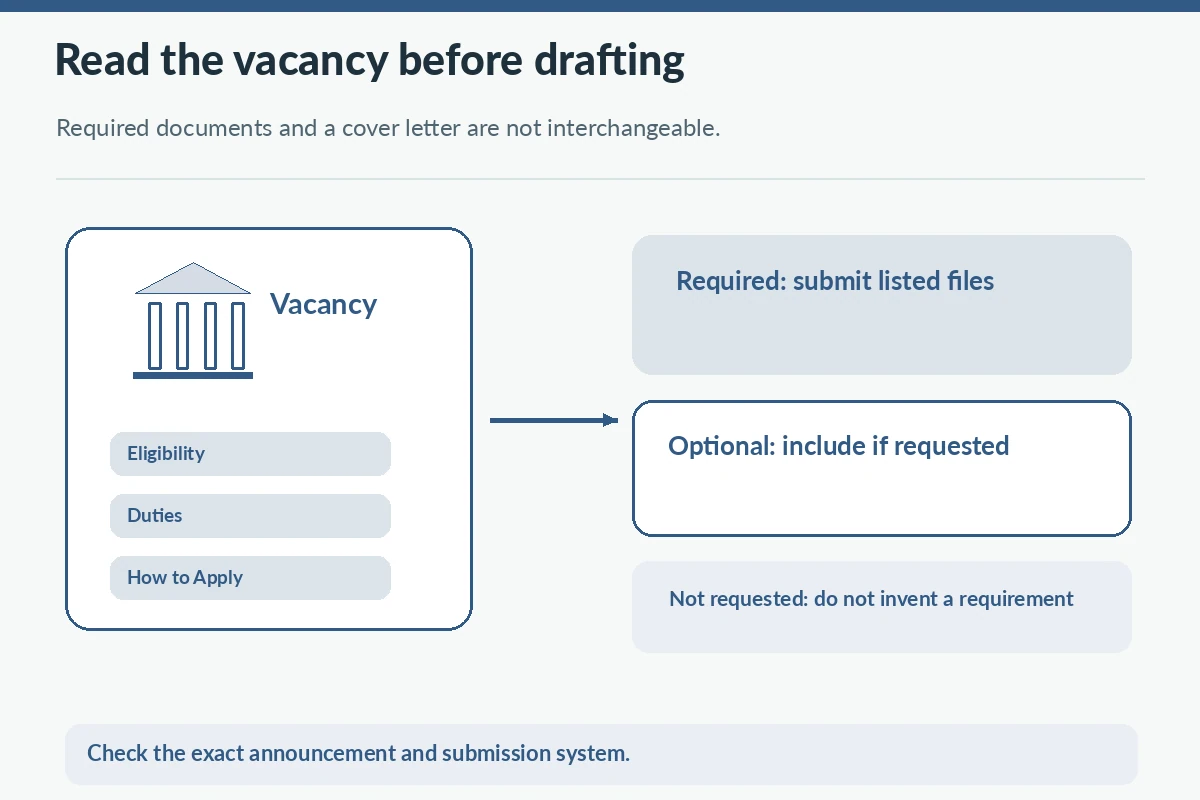
Open the current announcement and record the position title, series if given, grade, hiring path, closing date and required materials. Check the eligibility and qualifications areas separately. A letter may be encouraged, optional or absent; do not invent a mandatory cover-letter requirement for all Pathways jobs. If the announcement asks for a questionnaire or transcript, a narrative statement cannot replace it. Pay attention to document restrictions and the agency’s submission system so that the application is complete by the stated deadline.
USAJOBS’s student internship guidance tells applicants to list relevant courses, skills, projects and volunteer experience and to make those details match the duties in the posting. A statement such as ‘I am eligible for any federal internship because I study public policy’ is not reliable. Enrollment requirements, accepted education programs and additional qualifications are posting-specific. If you are unsure whether a course or experience counts, read the announcement and contact its designated agency office rather than guessing in your letter.
Translate academic work into the announcement language
A student who reviewed publicly available budget records in class might credibly describe organizing source files, checking calculations and explaining assumptions. That evidence could support an administrative or analytical duty, but it would not demonstrate that the student had authority to approve federal spending or perform official audits. Begin with a single selected qualification from the announcement, identify a matching task you actually performed, and describe what you checked and how the work was reviewed.
A useful sentence is: ‘In a policy-analysis course, I compared figures across two published datasets and documented differences before writing a short findings memo for faculty assessment.’ The evidence stays in its academic setting. Avoid generic claims about leadership, security clearances, systems access or federal experience you do not have. Make the reader’s work easier by using the actual duty words where accurate, without copying an entire requirements section or claiming automatic qualification.
Separate enrollment facts from career plans
Pathways opportunities are designed for eligible students in qualifying programs, but enrollment status alone does not answer every vacancy’s conditions. State your actual program and expected completion only if those facts are relevant and correct. Do not describe an unapproved transfer, intended school enrollment or future credential as already completed. If the job asks for proof of enrollment, the required document must be submitted through the authorized method rather than represented only in prose.
A letter may explain what you hope to learn about agency operations, but it should make an immediate contribution claim too. For instance, organizing an evidence log for a supervised class project can be relevant to records duties. Avoid promising conversion into a permanent federal position; conversion depends on program requirements, agency discretion and actual selection. Also avoid including personal identification numbers or sensitive documentation in a cover-letter body simply to prove that you qualify.
Use a short announcement-specific sample letter
Illustrative letter: Dear Internship Hiring Team, I am applying for the [Exact Position Title] internship listed under [Announcement Number]. The posting’s emphasis on documenting research and tracking assigned projects matches the work I completed in my public-administration coursework. In one class assignment, I maintained a source table for published agency reports, checked figures against the original files and wrote a summary identifying open questions for my instructor’s review.
I am currently enrolled in [Actual Program], and I would value the opportunity to support your office’s work within the responsibilities and training described in the announcement. I have used spreadsheets to compare publicly available information, but I have not worked in a federal system or approved official findings. I would bring careful documentation, a willingness to ask when instructions are unclear and attention to assigned deadlines. Thank you for considering my application. Sincerely, [Applicant]. Replace all bracketed terms and the project claim with verified information; this example is not an actual application.

Avoid mixing a federal résumé with a cover letter
The résumé should supply sufficient detail about qualifying experience, dates, duties and education as required by the vacancy. The cover letter, when requested, can select an example and explain why it relates to the agency’s work. Do not use a letter to repair missing required information on your résumé or to hide a conflict in dates. If the application asks for a different format or supplementary narrative, follow those directions before generic career-center advice.
If you have worked as a library assistant, for example, the résumé may document your dates, hours and actual inventory tasks. The letter might explain one difficult record-checking problem and how you sought review. Distinguish your contribution from the supervisor’s approval. Avoid repeating every duty in sentence form. The reader should gain a clear example, not a second abbreviated résumé or a speculative statement about federal hiring outcomes.
Verify the hiring path and agency-specific rules
Federal internships can be posted under different hiring paths and types of appointment. The USGS overview describes temporary and longer-running internship appointments and directs candidates to USAJOBS for postings. Do not assume the terms from one agency’s page apply to another. Check the announcement’s language about location, schedule, student status, documentation and whether the position is seasonal, part-time or full-time.
If a posting mentions citizenship, background requirements or other eligibility conditions, follow the exact wording and the agency contact process; a cover letter is not the place to speculate about waivers. Similarly, do not assert that an interview, referral or prior internship will lead to a job offer. Your goal is to show relevant evidence and submit a complete application, not to predict the hiring office’s determination. Check what is actually open before encouraging anyone to apply.
Check every identifier and attachment before submission
Confirm the announcement number, position title and agency office against the live posting. Generic salutations are acceptable if no contact is provided; never invent an officer’s name. Review the submitted résumé for dates, coursework and role titles that agree with the letter. Keep personal identity details to the fields and secure processes requested by the application system. If the letter file has a size or type limit, obey it, preview the rendered file and confirm it is readable.
A well-written optional letter cannot correct an application submitted after the deadline or with missing documents. USAJOBS advises allowing enough time for assessments and separate uploads. Save a private checklist of completed application steps and confirmation messages. If a question appears about how to attach a document, use official help channels. Do not send sensitive identity documents to an unsolicited recruiting email because it includes an agency logo.
End with accuracy rather than a promise of selection
The final paragraph can restate a genuine interest in the agency’s work and the precise experience you hope to contribute. It should not claim that enrollment guarantees eligibility, that the agency will provide a clearance or that internship completion automatically converts to a permanent role. Treat a letter as one small part of a defined federal application package. It is persuasive when it is consistent with the résumé and responsive to a real duty.
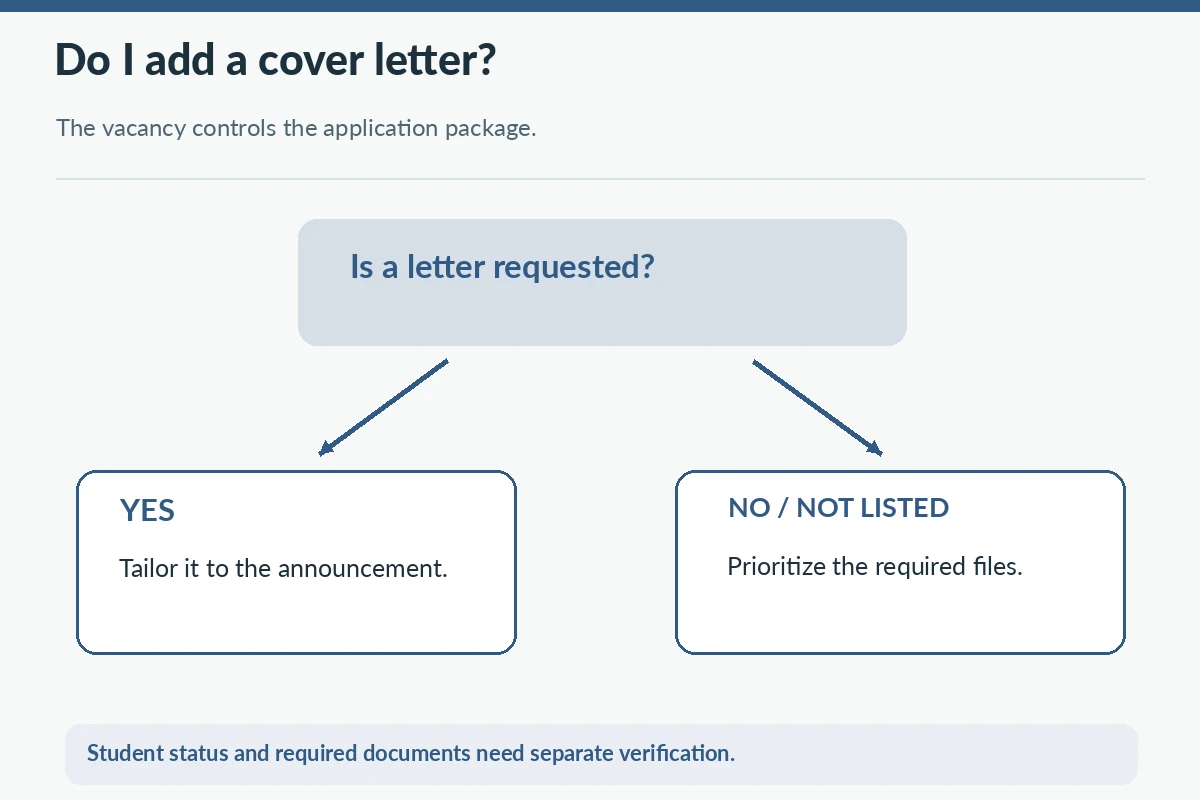
Compare your finished version with the agency posting one last time. Remove agency-specific statements copied from other applications. An applicant who can connect a modest, well-documented class project to a clear posting is easier to assess than one promising authority they have not earned. When the posting does not request a cover letter, invest that time in providing the exact required documents and responses instead of uploading extras that may not be reviewed.
| Area | Useful evidence | What not to imply |
|---|---|---|
| Eligibility | Read exact vacancy criteria | Letter cannot establish eligibility |
| Experience | Coursework and actual project tasks | No invented federal authority |
| Submission | All named forms and uploads | Letter does not replace documents |
How We Research Internship Cover Letters
We compared general career-center cover-letter guidance with role-specific institutional internship materials and the JobAsk topic inventory. We reviewed the sources listed below on 2026-11-05. Job and program descriptions illustrate tasks, not guaranteed current openings or universal eligibility. All sample letters and candidate histories in this guide are hypothetical. Follow the current official posting and protect sensitive records. For affiliations and funding transparency, see our affiliate disclosure.
Sources checked: USAJOBS — USAJOBS federal internship FAQs describe student eligibility, vacancy-specific requirements and required application steps.; USGS — USGS explains Pathways appointment variations and directs students to USAJOBS announcements.; University of Washington Career & Internship Center — University of Washington career services recommends matching a specific role to concrete experience.. Verify the latest instructions for the exact internship you are considering.
More Resume and Cover Letter Guides
No. Check the individual USAJOBS announcement and its How to Apply section; the required documents vary.
Yes, when a course project genuinely demonstrates duties or knowledge from the posting. State the academic setting and your actual contribution.
No. Pathways eligibility and vacancy qualifications must be checked against the specific posting and official rules.
No. Submit required identity or eligibility records only through the official secure process specified by the agency.
No. Potential conversion depends on program rules, agency decisions, qualifications and other requirements.