
A data science internship cover letter is strongest when it explains one complete student analysis, not a list of programming libraries. Show where the data came from, how you cleaned it, how you evaluated a result, and what the result does not prove. That is useful even if your experience is limited to assignments or independent projects. Employers can ask about your reasoning; they cannot verify a claim such as ‘advanced machine learning expert’ without evidence. Build a concise narrative around a reproducible decision and a role-specific reason for applying. Treat every writing sample in this guide as hypothetical, not a claim about your own experience. Start with the requirements on the actual internship posting, the permitted application format, and your truthful contribution to a relevant class, club, or independent project. A cover letter complements a resume: it selects one defensible example and connects that example to a task, rather than repeating every course or job title. If the employer does not request a letter and the portal has no place for one, follow the instructions rather than adding unsolicited files.
Read the specific internship tasks before selecting evidence
Start by separating a posting’s actual work into data preparation, exploratory analysis, dashboard production, model evaluation, and communication. A research-oriented intern may document data quality and methods; a product analytics intern may summarize metrics for a team. Do not assume every ‘data science’ internship involves training large models. Match one student project to the most central task. If the role requests SQL, Python or statistics, identify a concrete operation you performed rather than copying the technology list wholesale.
Check whether the organization describes supervised experiments, reporting, forecasting, or data infrastructure. The same notebook may be relevant in different ways: a data-quality team values missing-value checks, while an analytics team values careful definition of the outcome measure. Avoid a promise that your model will improve revenue or patient outcomes without an actual supported result. A useful sentence identifies a task the posting mentions and the specific evidence you can discuss.
Choose one credible project and preserve the review boundary
Choose a project where the data source and limitations can be named. For example, a hypothetical class project might analyze a public transportation dataset. Explain that you inspected duplicate records, handled missing fields, and documented which rows were excluded. If you joined tables, say what keys you validated. If you used a sample, state the sampling limit. These are stronger applicant signals than a screenshot showing a single accuracy score without data context.
Describe evaluation without claiming that a high score proves deployment readiness. You may have compared a simple baseline with a more complex method, reserved a test set, or checked for a coding error. Explain the validation procedure you genuinely performed and its limits; do not claim to have eliminated all bias or prevented every form of leakage. The BLS occupational profile describes data scientists as analyzing information and presenting findings; interns can demonstrate the discipline through reviewed classroom work.

Write a targeted opening and a complete example
A hypothetical opening: ‘I am applying to the [data science internship] because your team emphasizes reliable reporting and evaluation. In a course project using a public dataset, I cleaned inconsistent records and compared a baseline analysis with a revised method. I documented the data exclusions and presented results with clear caveats.’ Replace the public dataset, activity and team description with real details. If the project did not include a model, avoid adding one to sound impressive.
Hypothetical excerpt: ‘Hello [Hiring Team], I would like to contribute to [team’s documented work] as a data science intern. In [class or personal project], I used [tools genuinely used] to validate joins, inspect missing values, and prepare a reproducible analysis of [question]. I compared the output with [manual check, simple baseline, or instructor feedback] and noted [limitation]. My attached resume and optional authorized portfolio link provide more context. I am eager to learn your review process. Thank you, [Name].’
A good application letter usually needs only a focused opening, one evidence paragraph, a clear statement of fit, and a polite close. The example above is deliberately hypothetical; bracketed fields are not facts. Replace each with your own course, team, tool, artifact, and actual result. If there is no named hiring manager, a professional team greeting is appropriate. Avoid making up the organization’s mission or personalizing the letter with details you cannot verify. Have someone read it without the job posting: they should still understand what you did and why that work relates to the internship.
| Letter section | What to include | What to avoid |
|---|---|---|
| Opening | Exact internship and relevant team task | Generic enthusiasm without a match |
| Evidence | One student artifact, own contribution, check | Inflated job title or invented result |
| Fit | Why that evidence suits the real posting | Copying the employer description |
| Close | Interest in supervised learning and thanks | Guaranteed outcome or demanded reply |
Keep professional authority and outcomes accurately described
Never share personal records, employer data extracts, secret tokens, or a notebook that contains credentials. Strip identifying details only when you are authorized to use the work at all; anonymization alone does not give you permission. Avoid saying you deployed a production pipeline when you ran code locally. Likewise, distinguish exploratory correlations from causal findings. When a metric appears in the letter, define what it measures, the dataset scope and who reviewed it if those details are material.
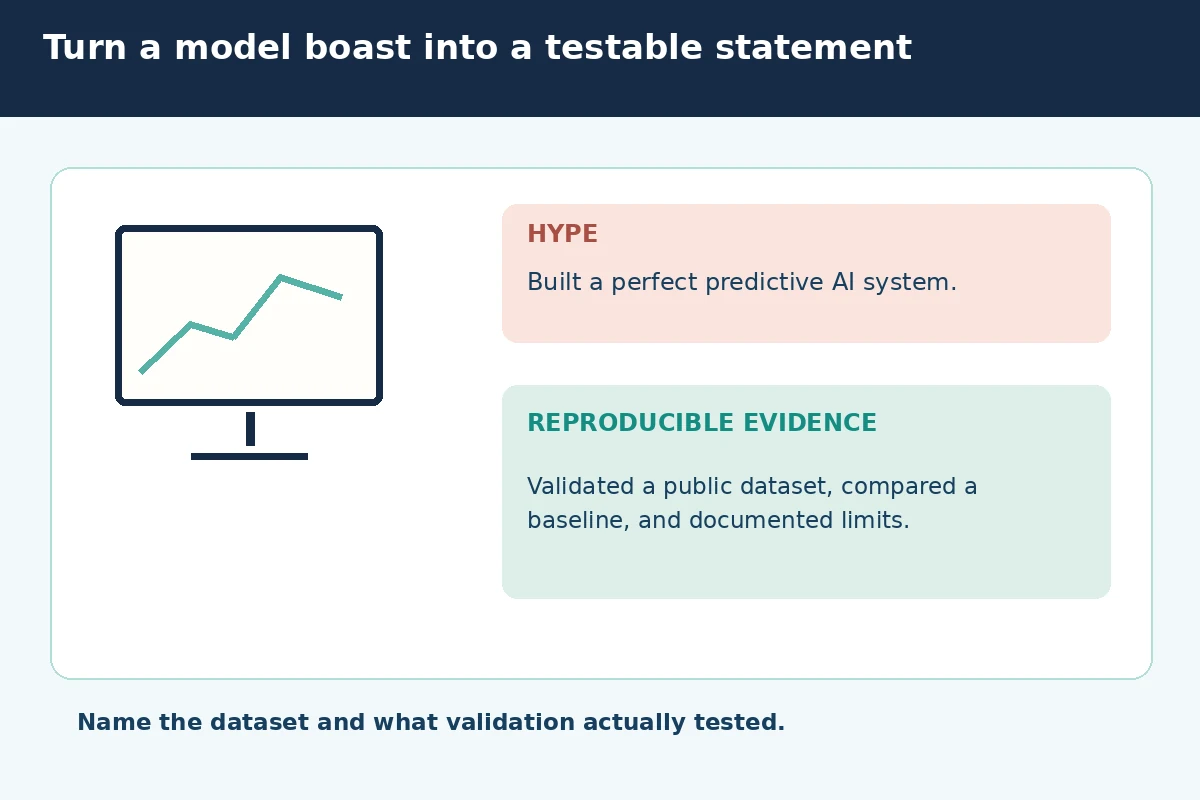
Weak copy says ‘I mastered AI and built a 99 percent accurate system.’ That statement hides the metric, validation split, class balance, and possible leakage. Better copy might say ‘I compared a simple baseline with a course model and documented why the result did not generalize to a different sample.’ The second sentence is useful because it supports a conversation about judgment. Another error is treating a dashboard as evidence of source reliability when its underlying rows were never checked.
Check the portfolio and application attachments before sharing
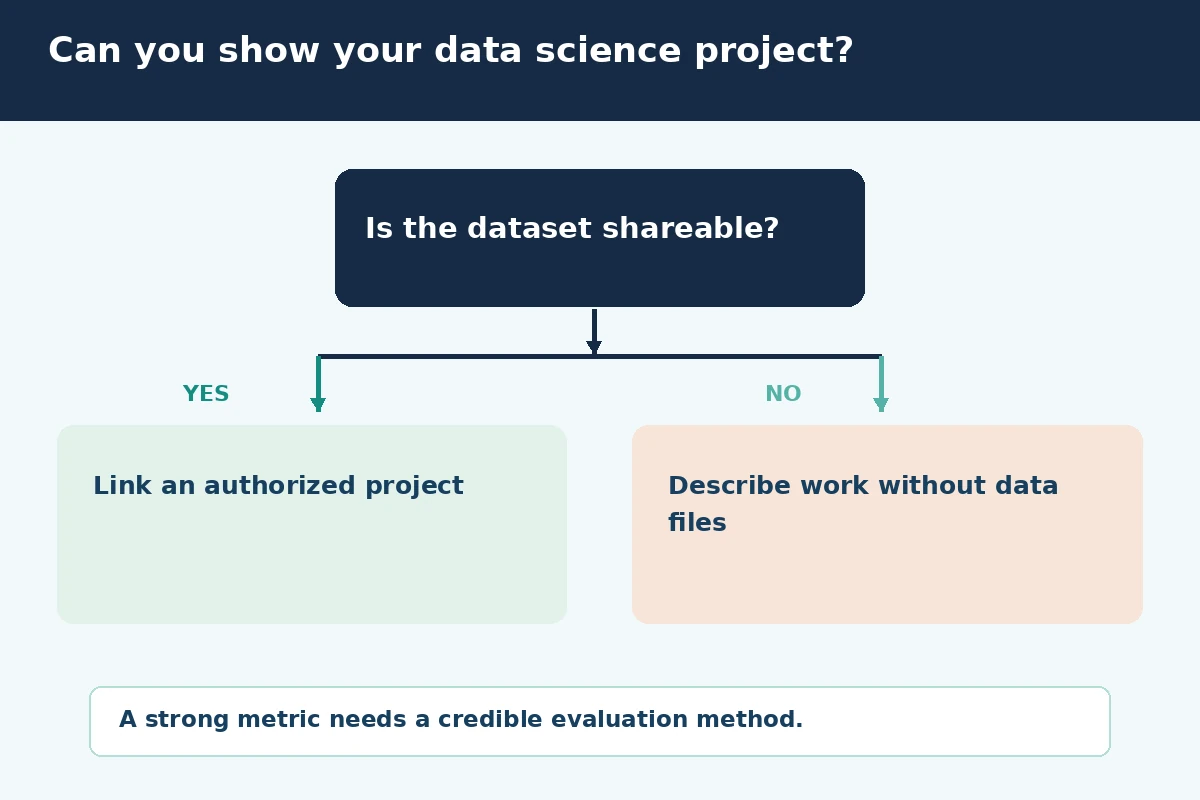
If you link a code repository, check that it contains a readme, source attribution, reproducible steps, and no secrets. A short project summary should explain the question, data scope, cleaning decision, result and limitation without demanding that a reviewer execute the code. Do not attach a full dataset unless redistribution is allowed. If an employer requests no portfolio, respect the application procedure. Your cover letter should stand independently of the link and make the relevance clear in one sentence.
Separate evidence you own from work you merely saw or helped with. If a school assignment was collaborative, name the part you wrote, drew, analyzed, or coordinated. A working public link is not proof that a work sample may be redistributed: permissions, ownership, privacy and the employer’s portal instructions still apply. Avoid unnecessary personal details, private participant information, and invented logos. When an application asks for a specific file type or document order, prioritize its explicit requirement over general internet templates.
Adapt the evidence for different teams and internship formats
For a business intelligence posting, emphasize metric definitions and communication. For a research-data posting, emphasize provenance, reproducibility and ethical handling. For a predictive modeling posting, mention actual validation steps and why the baseline matters. Do not relabel a basic spreadsheet chart as deep learning. Different teams value different evidence, but all benefit from an applicant who can identify uncertainty and distinguish personal work from a group notebook.
A paid summer position, an academic-credit placement, and an independent internship can have different eligibility and scheduling requirements. Check the actual notice for student status, start date, worksite, expected hours, portfolio rules, and whether a university approval is needed. Do not write that a role awards academic credit, training hours, or professional credentials unless your school or governing body confirms the particular program. Those administrative terms belong in verified application details, not in an invented promise.
Make a final accuracy check before submission
After drafting, audit every technical verb: built, trained, evaluated, deployed, monitored, and approved each describe different work. Replace verbs that exceed your actual contribution. Make sure the tools in the letter match your resume and links; verify that sample code still opens. Keep jargon low enough that a recruiting coordinator can understand the value of the project. A compelling closing asks to discuss the team’s work, not to be trusted with private production systems immediately.
Do one final pass for a mismatch between your claim and your evidence. A person interviewing you should be able to ask, “Which part was yours?” and receive a direct answer. Remove needless statistics, generic software lists, references to employer projects you have not verified, and unsupported claims about being “certified.” Test a PDF export for legibility and working links. Save the final version with a clear filename, then follow the application portal’s acknowledgement process. A polished letter may improve clarity, but it does not guarantee an interview or placement.
How We Research and Check Internship Cover Letter Advice
We checked the following primary professional and career-education sources on November 16, 2026: Data scientists collect and analyze information, build and test models, visualize findings and explain results to stakeholders.. CareerOneStop explains when a cover letter is useful and how to connect skills to a specific employer need.. NACE career readiness competencies include communication, critical thinking, professionalism and technology.. We compared this subject with the supplied JobAsk WordPress list of both published posts and drafts, recent local JobAsk production batches, the original READY candidate set, and public search results. Those checks flag likely duplicate intents but cannot establish that an unlisted unpublished WordPress slug is available. Every email and example in this article is hypothetical: replace placeholders with documented personal experience and obey the specific organization’s submission rules. We do not claim that a letter produces a particular hiring result or that a portfolio meets every employer requirement. There is no paid product recommendation or confirmed affiliate promotion in this guide. Read the affiliate disclosure.
More Resume and Cover Letter Guides
It can be, if it is relevant and you can explain the data source, your steps, a check, and a meaningful limitation.
Only if you can explain the metric and evaluation setup. A number without split, baseline or context may mislead readers.
Do not share employer data or access credentials without authorization. Use permitted public or synthetic materials for an example.
Describe concrete joins, validation checks, definitions and analysis; do not pretend experience with models or tools you have not used.
No universal cover-letter rule requires one. Follow the posting and use a permitted portfolio only when it improves the application.