
Preparing for an executive assistant interview means showing how you protect a leader’s time without pretending that you make every decision for them. Bring examples of scheduling trade-offs, information triage, travel changes, and discreet communication. Be ready to explain what you handled independently, what required approval, and what you recorded for the next person. A clear and accurate priority story demonstrates more than claiming to be “highly organized.”
Read the role as an operating system, not a job title
Compare the actual posting with the leader’s environment: one executive or several, board meetings, travel, vendor coordination, expenses, document preparation, and access to confidential correspondence. The BLS administrative assistant profile notes that executive assistants often handle complex documents, research, and high-level support; it also describes experience expectations. Do not assume every executive assistant position has the same authority to commit funds or release information.
Build a map of five tasks you can verify. For scheduling, name the calendar platform you used. For travel, distinguish booking from approval. For reports, describe what you drafted versus what an executive signed. If you supported a project as a class assignment or a temporary cover arrangement, identify that context instead of implying a permanent executive-support title.
Prepare a calendar collision case
Practice this prompt: “Two important meetings overlap and one participant cannot reschedule.” State how you would check the meeting purpose, participants, deadlines, time zones, buffers, and decision owner. Offer workable options with consequences; seek confirmation before moving a high-stakes commitment. An executive assistant can make thoughtful proposals without inventing a universal rule that one meeting is always more important.
In an illustrative case, a board briefing conflicts with a client call. Explain that you would verify constraints, propose alternate participation or coverage, and confirm the authorized choice. Record the agreed change and notify affected people discreetly. A good answer does not expose confidential calendar subjects, copy private invitations, or claim you overruled a leader without consent.

Show how you handle an urgent change without losing records
Travel cancellations, room changes, delayed visitors, and last-minute agenda edits test communication as much as planning. Describe how you confirm which detail changed, who must be notified, what costs or deadlines matter, and what record will serve as the new source of truth. Prioritize safety and official booking conditions over an invented assumption that the cheapest option is always best.
Prepare one truthful example of a plan that changed. Use “I verified the revised flight and sent the updated itinerary” only if you actually did so. If someone else approved the expense, name that approval step. The interviewer should hear that you can restore clarity after a disruption, not that you can waive policy or financial controls.
Explain judgment in confidential communications
An interviewer may ask, “A colleague wants to know why the executive is absent—what do you say?” Practice confirming what is shareable, providing only the necessary scheduling update, and routing sensitive inquiries to an authorized person. Confidentiality includes staff information, strategy documents, interview schedules, and financial details. You do not have to reveal a real incident or quote a private email to prove that you understand discretion.
A strong example is: “I acknowledged the scheduling change, gave the next available contact, and did not disclose the private reason.” If there is an emergency, follow the organization’s designated process. Avoid implying you can conceal required safety reporting, override records-retention rules, or make legal decisions from the assistant role.
Prepare prioritization and escalation answers
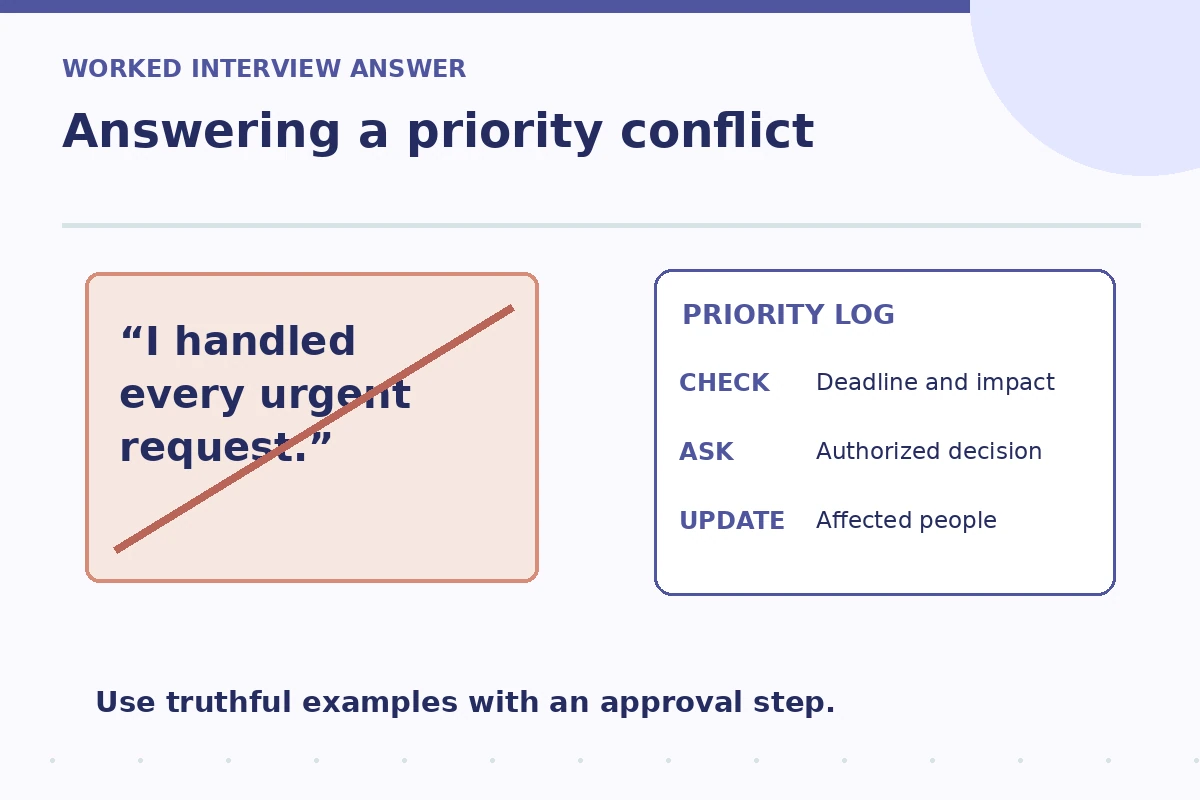
Use a simple triage method for incoming requests: time-sensitive decision, routine scheduling, awaiting information, and needs authorization. Explain how you keep a tracker that shows owner and next step without exposing details to people who lack access. State how you would respond when two senior stakeholders both describe their request as urgent. Clarifying the impact and requesting a decision is stronger than guessing at hierarchy.
In a fictional example, a visitor arrival needs immediate help while a routine expense report is waiting. You can arrange authorized reception coverage, send a status update, and return to the expense review. This illustrates priority reasoning; it does not prove that every organization handles security, visitors, or reimbursement in the same way.
Practice succinct answers with accurate ownership
Rehearse a 90-second example for scheduling, a 60-second example for discretion, and a short “tell me about yourself” linking your actual experience to the role. Use a sequence of situation, your action, confirmation, and what changed. The Harvard interviewing guidance encourages practice and research rather than memorized performance. Time the answers to discover where your descriptions become vague.
Avoid “I managed the company calendar” when you scheduled meetings for one team, or “I approved travel budgets” when you compiled options for a manager. Identify the leader, team, and workstream only at the level you may publicly disclose. A specific modest example often creates more trust than a dramatic but uncheckable story.

Ask questions about the leader’s working style
Ask which decisions can be handled directly, which must be approved, how priorities arrive, and who covers the desk when you are unavailable. You can also ask what good performance looks like in the first months and what access controls the organization uses. These are legitimate role-fit questions; they do not require the interviewer to reveal executive secrets.
Before the interview, review a redacted personal sample calendar or blank itinerary template, verify the meeting link or location, and prepare notes without confidential data. Practice explaining how you would raise an error promptly and correct the record. You are demonstrating dependable support, not promising to prevent every scheduling conflict.
How We Research Interview Preparation
We reviewed current career-center interview preparation guidance alongside occupational or professional descriptions relevant to this role. Sources: careerservices.fas.harvard.edu — Researching the employer, rehearsing responses, and preparing questions are core interview habits. bls.gov — BLS describes executive administrative duties, documentation, and scheduling tasks. careerservices.fas.harvard.edu — Harvard explains interview expectations, truthful qualifications, role interest, and informed questions. Examples in this article are illustrative unless explicitly described as real occupational guidance. No invented employer interview requirements, outcome metrics, or approvals should be inferred from these examples.
This guide is independent editorial advice. It is not endorsed by any employer and does not promise hiring results. For the website’s policy, see our affiliate disclosure. Always follow the actual hiring invitation and keep private workplace and customer information out of interview demonstrations.
More Interview Preparation Guides
No. Bring an approved, anonymized or fictional sample that demonstrates how you reason about priorities without revealing confidential appointments.
Identify time constraints and decision owners, offer alternatives with consequences, and confirm changes before acting outside your authority.
Responsibilities vary by employer. Explain what you prepared and which approvals your real role allowed, without claiming universal authority.
Use verified administrative, scheduling and communication work, and describe the scope accurately rather than adopting a senior title.
Ask about decision boundaries, calendar ownership, escalation routines, coverage arrangements and what effective support looks like.