
Graphic designer tell me about yourself is best answered with an accurate snapshot of your relevant work, one task you can explain and a reason for pursuing this particular role. Lead with a real example, not a copied personal biography. The interviewer needs to understand what you actually did, what you checked, and which decisions belonged to someone else. The examples below are illustrative and must be replaced with your own truthful experience.
Make the introduction a short portfolio doorway
A graphic designer introduction works best when it previews a concrete way you solve a communication problem. Do not lead with a list of every design application you have opened. State the type of work you actually do, the brief or audience you worked with, one decision you made, and why this opportunity is relevant. The interviewer should know which portfolio case to ask about next. The final answer should be understandable to a creative director and a non-designer hiring partner.
The role may involve brand layouts, editorial production, marketing assets, packaging or interfaces. The employer’s actual requirements determine which examples matter. O*NET lists designing graphics, selecting typography and layouts, and reviewing designs. It does not mean every graphic designer directs strategy, owns brand policy or codes products. Match the opening to the advertised job and be precise about whether you created, adapted or prepared the final asset.
Choose the project that reveals your own decisions
Pick a portfolio item with a clear brief, a real constraint and an identifiable contribution. A good opening might mention that a flyer had to be readable at a distance, that a catalog layout had a strict print specification, or that an email graphic needed a mobile version. One small design decision—reducing visual clutter, adjusting type hierarchy, rebuilding an accessible contrast pair—often tells more than a vague “I love being creative.”
Ask what you may disclose before featuring client work. Some projects belong to an employer, include licensed images, or remain under embargo. If you can only show your own practice project, call it a practice project. If a group designed the campaign, describe which sketches, production layouts or revisions you handled. Naming team members’ contributions is professional and prevents an interviewer from mistaking a shared case for solo authorship.

A sample answer that connects brief and evidence
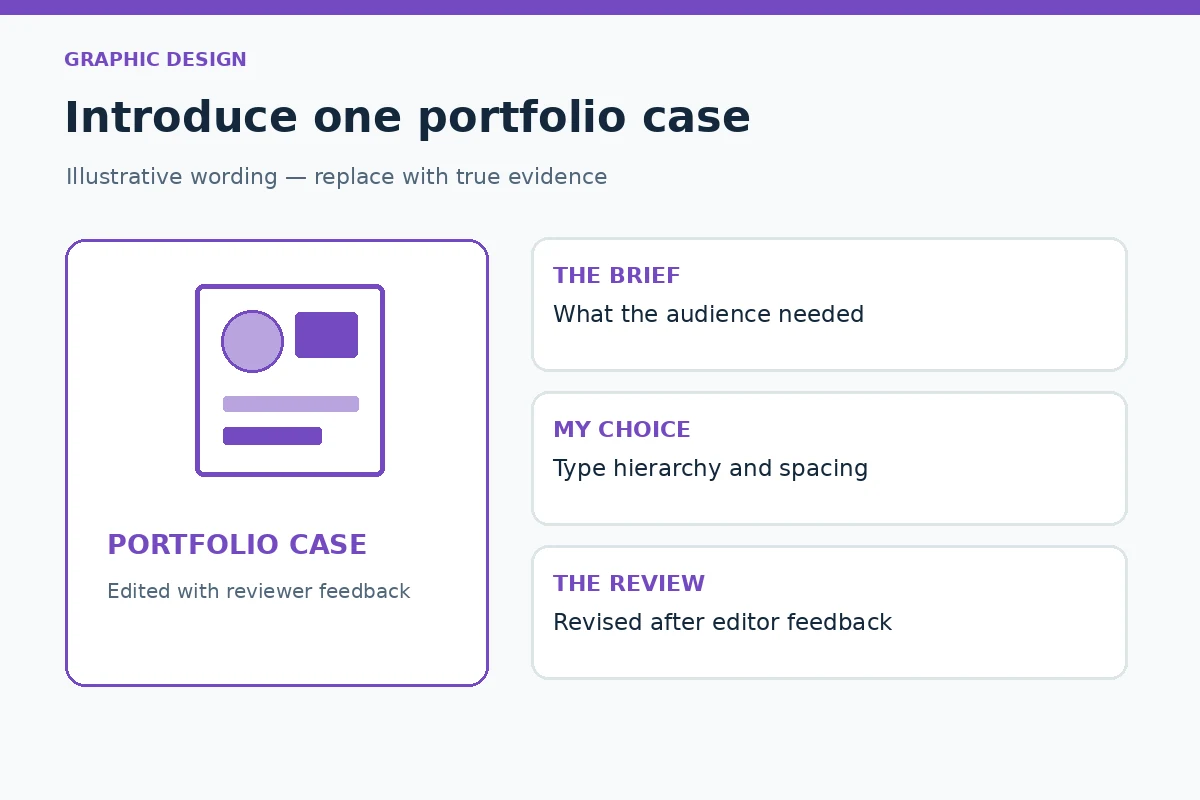
Illustrative sample, adapt only with true details: “I focus on making information easy to understand through layout and type. In a student publication project I took the agreed content and created a page hierarchy for readers who needed to scan event dates quickly. I tested the first version with the editor, revised the headings after feedback, and prepared the final layout for review. I’m interested in this role because your team works on multi-format design that needs the same careful iteration.”
This answer does not claim the sample was a paid client assignment or that it increased conversions. If your experience was on paid client work, use the client context you are permitted to disclose. When discussing an outcome, favor an observed approval, a completed deliverable or specific change made after review. Avoid saying “the design went viral,” “I owned the brand,” or “I drove sales” unless you have credible evidence and the attribution is yours.
Discuss critique without sounding defensive
Design interviews often explore how you respond when your preferred solution does not meet the brief. Include feedback as a normal part of your process: you presented a mockup, heard a concern, checked it against the audience need, and revised or tested another version. The introduction need not narrate a conflict, but it can show you distinguish personal taste from design requirements. That makes a portfolio conversation more useful than reciting favorite fonts.
Be clear about decision rights. You might have recommended a new layout or prepared options while an art director or client approved the final choice. State that boundary. If a reviewer asked for a change that affected accessibility or production accuracy, explain how you raised the concern and offered a documented alternative. Do not imply that you ignored the approved brand system because your idea was more creative.
Tailor the answer to the design role
For a production designer role, emphasize file organization, version control, specifications and reliable handoffs. For a marketing design position, connect campaign deliverables to target audiences without borrowing a marketing team’s performance metrics. For editorial work, discuss typographic hierarchy and corrections. For a junior role, an independent assignment or class project can support the answer if the setting is named honestly. A senior role may require scope across briefs and collaborators.
Check the job posting for format expectations: portfolio URL, PDF, case study, motion examples or design systems. Do not assume every company wants an interactive website. You can finish your opening with an invitation like “I can show you the two iterations and explain what changed after review.” That offers a specific conversation rather than a generic claim of creativity.
Protect assets and credits during the interview
When preparing to screen-share, remove client credentials, hidden notes, unused pages and private comments. Make sure the file opens with appropriate permissions. If the project contains stock assets or photographs, do not describe yourself as the sole creator of those elements. Your contribution might be composition, typography or adaptation, and that is worth describing clearly. A respectful credit note can help the interviewer trust the rest of the case.
Separate internal proposals from approved deliverables. A concept that was not launched can still illustrate design reasoning, but it is not evidence of a published campaign. If a reviewer asks about results, explain which outcomes you personally observed and which you cannot verify. The difference between “proposed,” “reviewed,” and “shipped” belongs in an honest introduction, especially when you are new to the profession.
Rehearse a clear opening and a visual follow-up
Practice the first minute without scrolling through your entire portfolio. Give a concise context, one design choice and a reason the employer’s work interests you. Then locate the artifact you want to show: a brief excerpt, early layout or before-and-after revision. Use natural, precise language rather than dense creative jargon. If the interviewer is from operations or recruiting, explain why the design decision mattered for the user.
After rehearsing, ask yourself what you would do if the portfolio link failed. Have an authorized local copy or a text explanation of the same project. The strongest introduction lets someone understand your contribution even without the screen. Close with the work you hope to do next, not an unverifiable promise that your creative style will deliver a particular business result.

How We Research Job Interview Introductions
We checked O*NET graphic designers profile for occupation-specific responsibilities and CareerOneStop’s interview preparation guidance for researching employers and practicing honest examples. We also consulted U.S. OPM structured-interview guidance to distinguish the situation, individual action, and result in a follow-up answer. These sources do not authorize particular workplace actions or verify a candidate’s history; employer processes vary.
All sample introductions and scenarios on this page are illustrative, not actual applicant statements or hiring guarantees. The sources are paraphrased and cannot certify a particular organization’s process. Review the affiliate disclosure for the site’s general policy; no employer endorsement, paid placement, or affiliate relationship is assumed here.
More Interview Preparation Guides
Yes. Name it as coursework or student work and explain the brief, your decisions, and feedback without implying a paying client.
Choose only tools relevant to the job and the example. The interviewer can explore the full software list later.
Only if you have permission. Use a public, redacted, or independently created case when confidentiality applies.
Describe the team context, identify your exact deliverables, and credit the roles of others.
No. Describe a verifiable revision, approval, or completed artifact. Do not invent engagement or sales metrics.