
Hotel manager interview preparation should connect guest experience to room readiness, staffing, handoffs, and business controls. Practice one guest complaint, one cross-team scheduling problem, and one example of checking facts before making a promise. A front-desk employee interviewing for a management role can show relevant initiative without claiming final authority for rates, compensation, staffing, or safety decisions. The strongest answers show who acted, how the situation was documented, and what the guest was told.
Identify the property and management level
Study the job posting for the property size, service level, shift requirements, and whether the role supervises front desk, housekeeping, maintenance, food service, or multiple departments. The BLS lodging manager profile distinguishes front-desk and general management tasks and notes that schedules may include evenings and weekends. A small property’s manager may perform hands-on tasks that a large hotel allocates among departments.
Prepare examples matched to the real scope. If you handled reservations but never set rates, say so. If you prepared shift reports but a supervisor approved expenditures, identify that boundary. Ask for clarification when a vacancy uses “manager” but describes mainly independent night-shift coverage.
Practice the room-not-ready guest scenario
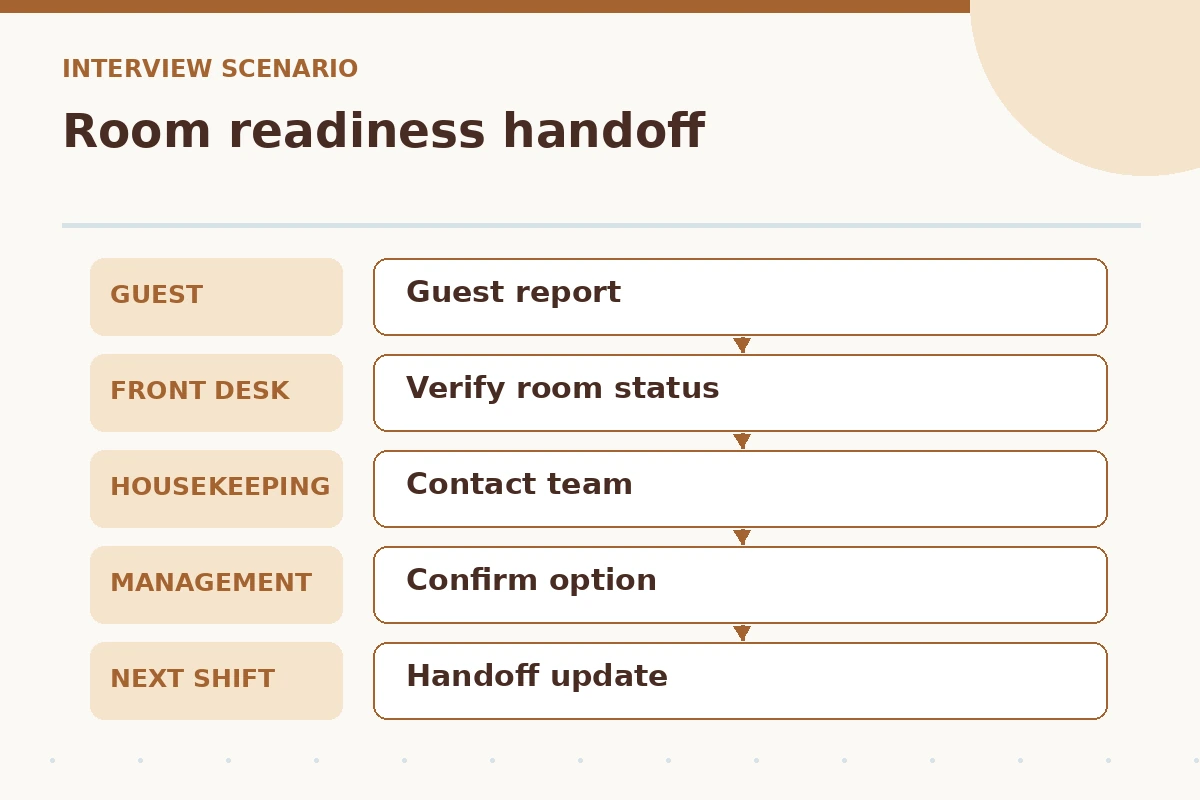
A likely question is: “A guest arrives and the promised room is not ready. What do you do?” Begin by verifying the reservation and current room status in the approved system. Coordinate with the appropriate housekeeping or front-desk lead, explain the situation without blaming a colleague, and offer available alternatives that the property permits. Do not assign another occupied room or guarantee compensation before checking the rules.
A hypothetical response might describe verifying the estimated readiness, arranging luggage storage if offered, and sending an agreed update. Distinguish what you can decide from exceptions requiring management approval. That sequence demonstrates calm service and operational awareness rather than an unrealistic promise to fix every issue immediately.
Prepare a cross-department handoff example
Hotels depend on accurate information moving between the front desk, housekeeping, maintenance, and sometimes security. Prepare an example where a maintenance concern affected room availability. Explain what fact you confirmed, who received the issue, how the room status was updated, and how a guest-facing employee knew what to say. Never invent an engineering repair action or claim to clear a safety issue without an authorized check.
If a guest reports an environmental or security hazard, follow the property’s emergency procedures and notify designated staff. In an ordinary service delay, focus on a traceable owner and next update. Avoid showing private guest records, room numbers, or employee performance files in an interview sample.
Discuss staffing and shift prioritization accurately
Interviewers may ask about high check-in volume with fewer employees than expected. Prioritize safe coverage and basic guest communication, verify who is on duty and cross-trained, and ask an authorized manager about overtime or schedule changes. A shift plan should never assume you can bypass labor rules, pressure an untrained worker into a restricted task, or leave essential coverage unattended.
Rehearse one real episode where you communicated queue status, supported a colleague, or escalated a staffing shortfall. If you were not the supervisor, describe your contribution rather than saying you “managed labor costs.” A concise role-accurate story can demonstrate leadership potential.
Show how you handle guest complaints and service recovery
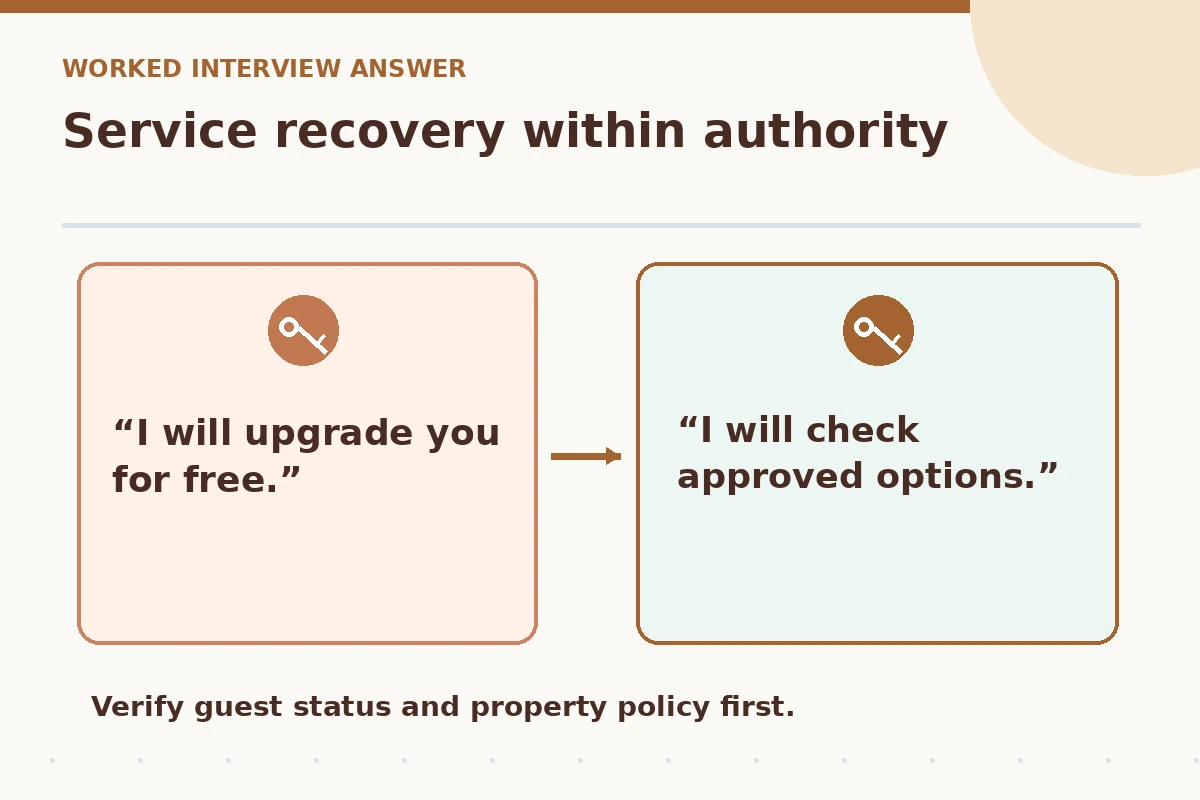
Practice listening, summarizing the concern, checking records, identifying available remedies, and following up. Do not debate a guest about an unverified charge or promise to waive a fee when you have no authority. Describe how you would document the issue for later shifts, avoiding unnecessary personal details. The interviewer should understand both how you treat a frustrated person and how you protect consistent procedures.
A useful fictional case is a noisy-room complaint after midnight. You would verify what can be checked safely, contact the authorized team, and explain the next step. The outcome may still be pending when your shift ends. Your handoff must convey the open issue and responsibility rather than pretending the complaint vanished.
Prepare an operational evidence story
Pick a genuine example involving readiness checks, reservations, billing reconciliation, guest wait times, or shift notes. Explain the starting situation, the check you performed, who made the decision, and what you observed afterward. If you lack verified numbers, describe the changed process rather than inventing a satisfaction percentage. The Harvard interviewing guide recommends targeted examples and questions rather than generic rehearsed claims.
Practice explaining the example to both an operations manager and a service-focused interviewer. The first may ask about logs and escalation; the second may ask what the guest heard. If your story omits one side, revise it until the sequence makes sense without disclosing confidential records.

Ask about service standards and decision rights
Ask which departments report to the role, what issues require a general manager, who can authorize service recovery, and how maintenance-related room holds are handled. Inquire how staff are trained for peak periods and how shift handoffs are evaluated. These questions demonstrate interest in realistic operations, not a promise to do work outside your training.
Before the interview, check the property brand and service model, plan your route or video setup, and prepare a short list of genuine achievements. Do not pretend you know a particular property’s occupancy, rates, or complaint policy without a source. Confirm what is publicly documented and ask when a process remains unclear.
How We Research Interview Preparation
We reviewed current career-center interview preparation guidance alongside occupational or professional descriptions relevant to this role. Sources: careerservices.fas.harvard.edu — Researching the employer, rehearsing responses, and preparing questions are core interview habits. bls.gov — BLS identifies guest service, room readiness, staffing, and departmental coordination. careerservices.fas.harvard.edu — Harvard explains interview expectations, truthful qualifications, role interest, and informed questions. Examples in this article are illustrative unless explicitly described as real occupational guidance. No invented employer interview requirements, outcome metrics, or approvals should be inferred from these examples.
This guide is independent editorial advice. It is not endorsed by any employer and does not promise hiring results. For the website’s policy, see our affiliate disclosure. Always follow the actual hiring invitation and keep private workplace and customer information out of interview demonstrations.
More Interview Preparation Guides
Listen, verify the relevant facts, identify a permitted remedy or escalation owner, communicate the next step and document the handoff.
Yes, where requirements permit. Describe actual front-desk and coordination experience without claiming final management authority you did not hold.
No. Remedies and rate exceptions depend on property policies and your assigned authority.
Choose genuine examples involving room readiness, reservations, cross-team communication, billing checks or shift reporting.
Ask which departments you oversee, who approves service recovery and staffing changes, and how night or weekend coverage works.