
A final interview with a department director may focus on how your work supports team priorities, how you understand responsibility and whether you can learn the organization’s constraints. That does not mean the director expects an entry-level applicant to claim strategic authority. A coordinator can speak clearly about accurate records, reliable handoffs and service outcomes without pretending to set policy. A senior candidate may discuss larger scope, but still needs credible evidence.
Expect a different level of conversation, not a different set of facts
Find out who you will meet and whether the conversation includes others. Review the job posting and your prior interviews, then identify the two or three responsibilities that appear most important. Prepare an honest example for each. Do not assume that meeting a director guarantees an offer or implies a particular level of compensation.
Connect a team objective to a specific contribution
Directors often care about outcomes beyond one task, but your answer should stay anchored in what you controlled. A department might want fewer missed handoffs, accurate reports or consistent service. You may contribute through record checks, follow-up notes, documented exceptions or approved communication. Describe the connection without claiming that one activity single-handedly produced the entire department result.
An illustrative example is: “The team needed complete monthly exception notes before its review meeting. I checked required fields, sent missing items back to their owners and prepared the consolidated list for the supervisor who made the final decision.” This explains why your work mattered and makes the approval boundary explicit. If the outcome was not measured, do not invent an improvement percentage.
Prepare one judgment example with a clear escalation path
A director may ask how you would handle competing requests or unclear ownership. Begin with facts and consequences, then identify who can decide. For instance, a safety-related issue or privacy incident should not be treated as a routine preference to settle independently. Refer to the employer’s documented procedures if they are provided; otherwise say you would escalate through the responsible supervisor or designated team.
The point is not to claim that you would resolve every conflict personally. It is to show that you recognize the difference between collecting information, recommending a course of action and authorizing it. Those boundaries differ across organizations and roles. Ask for clarification rather than inventing a chain of command.

Talk about your first weeks as discovery and responsible delivery
If asked what you would do first, outline a learning plan: understand the core services, meet people who own dependent tasks, review approved procedures, observe the normal reporting rhythm and take on appropriately scoped work. Then describe one early deliverable you could complete after expectations are clarified. Avoid guaranteeing that you will overhaul systems or cut costs without access to evidence.
For example, a new operations support employee might offer to maintain an accurate request log and identify recurring missing fields for a supervisor’s review. That is more realistic than promising to redesign the entire department in thirty days. Where regulated or confidential work is involved, learn the required access and supervision arrangements before proposing changes.
Speak in plain terms before giving specialized detail
Directors may have broad organizational context but not every feature of your previous tools. Explain an acronym on first use and say why a process mattered. A concise structure works well: the requirement, what you did, the information used, the approval point and the known result. Offer additional technical detail if the director asks. Resist covering every skill in your resume in one answer.
If asked a question outside your knowledge, say how you would find the answer and who could verify it. Do not substitute confident jargon for understanding. Responsible uncertainty is a genuine professional skill, particularly when a decision affects customers, staff or protected information.

Ask about the department’s real dependencies
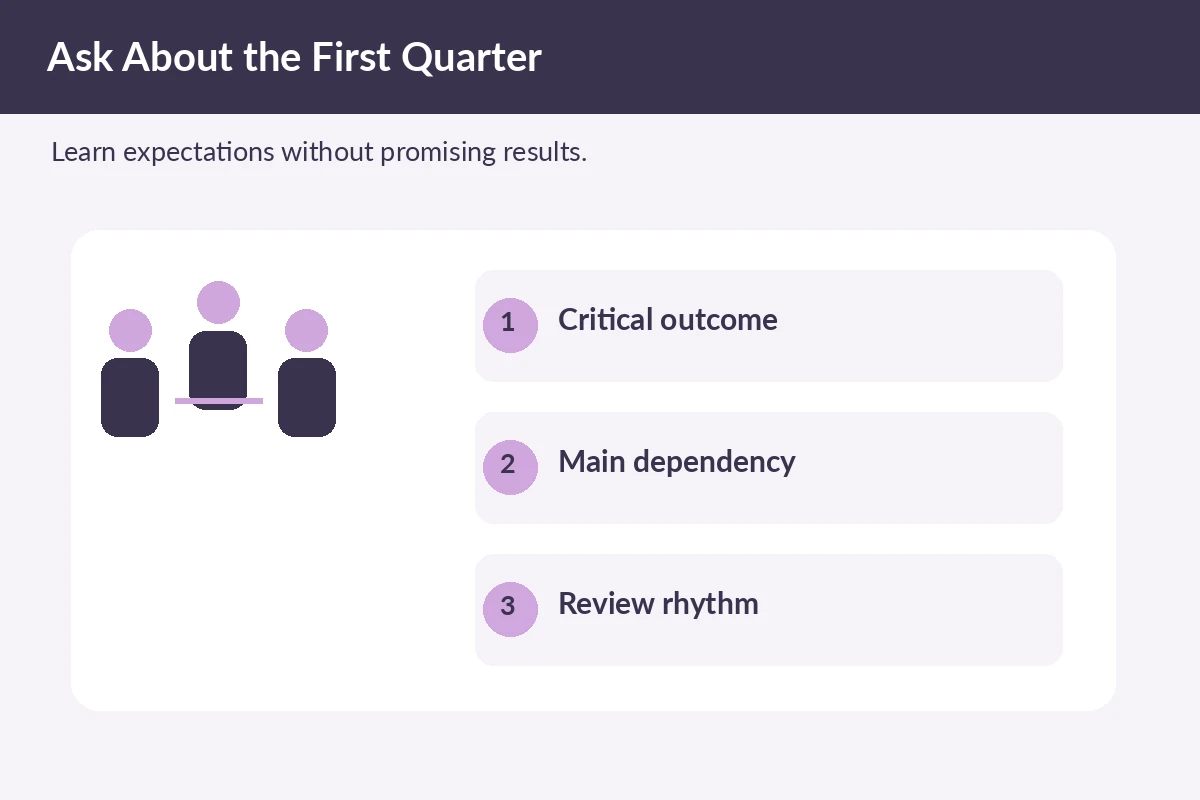
Consider questions such as “What results would make this role most helpful in its first quarter?”, “Where does the team rely most on another department?” or “Which decisions would this person recommend versus approve?” These are appropriate even for an early-career role because they clarify daily expectations. Keep your questions based on what you have actually learned, rather than publicly speculating about the employer’s weaknesses.
You can also ask what a successful onboarding process looks like, what training is available and how performance feedback is given. Pay attention to answers that reveal a mismatch between the advertised position and the day-to-day job. You are evaluating the role as well as presenting your qualifications.
Keep ambition aligned with evidence
It is reasonable to discuss growth interests, but avoid making unsupported claims that you can lead people, authorize purchases or set strategy. If you supervised a student group, say so; do not inflate it into corporate management. If you prepared information that informed a decision, describe the information and who acted on it. A director can understand the value of effective support work when you describe it well.
When outcomes are confidential or cannot be reconstructed, explain the process and what was verified without disclosing details. Never use another employer’s private records as an interview prop. A consistent account across rounds is more important than a bigger-sounding title.
Close by clarifying the remaining decision process
Before leaving, ask what additional information would help the interview team assess your fit and what next step the recruiting contact expects. Do not press the director for a hiring promise. After the interview, note the responsibilities the director actually confirmed and any unresolved questions to raise with the appropriate contact.
If there are changing expectations, ask for the updated job scope rather than relying on an informal remark. A final-stage meeting is a useful time to establish a shared understanding of ownership and evaluation, not a reason to abandon careful fact-checking.
How We Research Second and Final Interviews
For this U.S. audience guide we reviewed University of Alabama, University of Michigan, UC Berkeley, Harvard and University at Buffalo career-center interviewing resources on November 10, 2026. These sources describe common interview practices; individual employers may use a different sequence and assessment process. The scenarios, suggested answers and hypothetical examples here are not reports of real candidates or outcomes. We do not predict hiring success and we distinguish the applicant’s real responsibilities from decisions made by a supervisor, employer or hiring committee.
Sources checked November 10, 2026: career.sa.ua.edu (University of Alabama describes deeper later-round interviews with additional staff, practical demonstrations and the need to review first-round notes.) careercenter.umich.edu (University of Michigan recommends role-specific questions, evidence-based answers and different questions for different interviewers.) www.career.berkeley.edu (UC Berkeley describes interview preparation and post-interview evaluation of duties, work environment, and fit.) careerservices.fas.harvard.edu (Harvard career guidance provides behavioral prompts and questions about employer challenges and priorities.) management.buffalo.edu (University at Buffalo describes second interviews with prospective peers and supervisors and deeper discussion of qualifications.) Educational discussion examples require adaptation to the reader’s own facts. No career center or employer has endorsed this article. Review our affiliate disclosure.
More Interview Preparation Guides
No. It may be one of several evaluation steps. Continue to check the formal next steps with the recruiting contact.
You can show how your assigned work supports a department goal without claiming you set strategy or control budgets.
Start by saying what you would need to learn, who you would consult and which decisions require approval. Avoid criticizing unseen processes.
Yes. Ask which outcomes matter and what is within the new hire’s control. Do not pressure them to promise an exact future metric.
Lead with a concise point and one evidence-based example. Provide deeper operational detail when asked.