
A staffing agency can help a first-time job seeker discover temporary and contract assignments, but it is important to understand who hires you, who supervises the work, how time is recorded, and where safety instruction comes from. The agency and the business where you work may be different organizations. Before you accept an assignment, ask for the actual worksite, scheduled hours, pay arrangements, physical duties, training plan, and the contact for problems. A recruiter describing an opening is not the same as a confirmed offer. Use the written terms and the real employer’s instructions rather than guessing from an enthusiastic phone call.
Identify the staffing agency and host employer
In a common temporary staffing arrangement, the staffing agency recruits and pays the worker, while its client—the host business—directs day-to-day assignments at the worksite. OSHA explains that staffing agencies and host employers share responsibilities for temporary workers’ safety. The exact division depends on the arrangement. Find out which organization issues pay, who approves time worked, who gives work instructions, and who is the backup if a supervisor is unavailable. Keep these names separate in your notes, because confusing them can delay basic questions.
A job posting may hide the client company’s name before screening. That alone does not prove fraud, but you should not travel to an unknown worksite without sufficient details about the employer, task, location, and reporting instructions. Confirm the staffing agency through its independently located website or public contact information. The FTC warns that fake recruiters use real company names to gain credibility; independently verifying a phone number or application site reduces that risk.
Prepare a practical first recruiter conversation
Instead of repeating your entire work history, start with a concise description of your availability and transferable abilities. An illustrative introduction is: “I can work weekday mornings, have experience organizing stock for a student event, and want entry-level inventory or records work. Which assignments include training on the employer’s specific system?” Do not claim formal equipment certification, forklift authorization, cash-handling privileges, or experience with proprietary systems you have not used.
Ask whether you are applying for a specific assignment or merely joining a candidate pool. Find out if the agency requires an assessment, interview, reference, or background step and when that step occurs. Questions about legal work authorization should follow applicable employment processes; do not send scans of sensitive identity documents to an unexpected chat account. Keep copies of the positions you discussed, the recruiter’s business contact information, and any written assignment details.

Compare assignment terms before saying yes
Make a simple side-by-side comparison of role, location, start date, scheduled hours, assignment duration, pay rate, overtime policy when applicable, and person to contact. Also ask whether the position may be extended, whether that is uncertain, and what happens if the host company reduces its staffing needs. Avoid treating “temp-to-hire” as a promised permanent position. A proposed conversion depends on actual employer decisions and any applicable agreement.
If the job involves night shifts, lifting, driving, cleaning chemicals, or access-controlled areas, ask about the specific duties rather than assuming the job title is sufficient. For example, “warehouse assistant” might mean counting sealed packages, packing cartons, or operating powered equipment; these have different training requirements. Ask which tasks you can perform immediately, which require instruction, and which are outside the role. Do not assume an agency will always know every detail; have the correct worksite contact confirmed.
Confirm training and safety responsibility
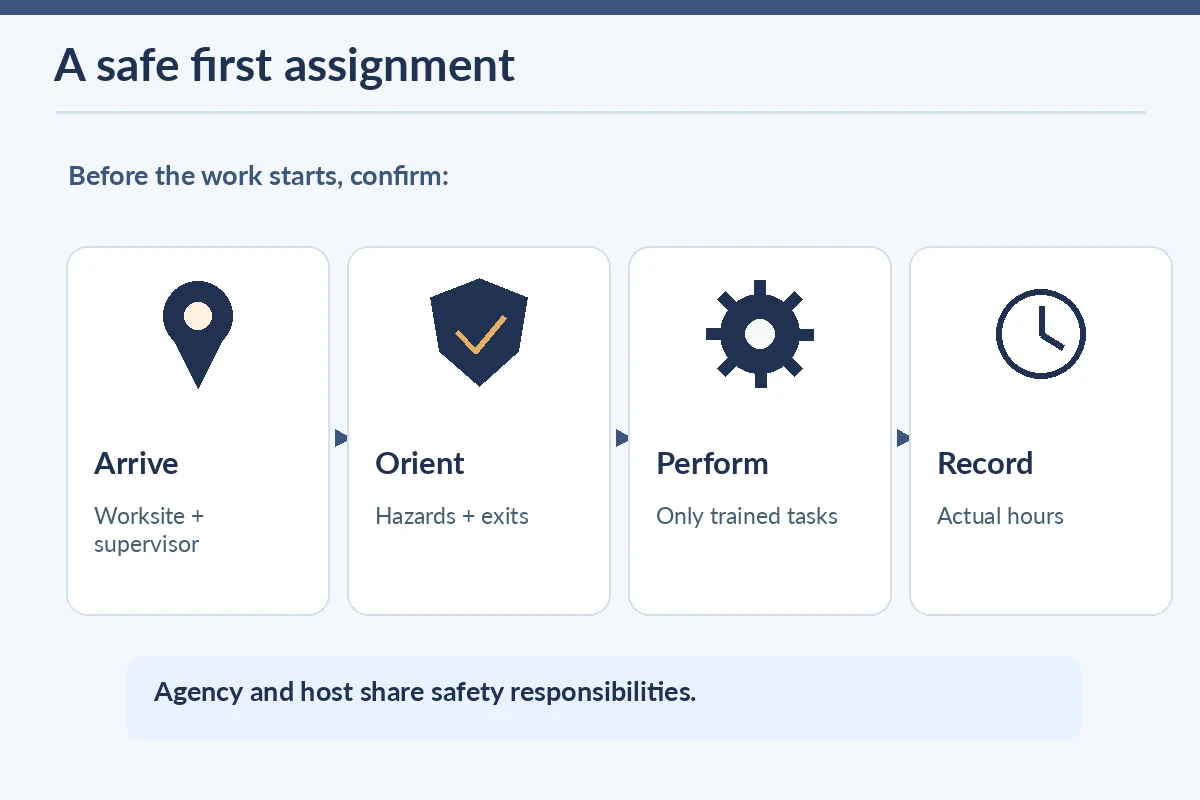
OSHA states that both the staffing agency and host employer have responsibilities for providing a safe workplace to temporary workers. The host commonly provides site-specific training about equipment, hazards, and emergency procedures, while the agency may provide general instruction. A new worker should know where to report a safety concern and who explains required protective equipment. If you are asked to operate a machine you have not been trained or authorized to use, stop and request the required instruction before proceeding.
A useful first-day checklist includes the reporting location, supervisor’s name, clock-in procedure, emergency exits, and any required protective gear. Do not improvise a procedure involving chemical handling, patient records, protected customer data, machinery, or driving simply because a coworker seems busy. An assignment may be entry-level without being safe for untrained independent work. Ask for demonstration and a chance to confirm your actual permitted duties.

Record hours and report discrepancies correctly
Before the assignment starts, ask how time is submitted, who approves it, when the pay period ends, and how payroll questions are raised. Record your own start, end, and break times accurately using the employer’s system, keeping a personal note where allowed. Do not enter hours you did not work or alter someone else’s timesheet. If a shift is canceled or an assignment ends early, ask the agency to confirm next steps in writing, including whether you need to report for any other work.
Suppose the host supervisor changes your shift, but the agency schedule still shows the original hours. Ask the appropriate contacts to reconcile the change; do not silently work an unconfirmed schedule or assume the pay difference will fix itself. Pay and overtime obligations depend on the applicable law and facts, not on one generic answer across every assignment. Use official wage-and-hour resources or an appropriate local agency when a serious pay issue remains unresolved.
| Question | Staffing agency | Host worksite |
|---|---|---|
| Who pays and handles payroll? | Confirm contact and pay period | Ask who approves hours |
| Where do I report? | Provide correct address | Confirm entrance and supervisor |
| Who explains hazards? | General information and coordination | Worksite-specific orientation |
| What if hours change? | Confirm updated assignment | Verify actual shift |
Spot questionable offers and preserve choices
A legitimate staffing discussion should clarify work, contacts, and the process rather than pressure you to transfer money immediately. The FTC advises job seekers not to pay simply for the promise of a job and to treat requests for a deposit or fake-check equipment purchase as warning signs. Never accept an assignment solely because the recruiter promises unusually fast hiring. Independently verify the company and read any documents before agreeing to terms you do not understand.
If an assignment does not fit your availability or safety needs, decline courteously and specify what kinds of roles you can consider. For example, “Thank you for the offer. I cannot cover the 5 a.m. start at that location, but I can consider afternoon stock-control work with documented training.” This leaves a clear record without implying you are entitled to a different offer. A useful agency relationship starts with accurate communication, not with saying yes to every suggestion.
How We Research Job Search Advice
We reviewed the official resources listed below on November 7, 2026, and matched their guidance to the particular decisions in this article. Examples are illustrative, not employer promises or descriptions of actual vacancies. Confirm current arrangements with the relevant employer, agency, program, or local provider. OSHA explains joint responsibility for protecting workers supplied by staffing agencies to host employers. supports the stated point. OSHA recommends communication between staffing agencies and host employers about hazards, training, and safety responsibilities. supports the stated point. FTC advises that legitimate placement firms typically do not charge prospective employees and describes recruitment scam signs. supports the stated point. CareerOneStop recommends recording the positions and employers contacted during applications. supports the stated point.
Our guides are informational and do not promise employment or endorse a recruiter. Any potentially commercial links are subject to our affiliate disclosure; no affiliate relationship or payment arrangement is implied by these resources.
Related Job Search Guides
In many temporary arrangements the agency hires and pays you while a host company directs daily work. Confirm the arrangement and payroll contact in the actual assignment documents.
No. It describes a possible path, not a promise that the host company will hire you permanently. Ask what conditions would need to be met.
OSHA describes shared safety responsibilities between staffing agencies and hosts. Get site-specific training before handling equipment or hazards for which you lack instruction.
A request to pay simply for the promise of a job is a major warning sign. The FTC notes that legitimate placement firms typically receive payment from businesses rather than applicants.
Contact the assigned payroll and worksite supervisors, preserve accurate personal notes, and request written clarification instead of changing records to match assumptions.