
To find a first job at a small business, start with real employers and plausible duties rather than a promise that every shop is hiring. Choose a few business types whose work you understand, confirm that each company actually exists, and look for its stated hiring channel. If no vacancy is listed, a short, respectful inquiry can be appropriate when the company permits it, but it is not an application to an advertised role. This guide builds an employer list that distinguishes active openings, possible future interest, and organizations you should not contact unsolicited.
Choose business types based on tasks, not names alone
Begin with work you can describe and potentially perform: front-desk scheduling, shelf organization, basic office support, event setup assistance, or routine customer service. These are examples of task groups, not claims that any employer has openings or that an untrained applicant can safely do every duty. A neighborhood organization may combine tasks that large companies separate. Ask yourself whether you can meet the expected hours, location and practical demands. Do not presume you can handle cash, confidential records, food-safety work or equipment without training and employer permission. Select two or three compatible kinds of business before you collect names.
Identify the actual organization behind a business listing
Use the business’s own website, reliable local directories, and visible public contact information to establish that an employer operates in the area. Confirm which location and legal or operating name appears on a job posting. A retail brand may be operated by a franchisee or a separate company, so avoid assuming the corporate site controls every position. Check whether a business has an official jobs page or stated application procedure. Do not copy personal employee contact details from social media, or treat an unverified profile as an official hiring manager. The point is to connect a genuine employer with an appropriate public recruiting route.

Separate active openings from exploratory inquiries
Mark an employer ACTIVE only if there is an identifiable, current opening on a credible channel. Mark RESEARCH if the organization appears relevant but you have not found a vacancy. Mark NO CONTACT when it explicitly says it does not accept unsolicited applications or has no public hiring route. You can still watch its official openings without interrupting staff. If an employer allows inquiries, ask whether there is an appropriate site or inbox for future entry-level opportunities. Do not write “I saw your vacancy” when you did not. An inquiry is a request for information, not proof that the business is recruiting.
Write a concise message that respects a small team’s time
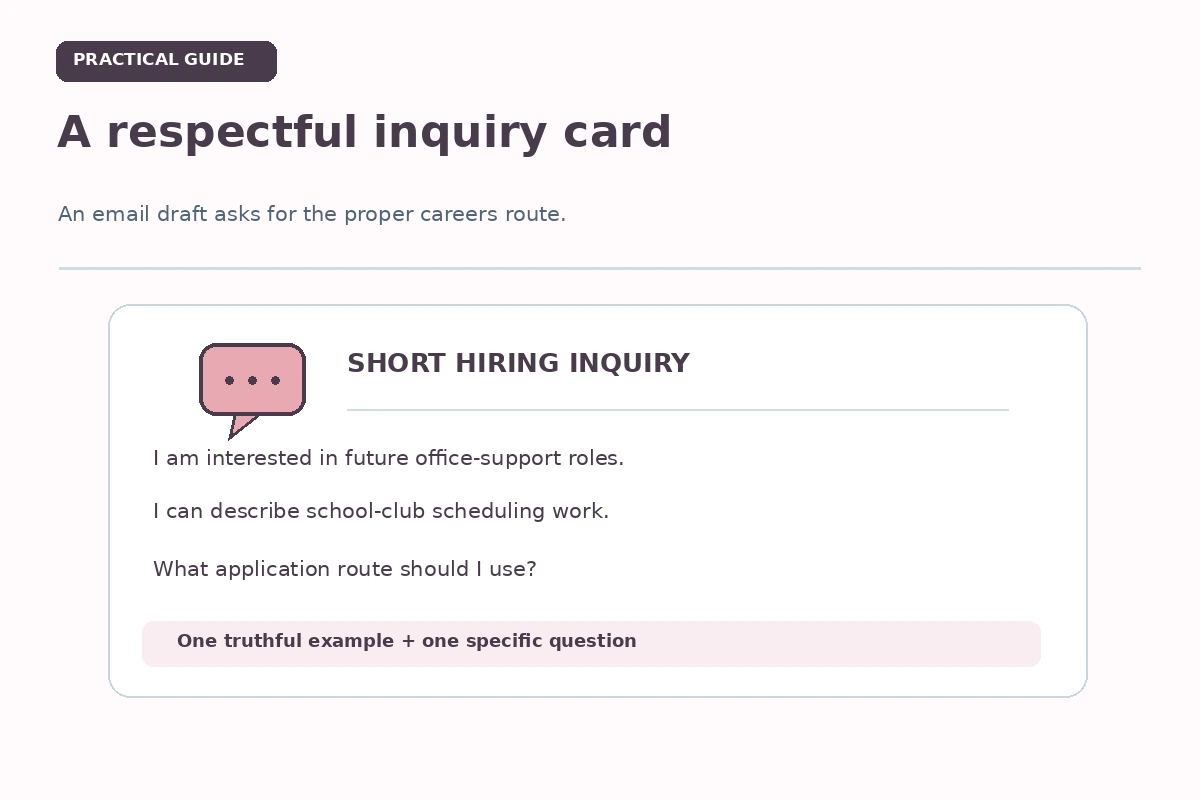
A short inquiry might read: “Hello, I am interested in future part-time front-office openings. I have school-club scheduling experience and am available on weekday afternoons. Is there a preferred careers page or application process I should use?” This is a hypothetical template; customize it only with true experience and availability. Avoid attaching sensitive identity details or sending a mass email to every employee. Do not repeatedly call a restaurant during service or appear in a restricted workplace seeking the manager. If the organization gives a preferred method, use it once and record the answer.
Use employer research to tailor the evidence you show
A small local business may need flexible support across several ordinary tasks, but applicants should never assume they will be allowed to perform all of them. Review any actual role description and choose one relevant example. For a general office helper position, a documented student event calendar can demonstrate scheduling accuracy if you clearly label the context. For a customer-facing role, an actual school volunteer greeting duty may show communication. Avoid claiming you “increased sales” or “managed payroll” without records and real authorization. A clear example of what you did is more persuasive than a generic list of desirable qualities, though no example guarantees selection.
Verify the application contact and avoid fake recruitment
Scammers sometimes impersonate small employers or post bogus local vacancies. Confirm that any new contact really represents the business using contact details obtained independently from its legitimate website or public listing. The FTC warns about fake-check schemes, requests for money to get a job and pressure to share sensitive information. Do not pay for an interview, buy gift cards for a manager, or move an application to an unverified messaging account because someone says the official hiring system is down. If the company has no secure application channel, ask what process it uses before sending identity or banking details.

Create a small, maintainable outreach tracker
Use columns for employer, business type, neighborhood, one plausible task, verified careers page, actual vacancy, official contact channel, message date, and status. Keep ACTIVE and RESEARCH entries in different groups so you do not misrepresent the volume of open jobs. Record one follow-up date only if the employer gave a suitable window or the application instructions invite follow-up. When an opening is filled, mark it closed instead of continuing to ask staff. CareerOneStop encourages tracking applications and employer contacts; a simple employer-first sheet makes that practice relevant to a beginner searching locally.
Review the list for role fit rather than raw volume
At the end of your search session, count genuine positions you can apply to, not the number of business names you collected. Are you finding real schedules that suit you? Are official sites more useful than directory profiles? Which role descriptions fit truthful school or volunteer proof? If most businesses are not hiring, broaden the type of task or geographic radius instead of pressuring the same employers. If travel or accessibility is a concern, compare the actual work location and shift before you commit. Your next action should be a verified application, a permitted inquiry, or an intentional decision to keep monitoring.
A sample local-employer prospect sheet
Prepare one row per company with business type, location, official website, hiring page, role or task of interest, opening status, permitted contact method, application date and next step. Use status labels ACTIVE, RESEARCH, and DO NOT CONTACT; do not confuse “relevant employer” with “vacancy available.” An illustrative row might say “Community repair shop | administrative intake | careers page checked | no opening | monitor.” No names or openings in this example represent a real employer. Protect personal contact information and delete outdated records periodically.
How We Research Beginner Job Search Guidance
We review U.S. primary resources about occupation requirements, official job-search services and employer verification, then translate those into a practical worksheet. Sample scenarios are hypothetical; they do not represent actual openings, hiring decisions, employer commitments or universal legal rules. Check the current employer posting and applicable licensing or program requirements before relying on an example.
Sources reviewed November 11, 2026: www.usa.gov — USAGov lists official job-search databases and libraries as job-search resources.; www.careeronestop.org — CareerOneStop advises identifying employers, using contacts appropriately and recording applications.; www.dol.gov — DOL recommends researching employers and building contacts as part of job search.; consumer.ftc.gov — FTC cautions job seekers to verify employment claims and avoid advance-payment scams..
This guide offers general U.S. job-search information, not legal advice, job placement, an employment promise or proof that a particular opening exists. Review the JobAsk affiliate disclosure. The internal category links here are informational, not paid endorsements.
Related Job Search Guides
No. Hiring methods vary. Check the business’s own website and preferred contact route before assuming it accepts applications.
A brief inquiry may be appropriate if the employer welcomes it. Be clear that you are asking about future opportunities, not responding to a real opening.
Follow the employer’s stated process. Do not interrupt service, enter restricted areas, or expect staff to meet without an appointment.
Yes, when honestly described and relevant to the actual duties. Do not present them as paid experience or work you never performed.
There is no universal target. Prioritize verified role fit, legitimate openings, and respectful outreach over sending large numbers of generic messages.