
To prepare for a UX researcher interview, select a study you can explain from research question through recruitment, method, observations, synthesis, and design recommendations. Your value is not a colorful wall of sticky notes; it is the reasoning that connects evidence to a useful decision. Be candid about a school project, small participant group, a method limitation, or findings that remained uncertain. Protect participant privacy and any nondisclosure agreements while showing your own research contribution.
Match your methods to the employer’s problem
Read the posting for discovery research, evaluative usability, mixed methods, accessibility, or product-team partnering. Prepare an example that shows why a certain question called for an interview, observation, test, survey, or another method. The Nielsen Norman Group UX researcher portfolio guidance recommends explaining study context, method, and artifacts rather than relying on visual polish alone.
A study of whether people understand navigation is not identical to research on their unmet needs. If you used only moderated usability testing, do not claim broad ethnographic expertise. Instead, show what you can do and explain how you would choose a different method for a different question.
Rehearse a sound research-plan conversation
Imagine the interviewer says: “Users abandon an onboarding screen; investigate why.” Start by clarifying what abandonment means, who the users are, what product stage is affected, and what information already exists. Propose a small plan that connects the question to participants, tasks, observations, and analysis. Explain what you could learn and what the chosen method would not establish.
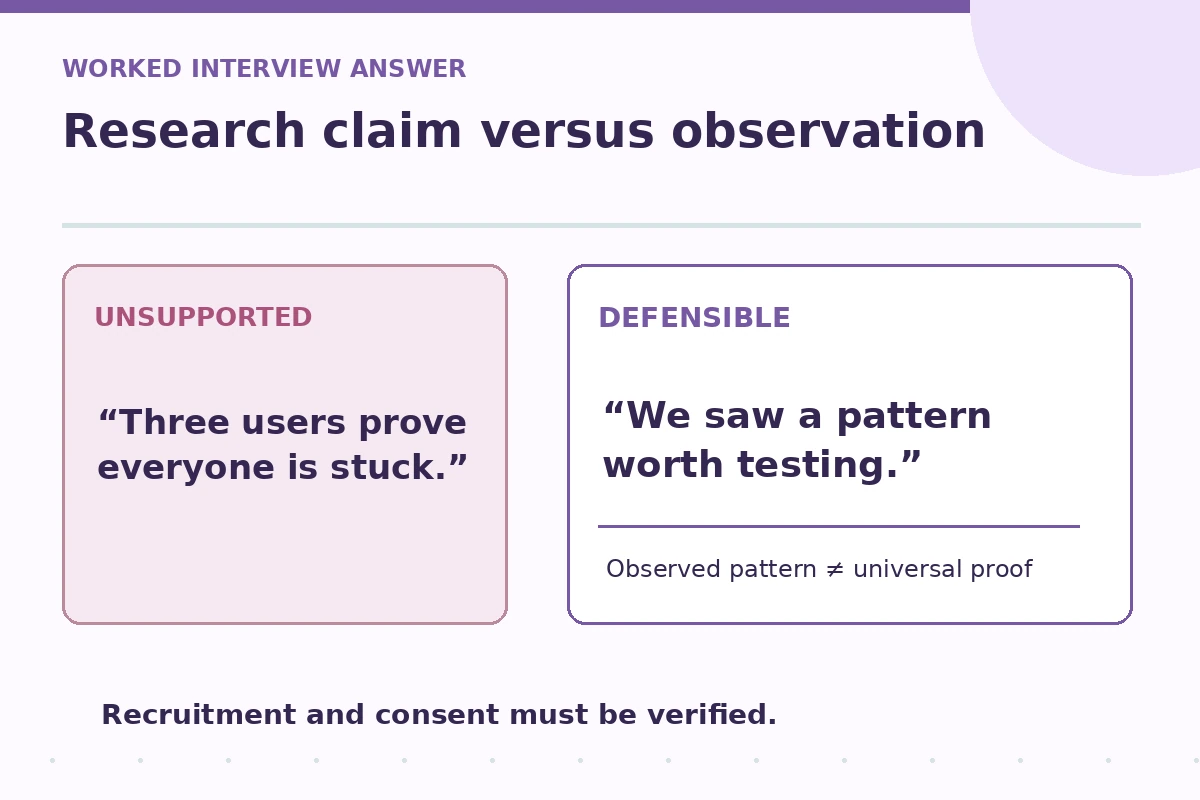
You might test whether a screen’s instructions are understandable, while product analytics reveals the scale of the issue. Neither automatically proves why a particular user left. State when further sampling or controlled evaluation would be needed. Do not promise a definitive answer from a handful of conversations.

Show participant recruitment and consent boundaries
Interviewers may probe how you recruited people and handled vulnerable or sensitive data. Explain approved recruitment criteria, informed participation, privacy-aware note taking, and how access to raw recordings was limited. Do not claim that a personal portfolio is allowed to publish participants’ quotes, names, or photographs merely because you conducted the sessions. Follow actual organization and applicable research requirements.
If your prior study cannot be shared, prepare a synthetic illustration of the process, clearly labeled as such, or obtain permission for approved redacted materials. NN/g discusses presenting sanitized artifacts when confidentiality limits portfolio sharing. Respect what you cannot disclose rather than showing screenshots from a protected project.
Explain how observations became findings
A convincing case distinguishes what a participant said, what they did during a task, a pattern noticed across sessions, and a design hypothesis. Walk through notes, coding or affinity grouping, and the evidence for a recommendation. Do not turn two quotes into an invented market-wide percentage or claim that a revised design caused higher sales without appropriate measurement.
For an illustrative example, several testers miss a save action. Explain how you checked the task and interface state before recommending a clearer label or placement. A good interviewer may ask for disconfirming evidence. Practice discussing observations that did not fit your first explanation.
Prepare for conflict with product stakeholders
A stakeholder may want a quick validation that confirms an existing idea. Describe how you would clarify the decision to be made, design a fair task, report findings even if they are inconvenient, and make the remaining uncertainty visible. Your job is to inform decisions, not manufacture approval. If the sample is too limited to generalize, say so and suggest appropriate next evidence.
Prepare an honest collaboration example: what you recommended, what designers or engineers did with it, and whether the decision was postponed. Claiming “I redesigned the experience” is misleading if you only produced the research plan. A clear distinction among research, design, and product ownership creates confidence.
Practice the portfolio narrative and live exercise
Prepare one five-minute study walkthrough: question, constraints, method selection, recruitment, key observation, limitation, and recommendation. Bring only assets you are allowed to share. A second short case can reveal a different method or a study that changed direction. The Harvard interviewing guide recommends clear, practiced stories that connect skills to the advertised role.
For a live prompt, begin with clarifying questions before proposing recruitment or sample size. You can ask who needs the decision, which users are affected, and what evidence already exists. Think aloud, but do not expose confidential data or invent findings to make the answer seem complete.

Ask what research quality looks like on this team
Ask how research requests are prioritized, how participant consent is handled, who has access to recordings, and how findings reach decisions. Clarify whether the team owns recruitment, analytics, repository maintenance, or design recommendations. These questions tell you whether the role matches your strengths and the employer’s research maturity.
Before the interview, review your actual study materials, note where a sample or method limited confidence, and prepare one case you can discuss without permission concerns. Test any screen sharing and have a plain-language explanation for nonresearch stakeholders. Finish with a clear example of how evidence informed a proposal, not a claim that research removes all product uncertainty.
How We Research Interview Preparation
We reviewed current career-center interview preparation guidance alongside occupational or professional descriptions relevant to this role. Sources: careerservices.fas.harvard.edu — Researching the employer, rehearsing responses, and preparing questions are core interview habits. nngroup.com — NN/g outlines research portfolio artifacts, methods, context and confidentiality. onetonline.org — O*NET describes gathering, analyzing, and reporting findings for research-adjacent work. Examples in this article are illustrative unless explicitly described as real occupational guidance. No invented employer interview requirements, outcome metrics, or approvals should be inferred from these examples.
This guide is independent editorial advice. It is not endorsed by any employer and does not promise hiring results. For the website’s policy, see our affiliate disclosure. Always follow the actual hiring invitation and keep private workplace and customer information out of interview demonstrations.
More Interview Preparation Guides
Clear study plans, methods, observations and limitations matter more than decoration. Share only materials you have permission to show.
Yes. Label the project as coursework, explain your own research actions and avoid claiming it produced real business outcomes.
Explain what the study could reveal, what it could not generalize, and which additional evidence would increase confidence.
Only when properly authorized. Use approved redacted or synthetic examples when privacy or confidentiality prevents disclosure.
Ask about research priorities, consent, recruitment ownership, evidence standards, stakeholder collaboration and how findings affect decisions.