
For most US job applications, aim for a concise cover letter of about 200–400 words, often three or four short paragraphs that fit on one readable page. Follow any length or formatting rule in the job posting first; an online text box with a character limit may require less. CareerOneStop gives a 200–400-word example range, while Princeton career services recommends roughly 250–400 words. Neither is a universal hiring rule. The purpose is to help the employer see your match to the role quickly, not to hit a magic word count. Choose one or two examples you can substantiate, then stop.
Start with the employer instructions, not a target number
Before drafting, inspect the application page and the job posting. A cover letter may be required, optional, prohibited, or entered into a text box with a strict limit. If the form says 1,000 characters, a 350-word letter will not fit, regardless of any career guide’s preferred length. If the employer asks for a specific prompt or separate qualification statements, answer those instructions rather than forcing a standard template. Save a copy of the exact language you are responding to, and note whether it requires an attachment, a pasted message, or a PDF.
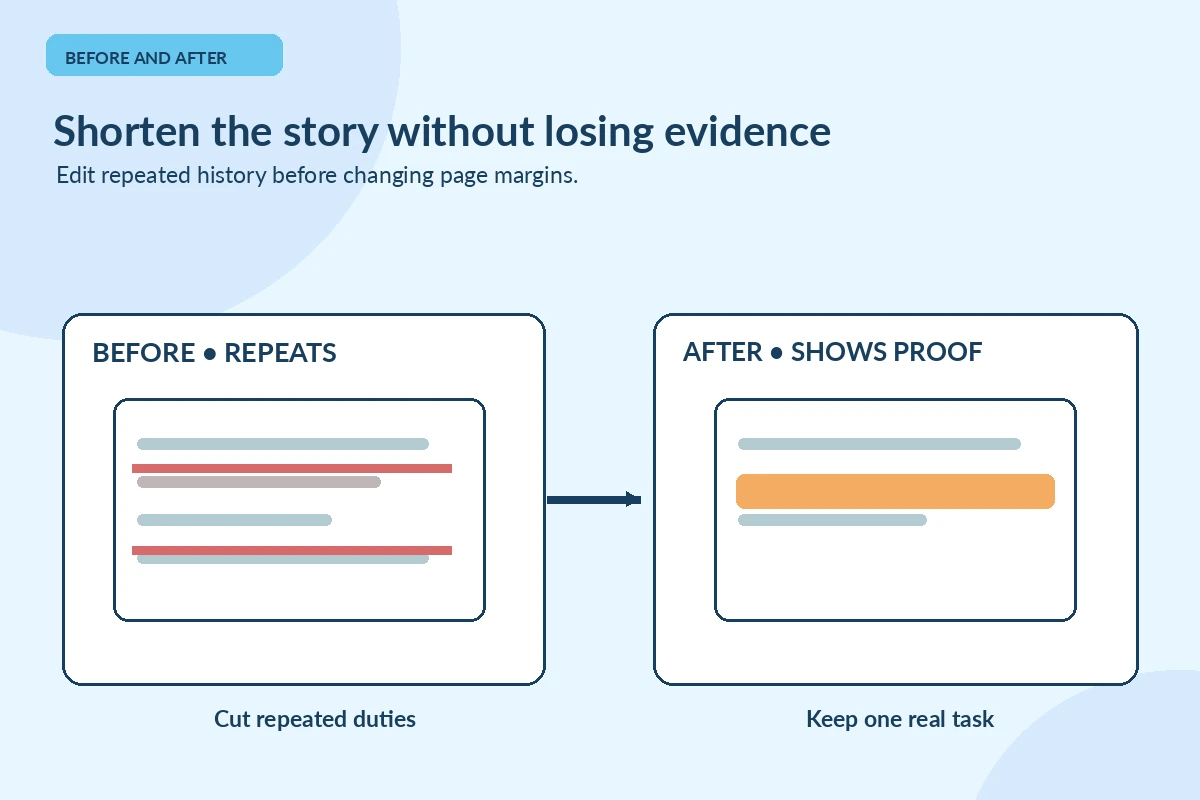
Do not assume that “one page” excuses a tiny font or narrow margins. If your draft spills onto a second page, first remove repeated résumé history, generic praise and unrelated projects. Change the examples before shrinking the document. For specialized academic or public-sector applications, an employer may specify a different format; those explicit rules take priority over general guidance. A readable letter that answers the instructions is more useful than one that achieves an arbitrary count by squeezing the lines.
Budget room for a role-specific opening and two proof points
Think of the letter as a small set of decisions. The opening identifies the exact job and the strongest reason your background fits. One or two middle paragraphs explain relevant actions you actually performed. The closing thanks the reader and indicates interest in discussing the role. You can use one especially strong middle example rather than manufacturing a second. This structure is consistent with career-center guidance from USC and Harvard. It is a useful drafting aid, not a fixed formula guaranteed to get interviews.
A practical editing test is to underline each sentence that adds information the hiring team would not get from a bare résumé bullet. If a paragraph simply repeats the title of every past job, shorten it. If it explains how you resolved a document mismatch while following review procedures, preserve that detail. Do not waste a whole paragraph explaining that you are enthusiastic, detail-oriented and a team player without an instance demonstrating any of those qualities.

Compare a too-long draft with a concise alternative
Imagine a fictional office applicant whose first draft begins with school history, lists five unrelated past responsibilities, praises the company in three separate sentences, and finally mentions the advertised scheduling work near the bottom. The problem is not merely word count; the relevant work is hard to find. The rewrite can open with the office coordinator role, describe one real scheduling or handoff example, and close with a short, courteous statement of interest. This is an illustrative exercise, not an applicant record.
A shorter version might say: “In a volunteer program, I updated the shift roster, confirmed changes with the coordinator, and left a written handoff for the next team. I would bring the same habit of checking schedule changes to your office support role.” Only use this wording if it matches your own work. The passage has a visible duty, an action, and a reason it matters. More adjectives would make it longer without making it stronger.
Use the word count as a diagnostic, not a verdict
A 175-word letter can be adequate when the role and evidence are straightforward, especially when an employer wants a short note. A 350-word letter can still feel empty if every sentence is generic. Rather than treating 200–400 words as an eligibility threshold, ask whether each line performs a job: identifies the position, shows matching experience, explains interest, or provides a sensible closing. If an employer gives a limit in characters, test the actual text inside the form instead of assuming that a document word counter translates perfectly.
Cut filler in a deliberate order. Remove introductory rituals that add no content; delete a second description of the same résumé accomplishment; replace lengthy descriptions of the employer with a verified detail about the role; simplify long lists of soft skills into one real example. Keep dates, titles, credentials and job location consistent with the résumé and posting. Brief is not the same as vague, and an elegant-looking page cannot repair a claim that is inaccurate.
Preserve readability when exporting to PDF or pasting into a form
If the application asks for a PDF, export the final file and reopen it. Check that the entire greeting, contact line, body and signature remain visible, that no words were clipped, and that the recipient or requisition number matches the selected job. If a form requests plain text, paste the letter and inspect the preview for broken paragraph spacing or characters. Do not attach a PDF when the instructions explicitly say to paste text or when there is no upload field.
Avoid treating visual design as a substitute for strong evidence. Large decorative headers, colorful icons and oversized spacing may consume the available page while hiding the actual reasons to consider you. A restrained layout often serves the reader better. Make sure any embedded link to a portfolio or work sample opens only material you may share publicly. A concise document should still be complete and professional when viewed on a phone or printed in grayscale.
Make each paragraph earn its place through a job requirement
Read the posting again and highlight the two or three needs you can support best. You might find “coordinate appointments,” “maintain records,” and “communicate updates.” If your strongest real example shows accurate scheduling, explain the action and checkpoint in a few sentences. You do not need to write three mini-essays simply because there are three requirements. Choose the most persuasive evidence and make the connection explicit. Do not invent a performance percentage or supervisor praise to make a short story sound impressive.
If you have no paid experience, a completed class project or volunteer assignment can illustrate task planning, feedback and corrections. Label it accurately. If you have long experience, resist the temptation to summarize your career chronologically; your résumé already does that. Use the letter to show judgment about which parts of the record matter to this employer. The employer can request more history during a later conversation, but the first reading should be clear without a glossary.

Run a final four-part test before you submit
Check instructions, relevance, evidence and legibility in that order. The first check determines the allowable format and length. The second asks whether the letter refers to this actual position rather than a generic industry. The third confirms that every significant claim could survive a follow-up question. The fourth checks the exported or pasted document for visible errors. A letter can pass a word-count check while failing all four of these more useful tests.
Finish by reading the letter aloud, slowly enough to hear redundant phrases. Verify the employer name, position title, requested attachments and current contact details against the application. Send only through the channel specified by the employer, and save a copy of what you submitted. Your final version may be shorter than your first because you removed weak material; that is an improvement if the evidence and purpose are clearer.
Compare the decision against a practical checklist
The following worksheet is a teaching aid, not an employer rule or real candidate outcome. Apply it to the current posting, using your own verifiable experience and the actual application instructions.
| Situation | Useful editing decision | Avoid |
|---|---|---|
| Posting specifies a limit | Follow that exact limit and format | Ignoring the application field |
| Standard PDF attachment | Aim for concise, readable one page | Shrinking type to fit a biography |
| Short online message | State role and one evidence point | Pasting a full formal document blindly |
How We Research Cover Letter Writing
The JobAsk editorial review used the US career and consumer-protection references below on November 6, 2026, checked the user-supplied WordPress post title inventory for overlapping intent, and compared public search results. Letter examples are explicitly fictional and are not actual applicants, employer endorsements or guarantees. Different employers may give different submission instructions. See our affiliate disclosure.
Sources checked November 6, 2026: cloudfront.careeronestop.org — CareerOneStop describes tailored cover letters, often about 200–400 words with three or four short paragraphs.; careerdevelopment.princeton.edu — Princeton Career Development emphasizes a job-specific letter no longer than a page and approximately 250–400 words.; careers.usc.edu — USC Career Center distinguishes a concise cover letter from a résumé summary and recommends three to four paragraphs on one page.; careerservices.fas.harvard.edu — Harvard career services gives a cover-letter structure with a job-linked opening, evidence-based middle and concise closing.; careercenter.education.wisc.edu — UW–Madison advises specific examples, careful proofreading, and following requested cover letter instructions..
More Resume and Cover Letter Guides
Not necessarily. If the job match is clear and the employer has not required more, a shorter letter with real evidence may be better than padded text.
Follow the employer’s instructions. For routine applications, career-center guidance commonly recommends one page; specialist applications may request something different.
No. Three or four short paragraphs is a useful structure, not a mandatory hiring rule. Choose the structure that keeps your evidence easy to follow.
Use the limit shown in that form, including any rule for spaces or punctuation; paste and review the actual field before submission.
Not by itself. Specific examples and a reason for applying communicate more than repeated claims of enthusiasm.