
HR Assistant situational interview questions test what you would do when a realistic problem has incomplete information and more than one person involved. In this guide, the central hypothetical is: “How would you respond if an employee shared a sensitive concern and demanded complete secrecy?” A strong answer asks what must be checked, describes a responsible action within the role, and explains who makes decisions outside your authority. The examples are invented for rehearsal, not accounts of employer experiences or guaranteed interview questions. State your limits before naming a confident next step.
Hear the concern without promising an outcome
A hypothetical HR question often starts with a distressed employee or an allegation about another person. The goal is not to show that you can decide who is right within a minute. Start by listening without interruptions, asking what happened, and distinguishing the employee’s direct observations from conclusions or rumors. Avoid saying “I know exactly what happened” before relevant facts are reviewed. An HR assistant or coordinator may be responsible for intake and accurate routing but may not have authority to investigate, decide discipline, or make legal conclusions. The interviewer wants to see that you know the boundaries and can respond respectfully.

Explain confidentiality as a careful limit, not a promise
An employee may ask for complete secrecy, but an organization sometimes needs to share relevant information with authorized people to assess or resolve a concern. Say you would handle the information discreetly and limit access according to policy, without guaranteeing a secret that cannot be kept. Avoid instructing the employee that they must never discuss an issue with anyone; confidentiality requirements and employee rights can depend on the situation. Explain the process and who can provide authoritative guidance. The difference between “private to the extent practical” and “nobody will ever know” is central to a trustworthy hypothetical answer.
Ask neutral questions before recording details
Begin with broad prompts about what happened, when, where, and who may have first-hand information. Make a clear distinction between the employee’s words and your own notes. Do not diagnose motives, accuse someone, or imply that one party is lying because two accounts differ. Record only information needed for the assigned work and store it through authorized HR channels. A candidate can sound empathetic without asking intrusive questions unrelated to the concern. When an issue potentially requires urgent protection or a trained response, explain that you would follow the organization’s applicable escalation and safeguarding procedures rather than conducting an improvised private investigation.
For this role, avoid the easy but weak answer: “Promise secrecy.” Instead, identify whether the information is verified, who is affected, and who has the authority to decide. The distinction between a hypothetical situation and a real past event matters: in a hypothetical you describe a responsible plan; in a behavioral question you must tell the truth about what actually occurred. The following sample uses a fictional situation and makes no claim about a past employer.
Respond to a request for complete secrecy
The sample response below is a hypothetical exercise. It shows empathy, clear limits, and a responsible handoff. It is not a legal script or a statement that every organization uses the same investigation process. If you have previously performed HR intake, describe only your actual tasks and avoid identifying real employees. If you worked as an administrative assistant, it is reasonable to discuss professional discretion, approved recordkeeping, and referring sensitive matters, but do not claim investigator experience. A strong answer clearly states what you can tell the person now and what only an authorized reviewer will determine later.
Illustrative answer to the central question
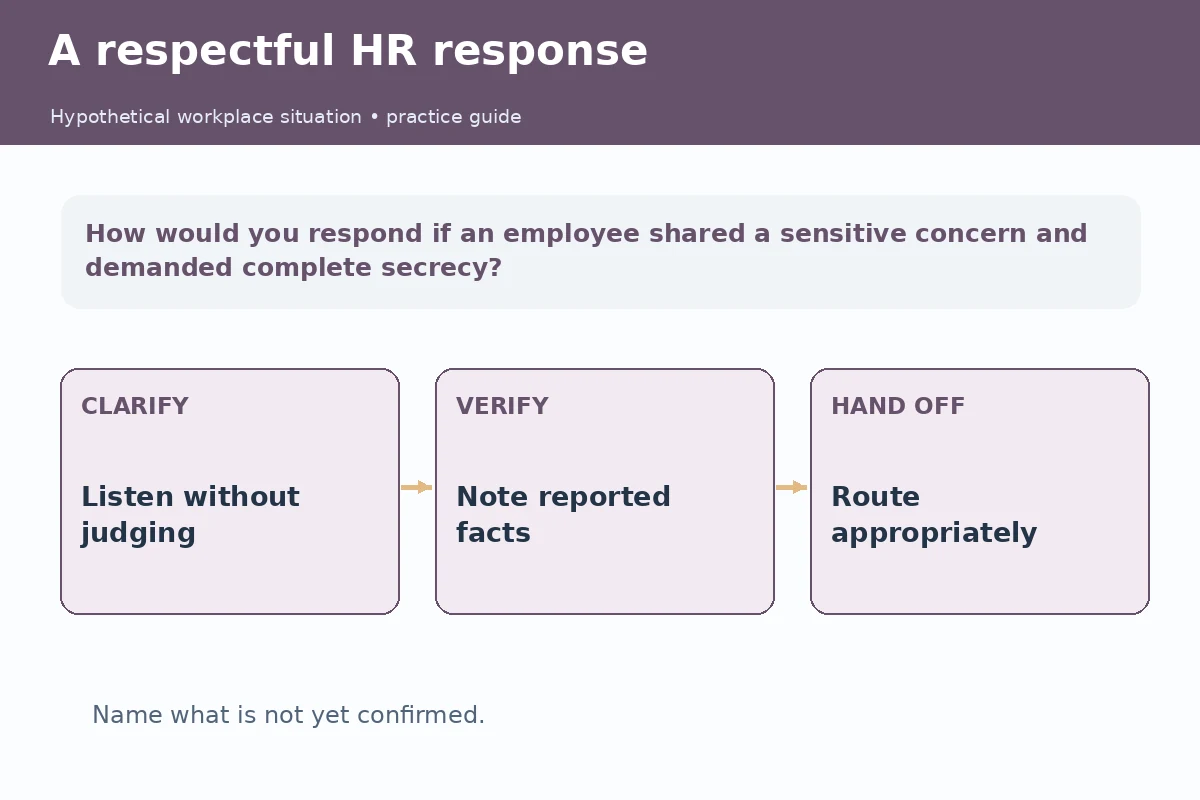
Hypothetical interview answer: “I would listen respectfully, ask open questions to understand the reported events, and avoid taking sides or promising an outcome. I would explain that I will handle the information with discretion but cannot guarantee absolute secrecy if the organization must review or respond to the concern. I would record relevant facts in the approved system, restrict access according to policy, and refer the matter to the person authorized to assess it. I would tell the employee what the next step is, without suggesting that I personally can make an investigation finding.” This is a model of reasoning, not a script to memorize verbatim. Replace its workflow with the organization’s actual rules and explain the scope you would have in the advertised position. The interviewer may interrupt to ask who owns the next decision. Use that interruption to make the authorization boundary explicit rather than inventing a result.
Practice competing accounts and requests from managers
If two employees report different versions, keep each account attributed and pass it to the authorized reviewer; do not combine them into one invented narrative. If a manager asks for an unrelated personnel record, check whether the request has an approved business purpose and access permission. A manager title alone is not a license to read every file. If an employee asks for a specific resolution date, avoid predicting an investigation’s timeline or finding. Explain what information can be shared and who handles process updates. These prompts test different aspects of judgment: neutrality, access control, and accurate communication.
Three follow-up questions to practice
A manager asks for private personnel details unrelated to a work task. What do you do? Confirm the business purpose and authorization; do not disclose restricted information simply because the requester is a manager. Two employees give different accounts. What is the next step? Record each account accurately and route to an impartial authorized reviewer rather than deciding who is truthful from an initial conversation. An employee asks when an investigation will end. What do you say? Share only approved process information, clarify who owns updates, and avoid predicting findings or completion dates.
Make a handoff that another HR professional can use
A factual intake summary can identify when the concern was reported, the employee’s described events, the records mentioned, any immediately applicable policy steps, and the person who now owns the matter. It should not contain unrelated medical, family, or other personal details merely to make the note sound detailed. Use approved storage and access restrictions rather than a personal email or public spreadsheet. A good interview answer also notes that an initial report is not a final finding. Explain that you would communicate the next step to the reporting employee only within your authority.

Review the job description for responsibility boundaries
An HR generalist, recruiter, employee-relations specialist, and HR assistant may have very different duties. Read which role the opening actually covers. If it involves complaint intake, learn who handles formal investigations and where sensitive notes are stored. If it is a recruiting-support role, emphasize appropriate access and referral rather than investigative authority. Practice giving your answer without names or identifying details from previous employers. Ask the panel how concerns are routed, how teams handle urgent escalation, and what training new staff receive. A good answer protects people while refusing to claim powers not assigned to the role.
Build a short scoring rubric for rehearsal
After a practice response, evaluate it against five observable questions: Did I identify the first missing fact? Did I state the safest immediate action? Did I name the relevant person or office that approves the next decision? Did I describe a usable handoff or status update? Did I avoid claiming a result I cannot know? For the hr assistant example, this means assessing whether you treated “employee concern” as a bounded role decision instead of a personal rescue mission. Have a peer ask “What would you do if that information were unavailable?” A convincing answer acknowledges uncertainty, asks for clarification, and keeps the process accountable without turning the interview into a speech about perfect outcomes.
How We Research These Situational Answers
We reviewed SHRM HR process guidance; SHRM HR process guidance; Northeastern career guidance; Princeton interview guidance to distinguish the typical responsibilities of the role from decisions that require a supervisor or designated professional. The career-center sources distinguish hypothetical situational reasoning from real behavioral examples. Role-specific sources inform the examples, but no source can confirm what a particular hiring manager will ask. This article does not claim that a fictional outcome happened, or that a reader has a credential or authority they did not earn. We avoid private employee, client, or student information in practice cases. Before relying on any recommendations or sponsored links, see our affiliate disclosure.
More Interview Preparation Guides
No. Explain that information will be handled discreetly with access limited appropriately, but some sharing may be necessary for an authorized response.
Not simply from an initial report. Record facts and refer findings or disciplinary decisions to authorized personnel.
Keep the accounts accurately attributed and refer the matter for an impartial review instead of guessing which story is correct.
No. Confirm the legitimate purpose and the requester’s approved access before sharing restricted information.
Use truthful experience handling sensitive administrative information, explain neutral communication, and identify where you would need HR-specific training.