
An HR internship cover letter works best when it explains how you coordinate people, communicate practical information, and handle records carefully. A student does not need to pretend to have made hiring decisions. Instead, take one verifiable example from a student organization, campus job, or administrative project and show how it resembles the support duties in the internship description. An HR application should also show judgment about confidentiality: describing safe workflows is better than sharing someone else’s personal details. The example letter below is hypothetical and needs real customization.
Identify which HR activities the internship supports
An HR posting might focus on interview scheduling, orientation logistics, employee records, training coordination, or recruiting events. Those are not interchangeable with authority to select candidates, evaluate sensitive complaints or decide pay. Mark the exact duties in the posting and note whether they involve organizing, communicating, documenting or making decisions. Then choose evidence that matches the level of responsibility. A student who coordinated campus volunteer interviews can explain scheduling and notifications without claiming they interviewed applicants on behalf of an employer.
The BLS lists recruiting, orientation, employment records and paperwork among HR-related responsibilities. That broad occupational picture is a useful vocabulary check, not an instruction to claim professional experience you do not have. Internship duties vary by organization. If the role emphasizes employee relations but your past experience is limited to organizing club schedules, use the scheduling example and state why you hope to learn professional procedures with supervision.
Translate coordination work into concrete evidence
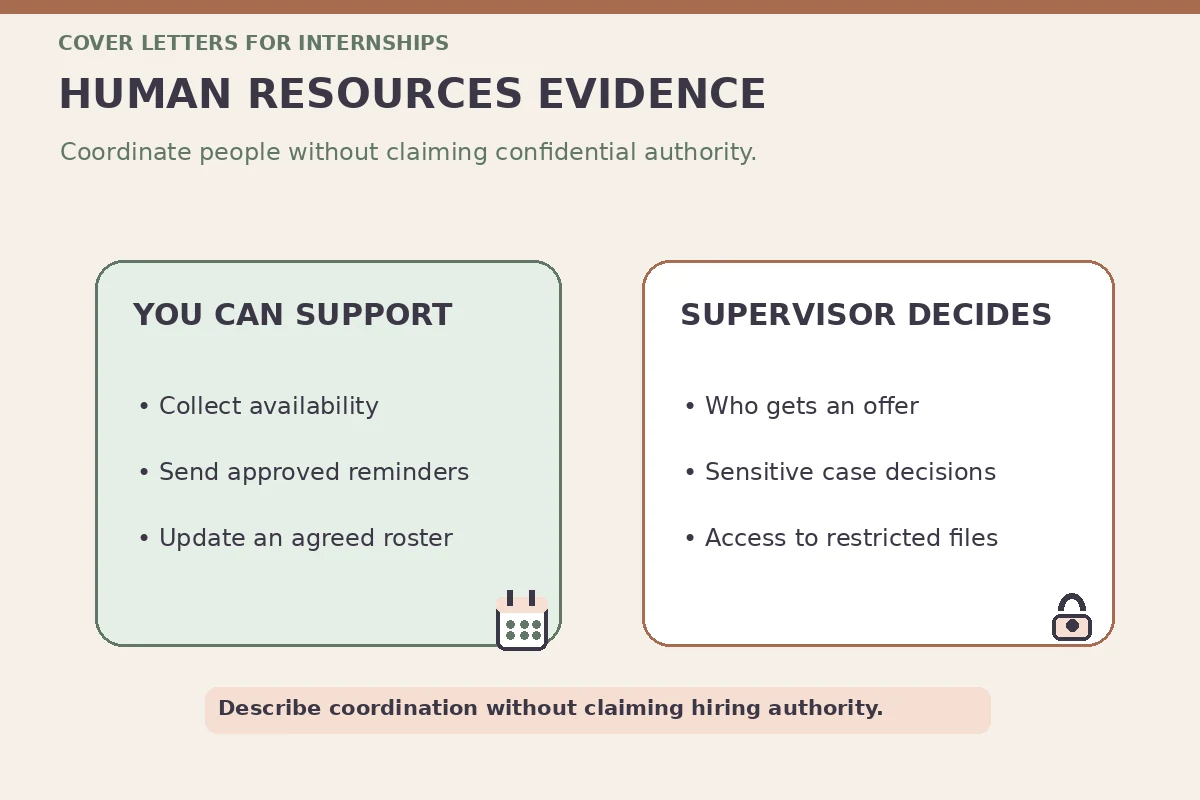
Imagine that a student organization assigned you to schedule orientation sessions. You collected availability through a permitted form, maintained a shared calendar, sent reminders and updated attendance after meetings. Your contribution is the process you organized; it is not ‘built a human resources program.’ A specific detail such as how you handled a scheduling conflict can demonstrate discretion and follow-through more effectively than saying ‘great people skills.’ Keep dates, counts and outcomes only if you can check them.
When describing records, avoid uploading sign-in sheets, student contact details or private messages as proof. A sanitized checklist, a blank scheduling template or a description of your method may be enough. If a class exercise used fictional personnel records, call them simulated records. An HR team needs people who know when not to share information, so an accurate boundary is an asset in a student application.
Use an example that sounds like an intern, not an HR director
The opening should give the job title, organization and a specific reason the internship’s support work interests you. The middle should offer one coordination story and explain why it is relevant. In the closing, name what you could assist with and what you want to learn. Avoid declaring that you can independently administer benefits, conduct investigations or choose candidates unless you actually held such responsibilities and the statement is appropriate to share.
Hypothetical opening: ‘I am interested in your Human Resources Intern position because the description emphasizes orientation planning and clear employee communication. As a student organization coordinator, I learned how much an accurate schedule and a timely reminder can matter to the people depending on them.’ The phrase should be edited to reflect an actual posting and a real experience rather than a generic claim about company culture.
Hypothetical evidence and closing: ‘I organized volunteer orientation sessions by collecting availability, preparing a shared calendar, and confirming changes with the team. When two sessions conflicted, I checked the available options with the coordinator before notifying participants. That experience taught me to communicate changes carefully and limit shared information to what each person needed. I would welcome the chance to support your onboarding and records workflows while learning the team’s privacy practices. Thank you for considering my application.’

Distinguish people skills from confidential authority
A weak sentence reads ‘I managed sensitive employee issues.’ If you only kept a school club roster, that would be misleading. A stronger statement is ‘I maintained a restricted volunteer contact list and followed the group’s sharing rules.’ The revised line identifies the actual data and process. If the list was not restricted or you did not manage access, do not claim it was. Employers may ask for examples, and an unembellished answer is easier to explain accurately.
Do not turn personal stories involving classmates or coworkers into recruitment anecdotes without their permission. If an event involved a complaint, describe how you referred it to the responsible person rather than retelling private allegations. Even a hypothetical example should not imply an intern has independent authority to access medical files, determine eligibility or disclose employee details. Clear boundaries keep the letter professional and reduce avoidable risk.
| Overstated phrase | Credible student-level evidence |
|---|---|
| Selected applicants | Coordinated interview times; the committee made decisions. |
| Managed employee records | Maintained a permitted student roster under existing rules. |
| Led orientation policy | Scheduled campus orientation logistics and reminders. |
Show evidence of written communication and follow-through
HR interns may need to prepare reminders, instructions or meeting logistics. A campus newsletter, club agenda or volunteer event can show that you wrote accurate messages for a real audience. Pick an example where you checked names, times, links or accessibility information before sending. If you corrected a mistake, explain the correction process rather than pretending mistakes never occurred. This shows your capacity to ask questions, use checklists and keep people informed.
If you worked with supervisors or team leaders, name your relationship to them. ‘Confirmed the final schedule with the event lead’ makes a more realistic claim than ‘approved staffing decisions.’ This also provides a credible answer if an interviewer asks how you handled competing priorities. Do not add company-specific HR software names unless you used those systems, and do not promise immediate access to regulated or confidential information.

Check the invitation, format and privacy wording
Before submitting, reread the internship listing for eligibility, location, work arrangement and requested files. Make the hiring team easy to identify in the letter; if you cannot find a person’s name, a straightforward hiring-team greeting is better than guessing. Check whether the organization asks for a letter as a PDF, a text entry, or a separate field. Follow the posted instructions. University career services recommend connecting specific experience to the role rather than sending the same generic letter everywhere.
Read each privacy-related sentence a second time. Replace broad claims about employee files with only the process you can discuss. Remove names and identifying details of classmates, clients or employees. Make sure your resume and cover letter describe the same activity at the same responsibility level. A student can look ready to learn HR operations without sounding as though they already hold authority the internship does not provide.
How We Research and apply this guidance
We checked career-center guidance and the U.S. Bureau of Labor Statistics occupational description on November 9, 2026. University of Pennsylvania Career Services emphasizes tailoring a non-academic letter and illustrating skills with particular examples; UC Berkeley emphasizes linking an application to the specific role and organization. The BLS duties provide occupational context, not proof of what an individual intern may do. All sample people, scenarios and quoted cover-letter passages here are hypothetical. Employer instructions and permission boundaries control any real submission.
Sources and further reading: University of Pennsylvania Career Services. UC Berkeley Career Engagement. U.S. Bureau of Labor Statistics. See our affiliate disclosure. No affiliate relationship is implied by these source citations.
More Resume and Cover Letter Guides
Yes, if it demonstrates relevant coordination or communication. Describe your actual duties and do not rename the club role as paid HR work.
Explain the process and safeguards without identifying people or revealing confidential content.
Do not claim software proficiency you lack. Name scheduling or document tools you used, then explain your willingness to learn employer systems.
Only if that accurately describes your authority. If others selected participants, say you helped schedule or organize the process.
Select two duties from the exact internship description, connect one real example, and explain why the organization and learning opportunity interest you.