
A software QA internship cover letter should show that you can explain what you tested, what happened, and how another person could check the result. You do not need to claim that you owned a production release. Select one class, volunteer, or personal project with a test plan or reproducible defect report, then connect its method to the internship posting. The letter should identify what you actually did and what you want to learn under supervision. This guide includes a hypothetical sample; adapt every claim to your own records.
Start with the testing work named in the posting
Read the internship description for concrete verbs: write test cases, explore a workflow, document defects, reproduce an issue, verify a fix, or communicate with developers. Circle two duties you have touched in an actual project and one duty you want to learn. If the employer mentions automated testing but your experience is entirely manual, do not rename manual checks as automation. You can explain a manual process and express interest in learning a specific tool once you know the team’s practices.
The BLS describes software QA analysts and testers as people who design test procedures, evaluate software, and report problems. That occupational summary helps you interpret duties, but it does not establish that every internship gives students the same access. For example, a classroom application may let you run tests freely while a real company’s production system requires permissions and an approved environment. Your cover letter should stay on the side of work you have actually performed.
Choose one bug report with a clear evidence chain
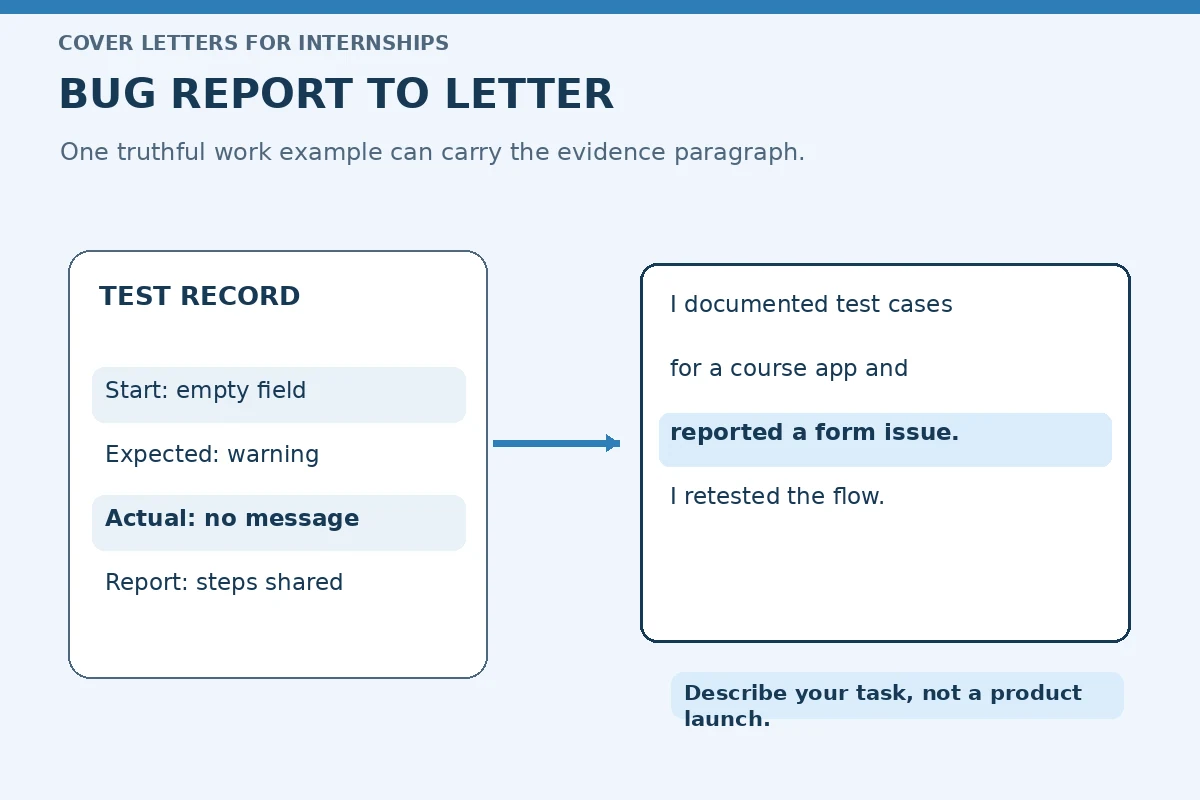
A usable student example begins with a defined starting condition. Suppose your team built a simple course-registration demo. You checked the form with an empty required field, recorded the steps to reproduce the problem, compared expected and observed behavior, and shared a short report with classmates. This is more persuasive than saying you ‘improved product quality’ when you have no deployment or customer evidence. Name the tool only if you truly used it, whether that was a spreadsheet, an issue tracker, or a test notebook.
Keep the chain short enough for a reader to verify: scenario, steps, expected result, actual result, and your communication. If a teammate fixed the bug, say that you documented or retested it, not that you built the fix. If you do not have a screenshot or public repository, a descriptive sentence can still show testing judgment. Never upload private code, accounts or user data as a writing sample just to make the letter look more technical.

Write the letter around the method rather than the tool list
A practical opening identifies the specific QA internship and why its stated testing work interests you. Do not replace this with a paragraph about how much you love technology. The middle should demonstrate one short example. The closing can name a reasonable next step, such as discussing a permitted class project or explaining your test case. The entire letter should usually fit on a page, with the most useful evidence visible early rather than buried in a catalog of coursework.
Hypothetical opening: ‘I am applying for the Software Quality Assurance Intern position because your description emphasizes clear defect reports and careful retesting. In my software testing course, I practiced turning an ambiguous form failure into steps another teammate could follow.’ This does not invent a company product or a specific internship requirement; swap in the real job title and only the duties that appear in the posting.
Hypothetical evidence and closing: ‘For a class registration demo, I wrote test cases for required fields and recorded the expected and actual outcomes when validation failed. I shared the reproduction steps with the team and checked the revised flow after a classmate updated the form. I would welcome the opportunity to learn your team’s review process and contribute carefully documented tests under the appropriate guidance. Thank you for considering my application.’
Make vague technical statements measurable without inventing results
Instead of ‘I am skilled at finding bugs,’ describe an action a reviewer could recognize: ‘I recorded the browser, test inputs, reproduction steps, and expected behavior for a form-validation issue in a class app.’ This is a useful detail even without numerical claims. If you did run a documented set of cases, you may name the actual count, but do not estimate percentages or assert that your work prevented incidents. A QA letter needs accuracy more than impressive-looking numbers.
Ask whether each statement would be supported by your notes, code, or classmates’ recollections. Distinguish writing test cases from designing the product, reporting a defect from repairing it, and retesting from approving a release. The first statement tells the employer what you can already do; the other distinctions tell them you understand teamwork and access boundaries. Employers can assess a teachable intern from a small honest example.
| Vague claim | Evidence-based alternative |
|---|---|
| Found critical bugs | Documented a reproducible form-validation issue in a class demo. |
| Automated all testing | Created simple assertions for a course exercise, if true. |
| Released a flawless app | Retested an assigned flow after a classmate made changes. |
Address tools, access and teamwork responsibly
You may list a version-control system, testing framework, browser developer tool or issue tracker if you used it. Describe your level concretely: ‘created simple assertions in a course exercise’ is more credible than ‘expert automation engineer.’ When you worked in a group, separate your contribution from the team’s output. The cover letter can say you coordinated test findings without implying that you managed engineers or reviewed confidential customer records.
QA work may involve sensitive accounts or real user activity. Never disclose a real vulnerability, working credential or personal record in an application sample. Use a sanitized description or a public, permitted project. If the posting expects familiarity with security testing, distinguish basic functional checks from penetration testing; an internship application is not permission to probe an employer’s systems. Your interest in learning can be specific without promising access you have not received.

Review the final page like a small quality check
Before sending, confirm the employer name, position and term against the listing. Compare every tool named in your letter with the resume and your actual work. Read the sample aloud to detect vague verbs, duplicated words and invented ownership. Save the document using an ordinary professional filename, then open the final PDF to check line breaks and legibility. If the portal requests text rather than a PDF, paste a plain version and preview the submission rather than trusting the editor’s formatting.
A useful last test is to ask a classmate to identify the one project you are offering as evidence after a single read. If the answer is ‘lots of technical skills’ rather than a specific test case, remove generic language. Keep the project details that show method, limits, and communication. A clear QA cover letter cannot guarantee an interview; it simply gives the reader a trustworthy starting point for a conversation.
How We Research and apply this guidance
We checked career-center guidance and the U.S. Bureau of Labor Statistics occupational description on November 9, 2026. University of Pennsylvania Career Services emphasizes tailoring a non-academic letter and illustrating skills with particular examples; UC Berkeley emphasizes linking an application to the specific role and organization. The BLS duties provide occupational context, not proof of what an individual intern may do. All sample people, scenarios and quoted cover-letter passages here are hypothetical. Employer instructions and permission boundaries control any real submission.
Sources and further reading: University of Pennsylvania Career Services. UC Berkeley Career Engagement. U.S. Bureau of Labor Statistics. See our affiliate disclosure. No affiliate relationship is implied by these source citations.
More Resume and Cover Letter Guides
Not necessarily. A course or permitted personal project can provide relevant evidence. Label its context and describe your own test work accurately.
Do not expose proprietary systems or user data. Use a public, permitted example or a sanitized process description that you have permission to share.
No. Choose tools that match the posting and that you have actually used. One clear test method is more helpful than an unverified inventory.
Name manual test design and documentation honestly. Show interest in learning automation without claiming you already built automated suites.
No. It is hypothetical. Replace the project, duties, company interest, and outcomes with evidence from your own history.