
It support self-appraisal: For an IT support self-appraisal, describe which user problems you diagnosed, how you documented work, where you escalated issues and what you learned. Use approved aggregate ticket or service records when they exist, not private screenshots, user names or invented resolution rates. A useful review distinguishes your direct contribution from a team fix and adds one next-step goal tied to your actual role.
Separate ticket ownership from the final resolution
A completed ticket may involve a first-line analyst, an infrastructure engineer, a security team and the requesting user. O*NET lists providing technical assistance and helping users with software or hardware problems among common support duties, but an occupational description does not make every technician the owner of every fix. For each example, identify the request category, your diagnostic step, the point of handoff and the outcome you could verify. If another team resolved the root cause, do not claim that final resolution as your own. A correct handoff is work worth naming.
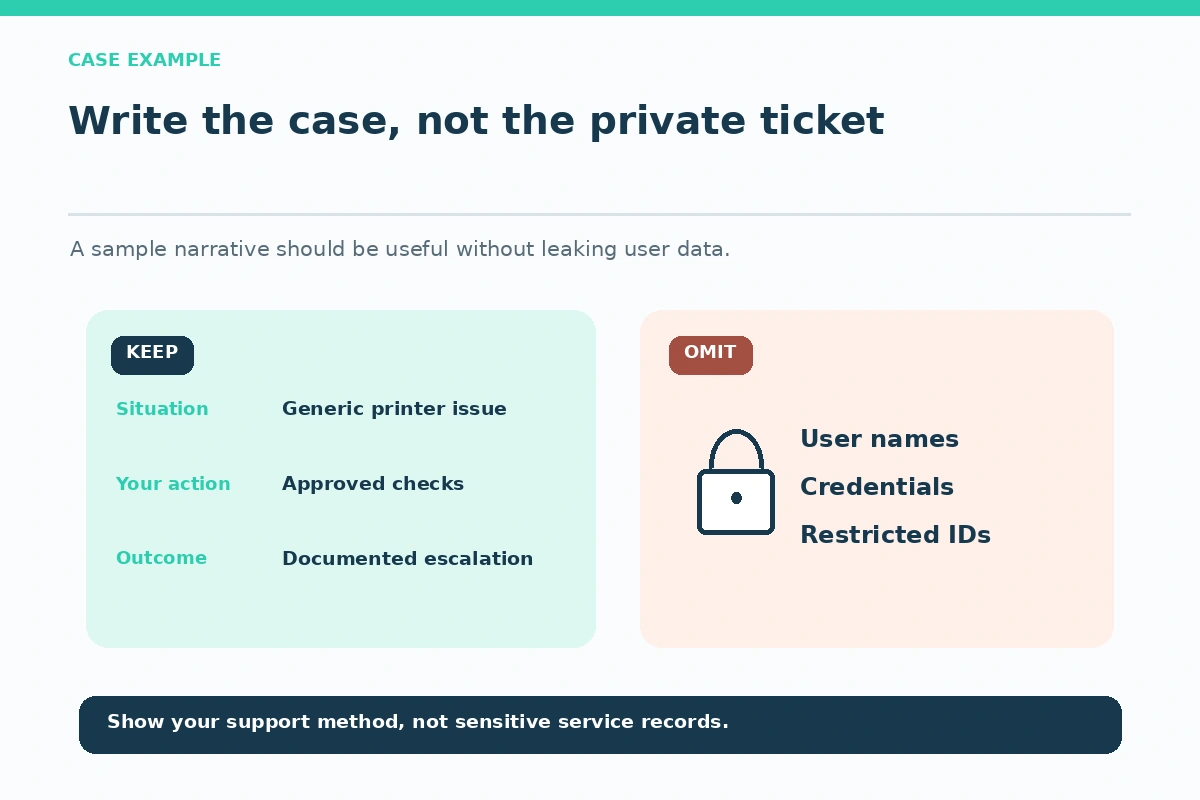
Build a private evidence list before writing. Possible entries include confirming reported symptoms, reproducing an error safely, checking approved knowledge-base steps, documenting what was tried and routing the ticket to the proper queue. A hypothetical self-appraisal line is: “I improved my escalation notes by recording the user-visible issue, attempted checks and the reason for referral.” Use this only if it reflects your documented work. Do not paste ticket IDs, user credentials, customer narratives or restricted system details into a broadly shared review form.
Select quality signals instead of claiming raw ticket volume
Ticket counts can tell part of the story, but total volume varies with assignment mix, incident complexity, hours and queue ownership. A specialist assigned to complex escalations may close fewer requests than someone answering routine password questions. The OPM performance-standard framework distinguishes quality, quantity and timeliness and asks that measures be defined clearly. If your employer supplied a target, name the agreed measure and period accurately. If the dashboard has incomplete periods or shared queue data, explain that limitation rather than presenting a precise personal success rate.
Quality examples may include complete notes, repeatable troubleshooting steps, appropriate priority selection, accessible user instructions and clean handoffs. If you can verify a pattern, describe it without inventing improvement percentages: “During the review period, I used the approved incident template consistently and flagged incomplete requests for clarification.” If someone else evaluated your ticket quality, cite the actual feedback rather than treating a self-rated score as an independently measured result. This is also a good place to acknowledge a documented gap, such as needing to ask for context sooner.

Turn one support case into an evidence-based narrative
For a useful example, select a routine, non-sensitive scenario you can discuss without naming a real customer. A fictional case: a user could not print after a software update; the analyst checked connectivity and approved printer settings, recorded results and referred a driver issue to desktop engineering. A responsible self-appraisal says, “I isolated the likely workstation issue and passed a reproducible summary to the desktop team.” It does not say, “I fixed a company-wide printer outage,” unless the employee actually did so.
The structure is context, personal action, outcome and follow-up. Context tells the reviewer what problem the employee faced; action sets the boundary of ownership; outcome records only what is known; follow-up explains the repeatable improvement. If a case was unresolved at your shift end, the honest outcome may be “completed a documented escalation before handoff.” The aim is not to rewrite a confidential ticket into a story. It is to show transferable diagnostic and communication behavior, using the privacy rules of your organization.
Describe documentation and knowledge sharing precisely
Support teams often benefit when employees improve troubleshooting notes or share a verified resolution with colleagues. Distinguish drafting a knowledge-base article from publishing an approved article. If you authored a draft but a senior engineer checked it, write “drafted steps for review,” not “approved a company-wide troubleshooting standard.” Likewise, training a coworker on an authorized process is different from having formal administrator privileges or being responsible for that coworker’s performance.
A hypothetical review statement might read: “I documented common troubleshooting questions in a draft reference and incorporated peer corrections before submitting it for approval.” That shows learning and collaboration without guessing at a measurable service effect. Do not include configuration secrets, screenshots with identifiable accounts or a link that reviewers cannot access. A short description of the process and the approved artifact type is sufficient. UC Berkeley’s review guidance includes work samples and professional development as possible inputs, but access and confidentiality still govern what may be shared.
Acknowledge improvement needs without creating false negatives
A self-appraisal is not only a list of accomplishments. If you found that escalation notes sometimes lacked troubleshooting context, identify the pattern, a specific change and how you will check improvement. Avoid self-blame for outages, staffing shortages or policy decisions outside your control. A constructive draft could say: “I sometimes delayed escalation while searching for a solution. Next cycle I will use the team’s escalation criteria earlier and seek feedback on the completeness of my notes.” The statement belongs only where it is truthful.
For goals, ask your manager what success looks like under the existing performance plan. You might propose mastering an approved diagnostic workflow, learning to write concise instructions or improving knowledge-base review handoffs. Do not promise a certification, promotion or fixed reduction in incident time before one is supported. The next review should use evidence gathered during the period, not a retrospective guess based on a single busy week. Focus on behavior you can control and evidence your organization permits you to retain.
Use a final IT self-appraisal checklist before submitting
Review each sentence for ownership, source and privacy. Can you explain the ticket type without disclosing a person or environment? Does “resolved” mean you performed the final fix, or should you write “diagnosed and escalated”? Is a count for your own queue and the full review period? Was the documentation a draft, a reviewed article or simply a note? If you cannot verify a figure, remove it. An accurately scoped qualitative example is stronger than an impressive but unsupported percentage.
Close with two or three priority contributions, one genuine improvement area and a concrete request for support, such as coaching on a new queue or time to review approved procedures. Do not give yourself a rating that conflicts with the organization’s stated scale without explaining the reasoning. Share the draft through the authorized review system and request correction if an evidence source is mislabeled. This produces an IT support self-appraisal a manager can discuss rather than an uncheckable list of technical claims.

How We Research Performance Reviews
JobAsk reviewed these authoritative workplace and occupational sources on November 4, 2026: O*NET: Computer User Support Specialists (O*NET describes computer user support duties such as diagnosing problems and supporting users). UC Berkeley: Preparing for the Review (UC Berkeley recommends self-appraisals, work evidence and discussion of improvements). OPM: Developing Performance Standards (OPM separates performance elements from objective measurable standards). The guidance identifies useful review practices, but none of these sources verifies an individual reader’s work performance or employer-specific review procedure.
Every sample comment and illustration above is hypothetical, including references to employees, managers and projects. Use your organization’s real expectations, review period and authorized evidence. For commercial and editorial context, see our affiliate disclosure. This article does not claim paid endorsement, legal advice or a guaranteed appraisal outcome.
Explore Related Career Guides
Only when a reliable report defines your own tickets and review period. Include work mix and context; never fabricate counts.
Discuss the kind of task and your approved actions in generic terms. Avoid user identifiers, screenshots, credentials, secret configurations and restricted incident details.
Name the diagnosis or escalation you performed. Do not claim responsibility for another team’s final fix.
Use verified qualitative cases, reviewer feedback and authorized documentation; do not invent numeric benchmarks.
Distinguish drafting, editing, testing and final approval, and use the precise stage you completed.