
Employee feedback to company examples: Employee feedback to a company is most useful when it identifies an observable work problem or helpful practice, describes its effect and proposes a realistic next step. Feedback is not the same as a self-rating, an accusation about a coworker or a guarantee that management must adopt an idea. Choose a suitable channel, remove confidential details and be clear about the result you are asking leadership to consider.
Choose a channel that matches the issue and audience
A performance review may include a question about how the organization supports your work. A staff survey can ask about processes or culture across many departments. A one-on-one can handle a sensitive handoff issue; a dedicated reporting procedure may be required for safety concerns or discrimination. These channels serve different purposes. CDC/NIOSH guidance on two-way workplace communication describes options such as surveys, suggestion systems, meetings and anonymous feedback, alongside the need to respond to employee input.
Before writing, identify whether you want to recognize something that helps, request a process change, ask for training or report a problem that should follow a formal procedure. Do not treat an anonymous survey as a secure channel for reporting emergencies. Privacy, retaliation concerns and legal protections vary by circumstances and employer; this article is not a substitute for a workplace policy or professional advice. If the concern is urgent, use the designated organizational channel rather than waiting for an annual feedback form.
Use observation, impact, suggestion, and ownership
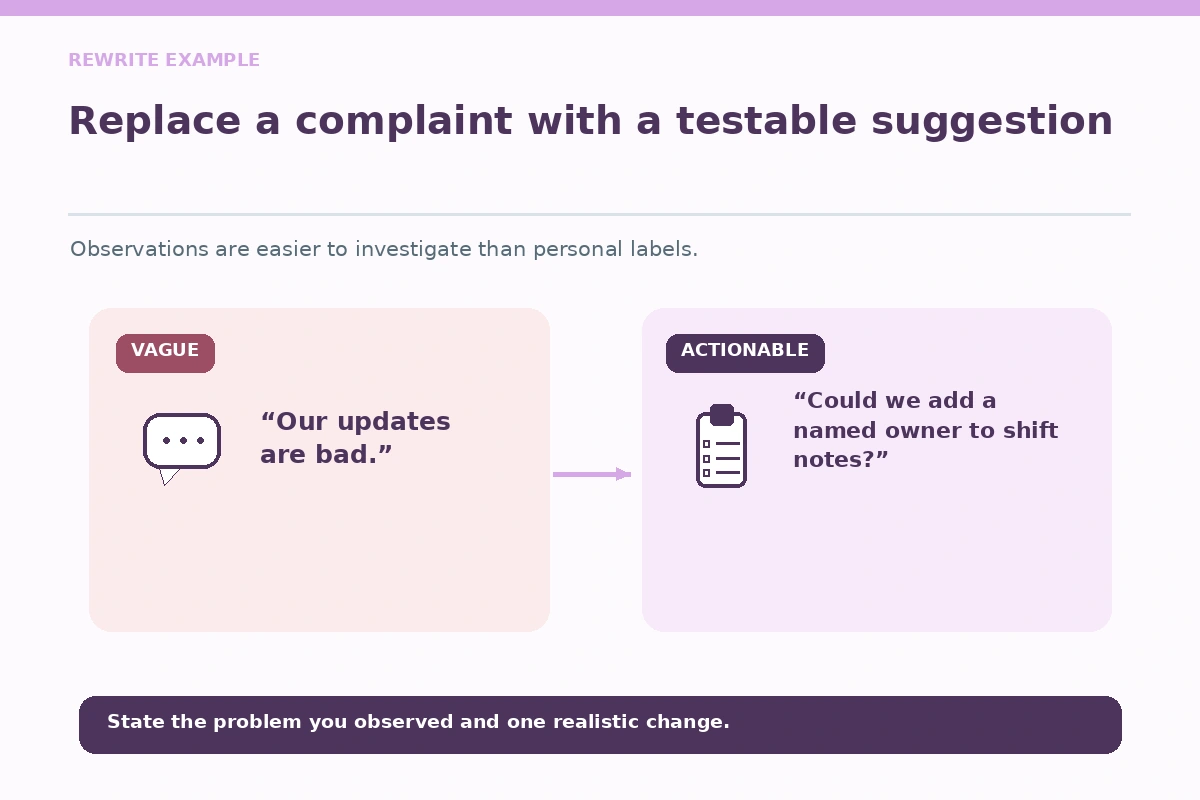
General statements such as “communication is terrible” make it difficult to find a fix. A better hypothetical example is: “Our shift handoff notes sometimes omit the current request owner, so the next shift spends time clarifying responsibility. Could we test a required owner field in the template?” It names the observable friction, explains the impact and suggests a manageable experiment. Do not state that all employees agree unless you gathered and may share that evidence. Keep the comment about a process rather than a person’s character.
For positive feedback, use the same structure. “The new onboarding checklist made it easier for me to locate approved procedures; please keep the version history visible” is more actionable than “everything is great.” Avoid inventing a company-wide benefit from your individual experience. If you are unsure why a process exists, ask a question first. The organization may face regulatory, technical or budget constraints you cannot see, and a constructive suggestion leaves room for an explanation or a smaller pilot.

Write training and workload comments without blame
Training suggestions should identify a task that is hard to perform with current resources and what support would help. Hypothetical wording: “New staff can locate the policies, but we do not have a practice session for the approval workflow. A short supervised walkthrough could help clarify when to escalate.” This does not claim new employees are incompetent; it describes a missing work aid. The request can be evaluated against schedule and role requirements instead of treating a complaint as a personal attack.
Workload feedback is more credible when it separates a temporary peak from a recurring mismatch between tasks and coverage. “During month-end close, two approval steps converge on the same shift; can we review handoff coverage?” describes an operational bottleneck without naming coworkers or guessing about staffing plans. Never attach private schedules, medical details or personnel files to prove a point. If a constraint requires an urgent accommodation or protected reporting path, use the appropriate workplace process rather than relying solely on a generic survey answer.
Distinguish company feedback from rating your manager
A review may ask, “What should the company change?” That is not identical to “How is your manager performing?” Organization-level comments should focus on policies, systems, training access, onboarding, tools or coordination that the company can address. Feedback about an individual manager may need a more specific channel, a factual incident and the organization’s policy for upward feedback. Avoid rumors or unsupported motives. It is usually more useful to describe the observable approval delay than to speculate that a manager does not care.
A possible response is: “Team leads use different versions of the request form. A single published version with a change log would reduce rework between teams.” That leaves room for the employer to assign ownership and investigate. Where leadership has already improved a process, acknowledge the effect on your own work and request a small follow-up. The Cornell performance dialogue framework emphasizes results, development and support needs; your comment can connect company support to those categories without becoming an employee self-appraisal.
Protect confidentiality and use anonymous channels carefully
A short feedback comment should not contain customer accounts, medical information, payroll records, private conversations or identifiable complaints about coworkers. In a small team, even a supposedly anonymous quote can reveal who wrote it. Avoid submitting detailed anecdotes that identify a patient, client or colleague indirectly. If the problem involves harassment, retaliation, security or another serious concern, use your organization’s designated reporting process and obtain appropriate advice as needed.
Anonymity promises depend on the survey provider and the employer’s actual setup; no online writing guide can verify that an individual response cannot be connected to the sender. If the question is optional, choose a reasonable level of detail and consider whether the intended channel is appropriate. You can still ask for a process improvement without giving an unnecessary personal history. Good company feedback is careful with evidence, not merely polite in tone. The intended reader should understand what could change while the submitter respects other people’s privacy.
Finish with a test, owner, and feedback loop
A suggestion becomes practical when it identifies who could review it and how the team would learn whether it helped. For example: “Could the operations team pilot a shared handoff checklist for one cycle and ask the next shift whether missing owner fields decreased?” This is an illustrative proposal, not a claim that the pilot worked. Keep the first experiment proportionate. If the company declines a request, employees may still benefit from an explanation of the relevant constraint or an alternative path.
Before submitting, ask four questions: Is the observation firsthand or clearly attributed? Is the impact stated without exaggeration? Is the suggestion within a plausible company process? Could the wording expose someone else? You do not need to write every issue into a single comment. Select the most concrete one or two, include a positive practice worth keeping, and invite a short follow-up where the channel permits. Your goal is a useful conversation about operating conditions, not a performance rating you can force management to accept.

How We Research Performance Reviews
JobAsk reviewed these authoritative workplace and occupational sources on November 4, 2026: CDC/NIOSH: Two-Way Communication (CDC/NIOSH describes surveys and other two-way feedback channels, with response communication). Cornell: Performance Dialogues (Cornell performance dialogue framework includes strengths, development and support needs). UC Berkeley: Preparing for the Review (UC Berkeley recommends a private review dialogue in which employee input is included). The guidance identifies useful review practices, but none of these sources verifies an individual reader’s work performance or employer-specific review procedure.
Every sample comment and illustration above is hypothetical, including references to employees, managers and projects. Use your organization’s real expectations, review period and authorized evidence. For commercial and editorial context, see our affiliate disclosure. This article does not claim paid endorsement, legal advice or a guaranteed appraisal outcome.
Explore Related Career Guides
You can offer a specific, professional observation through an appropriate channel. Check workplace rules and use formal reporting channels for protected or urgent concerns.
Name a practice that helped your own work and suggest what to preserve, rather than stating all staff experienced the same outcome.
Avoid identifying other people or sensitive details in a general survey. Use designated confidential reporting processes where needed.
Not necessarily. The actual survey setup and small-team context determine how identifiable a response may be.
Usually one concrete observation, its work impact and a reasonable next step is more useful than several unrelated complaints.