
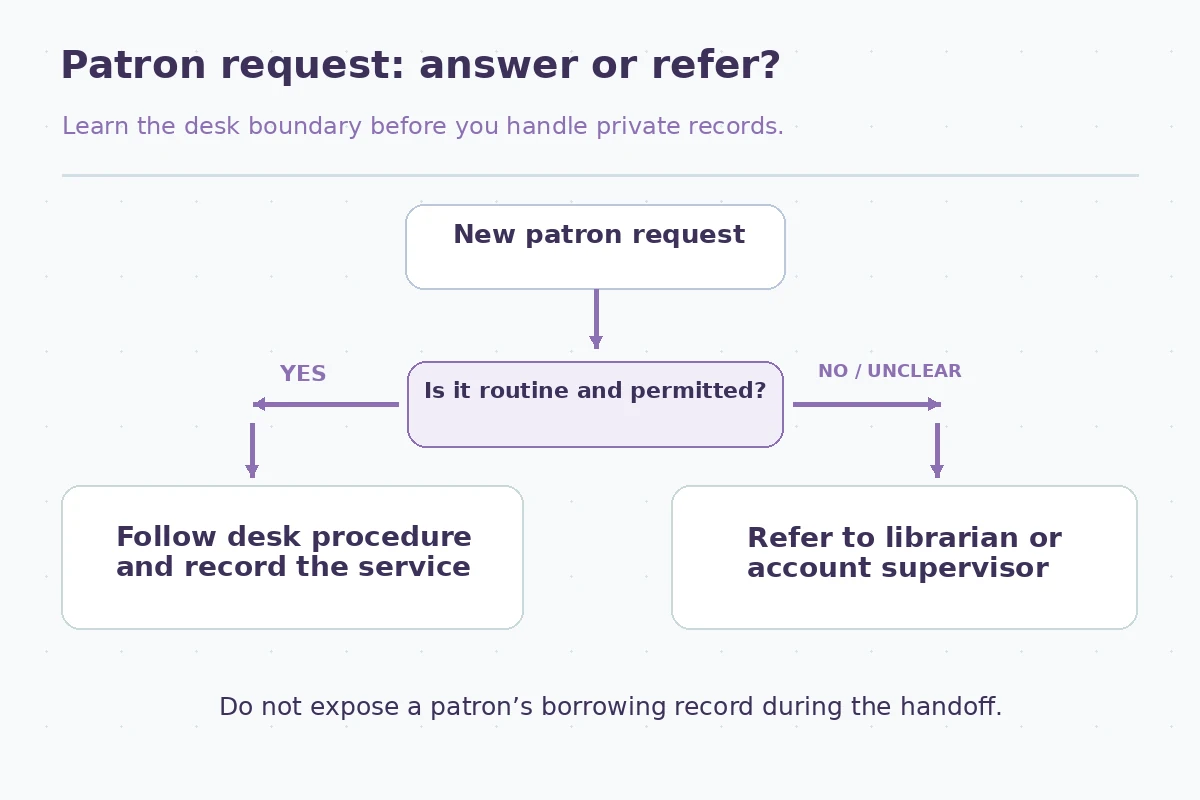
If you are interviewing for a library assistant or technician position, arrive with three or four questions that reveal the actual work rather than asking only about culture. A helpful library interview should reveal how a patron request moves from the desk to the right person while circulation records stay private. Start by checking the job description, choose questions the interviewer can realistically answer, and take brief notes on who reviews or approves the important steps. The questions below are designed for candidates learning about a role; they are not claims about the policies of any particular employer.
Libraries may divide work among pages, clerical assistants, library technicians, librarians, and public-service staff. Training, authority, and patron-service rules depend on the employer. Do not assume access to a patron account authorizes public discussion of borrowing history, account changes, or decisions reserved for another role. According to the University of Michigan Career Center, preparing approximately three to five employer questions helps you learn whether a job fits, and the right questions depend on the interview stage and the person answering. The wording below is a practical starting point: adapt it to what you have already been told instead of reading a script. All example conversations are hypothetical.
Clarify which desk duties belong to this position
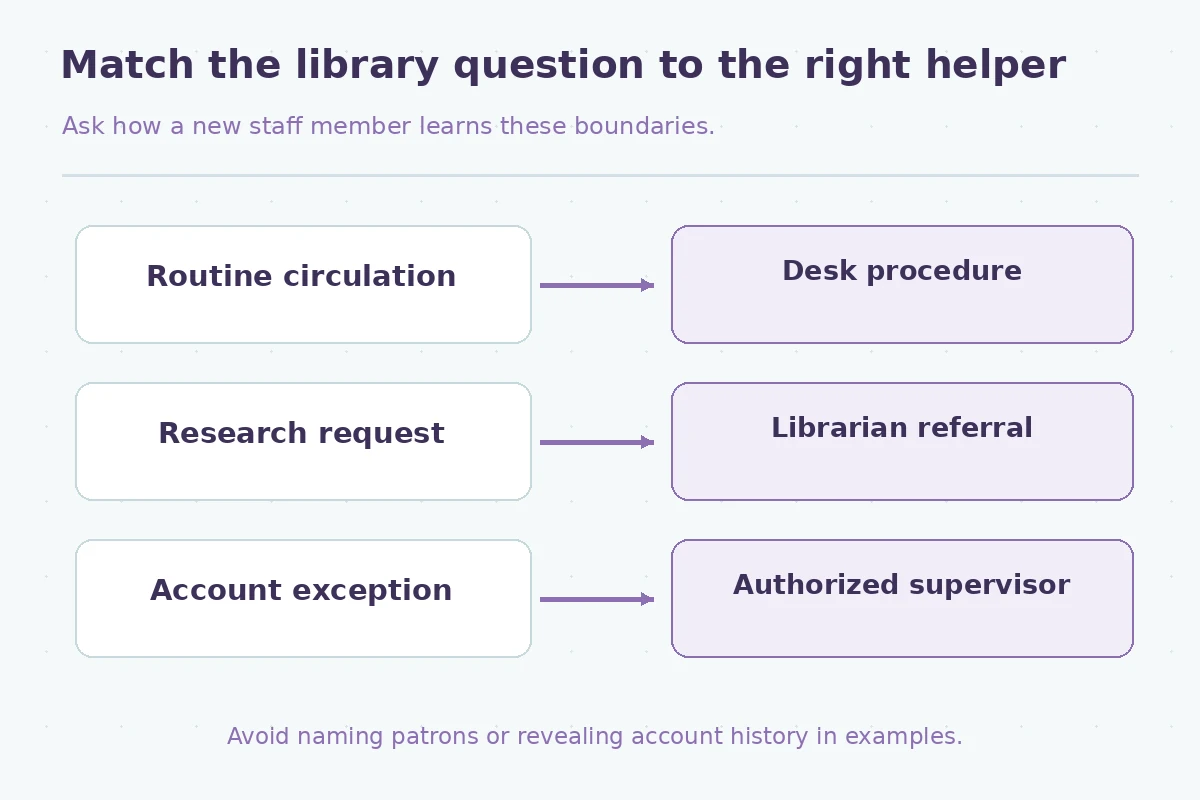
Ask: ‘Which tasks will I handle at the circulation desk, and which situations go to a librarian or supervisor?’ You might hear about issuing library cards, checking items in and out, resolving an ordinary hold, or directing a patron to research help. The division matters more than the job title because different library systems distribute tasks differently. Follow with: ‘What written procedure does the team use when a patron disputes a fee or account restriction?’ You are checking whether new employees have instructions and support, not trying to determine the correct fee policy during the interview.
Learn how patron information is protected
Ask: ‘What training is provided before staff use patron accounts, and how are privacy questions escalated?’ A good response identifies controlled access, a reason for opening a record, and someone to contact when a request falls outside the worker’s authority. Do not ask to view actual borrowers, account balances, circulation histories, or screenshots from the library system. If the interviewer says ‘everyone can see everything,’ clarify whether access is role-based or how misuse is prevented. The interviewer’s answer is a clue to the organization’s working culture, not evidence of a specific legal breach.
Explore shelving accuracy and missing-item workflows
A question like ‘How does the branch track mis-shelved items and materials that cannot be located?’ shows that routine work has an accuracy component. Ask whether the role uses shelving maps, call-number practice, scanning checks, or a daily exception list. The interviewer need not share internal logs. You want to know how an item is marked, where discrepancies are recorded, and who confirms a status change in the catalog. If the library uses several branches, ask how transfers are documented. This offers a better understanding of service reliability than simply asking whether the work is busy.
Use a question-to-evidence comparison table
A question is useful when the answer tells you something you can verify later: the person who approves, the document the team uses, the training step, or the process for reporting an exception. This comparison grid captures the decision behind each question, so you can tell whether the interviewer actually answered it. If a topic was already covered naturally, replace the prepared question with a brief, relevant follow-up rather than forcing a repeated conversation.
| Decision point | Ask the interviewer | Listen for |
|---|---|---|
| Circulation | Which requests can I finish? | Desk rules and escalation point |
| Patron privacy | How is access taught? | Training and limited access |
| Missing items | Where is an exception logged? | Records and reviewer |
| Research help | When do I refer? | Clear librarian handoff |
Ask what support exists during difficult patron moments
Try: ‘When the service desk becomes busy or a patron is upset, how do staff get assistance?’ Different branches may have desk partners, a lead worker, a security contact, or a librarian nearby. You are asking about the handoff process and training, not seeking a guarantee that no conflict ever occurs. Follow with: ‘Which requests should not be handled independently by a new employee?’ Pay attention to whether the team gives clear boundaries around complaints, emergencies, and account records. Good training leaves room for respectful service and timely escalation without requiring staff to improvise beyond their role.

Understand the difference between brief help and research
Ask: ‘What kinds of questions can this role answer directly, and when should I refer someone for deeper research support?’ O*NET’s technician description includes helping readers locate materials and referring some inquiries to librarians. That does not mean every library follows an identical credential or task structure. The interviewer can explain whether you help people navigate the catalog, demonstrate basic computer use, provide directions, or schedule specialist assistance. Ask how a referral is recorded so the patron does not have to repeat the request. The answer reveals both service quality and realistic training expectations.
Turn vague questions into useful follow-ups
A broad prompt: “Do you help people?” A useful version: “Which circulation requests can a new assistant complete, and which go to the librarian?” If the manager says “we handle all questions,” ask “How do staff hand off reference requests or sensitive account disputes that need a specialist?” Neither example should be asked verbatim if the interviewer already explained the process. A considerate candidate connects a follow-up to the employer’s answer: “You mentioned a shared queue. How does a new hire learn when to escalate an item?” That demonstrates listening while keeping your goal to understand the job rather than impress someone with jargon.
It is also useful to avoid questions that ask for restricted account details, identifiable personal records, private supplier terms, or internal performance numbers. Ask for the method and boundaries instead. If an interviewer cannot give a detailed response in a short screening call, note the subject and return to it in a later discussion with a manager. Silence or a partial answer is a reason to clarify at an appropriate stage, not proof that the organization lacks a policy.
End with staffing, learning, and service evidence
Near the end, ask: ‘What would successful service look like during my first month at this branch?’ A useful answer might involve accurate circulation records, consistent shelving practices, patient catalog help, and appropriate referrals. Ask about desk rotation, evening or weekend coverage, and training across branch systems if those factors affect the job. Keep the scheduling question specific and relevant rather than making assumptions about work hours. Use the response to decide whether you can describe transferable experience in accurate records, customer service, and respectful handling of private information.
Choose three priorities before the meeting
Prepare one operational question, one training or scope question, and one question about how good work is reviewed. If there is time, retain a fourth question about patron request and handoff to the next employee. Put the highest-value question first so a short interview still produces useful information. In your notes, mark whether the interviewer gave a specific example, named a reviewer, described a documented process, or deferred the answer. This is an organizing device for your decision, not a score for the employer.
A short follow-up email should thank the person for the conversation without requesting confidential examples. If a concrete gap remains, ask one narrow question such as ‘Who normally reviews this step during onboarding?’ rather than sending the entire list again. Before accepting an offer, compare the interview account with the written job description and any practical terms you receive. Do not treat an exploratory answer as a contractual promise. Your own goal is to understand expectations accurately and decide whether the day-to-day work matches the position you applied for.
How We Research and Verify Interview Guidance
We reviewed the University of Michigan and Santa Clara University career-center guidance on preparing role-relevant questions, together with the O*NET occupational description for library assistant or technician work. O*NET distinguishes clerical library assistants and technicians; its descriptions include circulation and reference support but do not authorize every employee to resolve specialized inquiries. We distinguished broad occupational duties from employer-specific authority and used only hypothetical interview exchanges. Source review date: November 15, 2026.
Sources consulted: University of Michigan Career Center — Interviewing Resources; Santa Clara University Career Center — Practice for Interviews; O*NET — role duties and related occupational profile. Each source helps frame questions; none tells us the policies of a specific employer.
Reader trust and commercial relationships are explained in the JobAsk affiliate disclosure. This page is independent career education; it does not guarantee an interview outcome.
More Interview Preparation Guides
Yes. Ask about training, access rules, and whom to contact, not for any actual borrowing history or personal account.
Yes. Accurate shelving and item-status records affect whether patrons and staff can find materials; ask how errors are identified and corrected.
No. Titles and scopes differ. Ask which reference requests, accounts, and decisions belong to your specific role.
Focus on the branch escalation process, available support, and any training rather than asking for private incident details.
Shift your questions toward shelving routes, material handling, location checks, and who reviews exceptions in that position.