
If you are interviewing for a logistics or shipping coordinator position, arrive with three or four questions that reveal the actual work rather than asking only about culture. Logistics interviewing should make the movement of information as visible as the movement of goods: who updates the record, who contacts the carrier, and who resolves an exception. Start by checking the job description, choose questions the interviewer can realistically answer, and take brief notes on who reviews or approves the important steps. The questions below are designed for candidates learning about a role; they are not claims about the policies of any particular employer.
Shipping and logistics teams may track shipments, plan routes, prepare records, reconcile shortages, and respond to exceptions. Whether a role can change routes or spending depends on local process. Do not assume the person tracking a shipment may approve freight changes, override a delivery record, or promise arrival times on behalf of a carrier. According to the University of Michigan Career Center, preparing approximately three to five employer questions helps you learn whether a job fits, and the right questions depend on the interview stage and the person answering. The wording below is a practical starting point: adapt it to what you have already been told instead of reading a script. All example conversations are hypothetical.
Ask how a shipment becomes a reliable record
Start with: ‘What information must be confirmed before a shipment is marked ready to ship?’ The interviewer might mention item counts, packing lists, order numbers, destination details, carrier instructions, or weight. Those are examples; each workplace uses its own controls. Ask which document is considered the source of truth and who corrects a mismatch. This matters because a tracking screen alone may show a status that was entered earlier or by another team. A role that handles shipment data needs a clear handoff from physical checks to electronic records without pretending that a scan proves every item is correct.
Identify ownership of carrier updates and delay notices
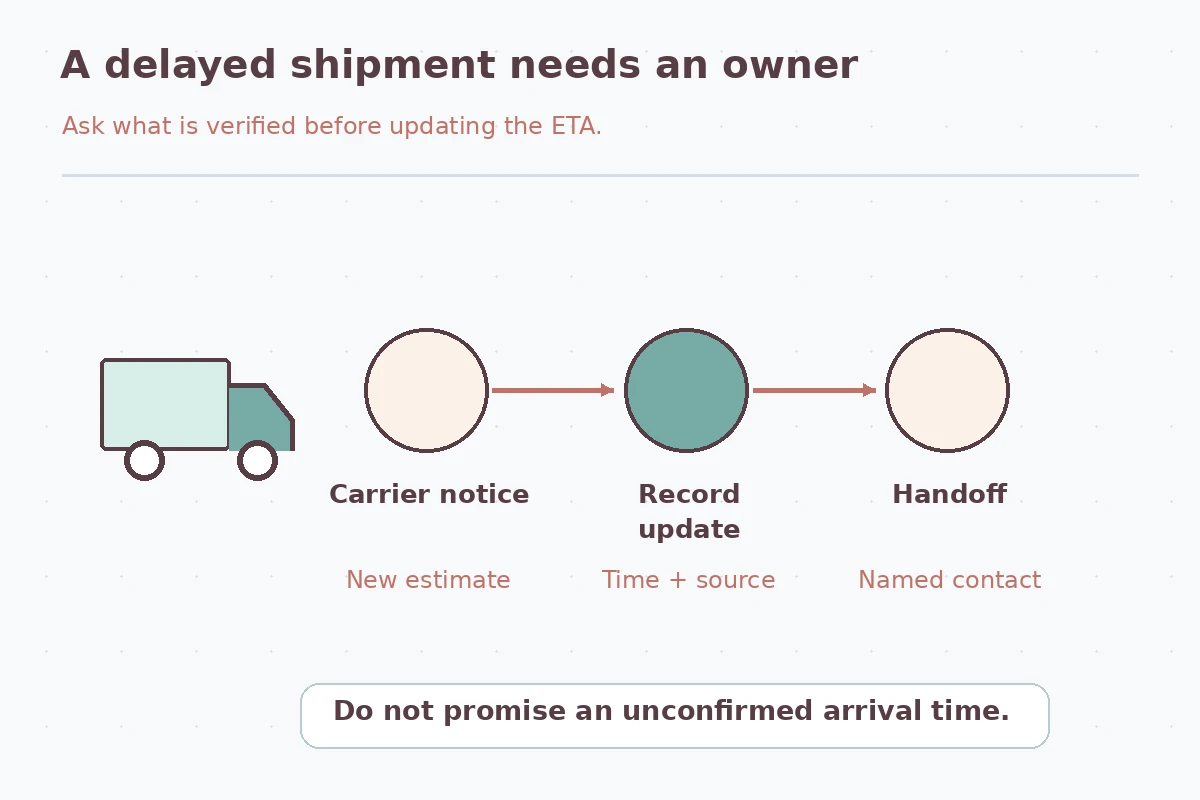
Ask: ‘Who contacts the carrier when pickup changes, and who is responsible for updating the customer or internal team?’ This separates receiving information from making a promise. Follow with: ‘What happens if the carrier’s estimated arrival time changes after we notify the customer?’ Listen for a method of recording the update, contacting stakeholders, and escalating disputed information. Do not ask the interviewer to disclose a real customer’s shipment or proprietary tracking details. Your aim is to learn how the job turns an uncertain ETA into a transparent update, not a guarantee that every package arrives on schedule.
Learn what happens to damage and shortages
Try: ‘If received quantities differ from the manifest, how is that difference recorded and resolved?’ O*NET describes verification against shipment records and discrepancy logging in shipping and receiving work. The interviewer can explain when staff count again, create an exception report, notify procurement or a manager, and hold the affected inventory. Ask who has authority to change on-hand quantities or approve a replacement. Good logistics work is not just moving quickly; it prevents an unverified quantity from flowing into purchasing, invoicing, or a customer promise. Avoid saying you would edit counts merely to reconcile a screen.
Use a question-to-evidence comparison table
A question is useful when the answer tells you something you can verify later: the person who approves, the document the team uses, the training step, or the process for reporting an exception. This comparison grid captures the decision behind each question, so you can tell whether the interviewer actually answered it. If a topic was already covered naturally, replace the prepared question with a brief, relevant follow-up rather than forcing a repeated conversation.
| Decision point | Ask the interviewer | Listen for |
|---|---|---|
| Shipment ready | Who confirms count and label? | Source record and signoff |
| Delay | Who communicates the changed ETA? | Owner, timestamp and caveat |
| Shortage | Who updates inventory? | Exception and authorization |
| Shift change | What remains open? | Shared queue and next owner |
Examine the shift handoff under real constraints
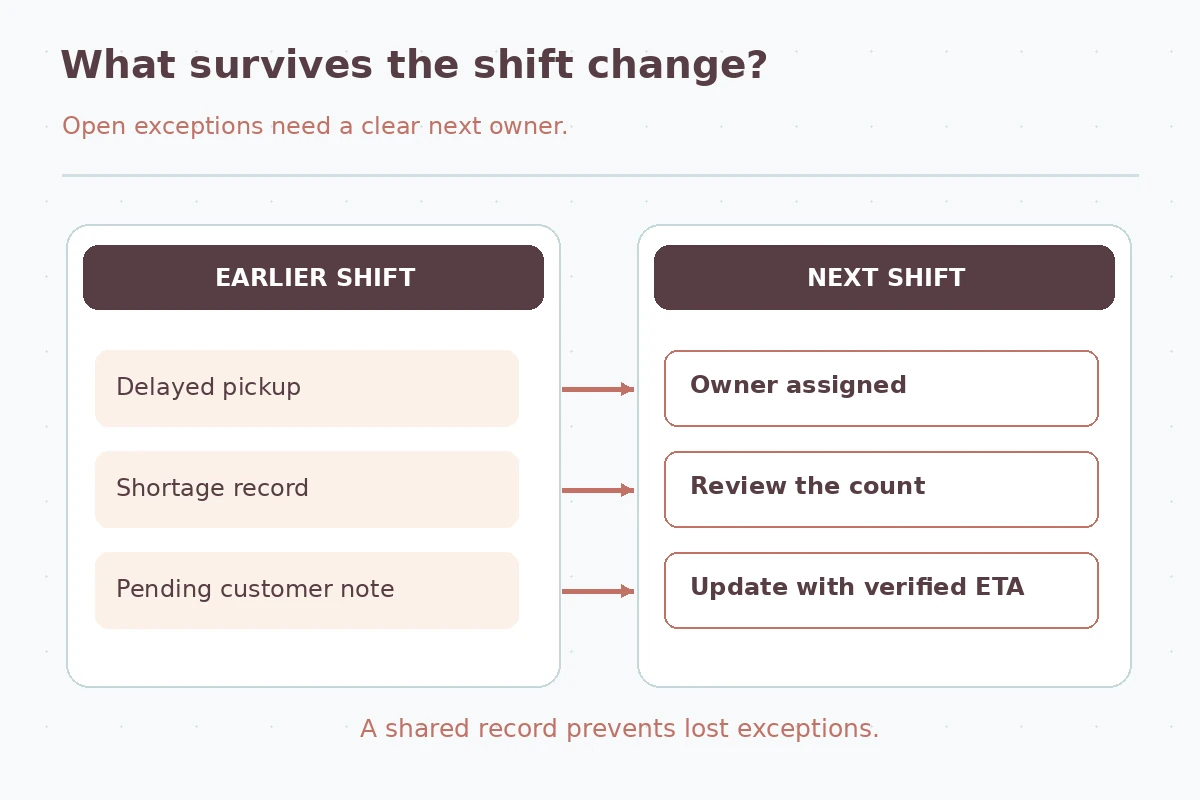
Ask: ‘What does the next shift need to see about shipments that are still open?’ A useful answer might identify pending pickup, delayed transport, unverified receipts, or unresolved claims. Ask whether the handoff is recorded in a shared queue, operations log, or shift meeting, and who monitors old exceptions. The best evidence is a repeatable process rather than a claim that people simply remember things. If the job has late hours or multiple sites, ask which location and time zone owns each milestone. This gives you a clearer picture of coverage without assuming the role includes round-the-clock work.
Check which routing decisions belong to the new hire
Ask: ‘Which route or carrier changes can this role recommend, and who approves cost or service changes?’ Some logistics positions compare transport options; others mainly enter records and contact carriers. O*NET describes a range of shipment and logistics tasks, but the posting determines your actual remit. Ask whether staff use rate tables, approved carriers, or an escalation list when delivery requirements change. A clear answer prevents a new hire from assuming a saved quote is authorization to spend money or that an urgent request allows an undocumented change. The role can be operationally important without having every approval right.
Turn vague questions into useful follow-ups
Instead of “Is shipping fast?” ask “Who owns an unresolved shortage when it crosses to the next shift, and where is that recorded?” If told “just update the tracking system,” ask “What source must be verified before changing a delivery status, and who approves unusual changes?” Neither example should be asked verbatim if the interviewer already explained the process. A considerate candidate connects a follow-up to the employer’s answer: “You mentioned a shared queue. How does a new hire learn when to escalate an item?” That demonstrates listening while keeping your goal to understand the job rather than impress someone with jargon.
It is also useful to avoid questions that ask for restricted account details, identifiable personal records, private supplier terms, or internal performance numbers. Ask for the method and boundaries instead. If an interviewer cannot give a detailed response in a short screening call, note the subject and return to it in a later discussion with a manager. Silence or a partial answer is a reason to clarify at an appropriate stage, not proof that the organization lacks a policy.
Define success through accuracy and follow-through
Close with: ‘What would a reliable first-month handoff or exception report look like here?’ A manager might value complete shipment records, timely clarification of shortages, clear stakeholder updates, or fewer unowned exceptions. These are possible criteria, not guaranteed metrics. Ask how the team checks accuracy when it reviews performance; raw shipment volume does not tell you whether records were correct. Use the response to decide which of your own examples to discuss: documenting a transfer, tracking an issue to resolution, or communicating a limitation clearly without making an unsupported delivery commitment.
Choose three priorities before the meeting
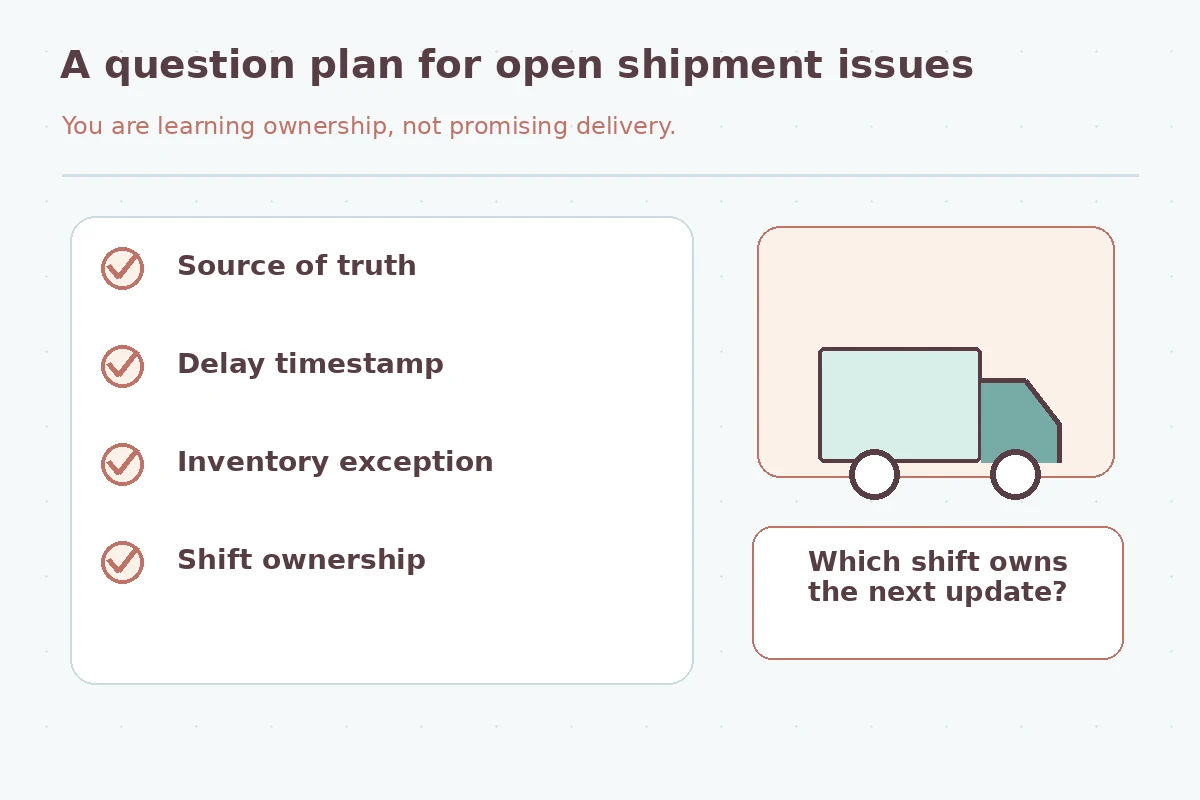
Prepare one operational question, one training or scope question, and one question about how good work is reviewed. If there is time, retain a fourth question about shipment timeline and handoff to the next employee. Put the highest-value question first so a short interview still produces useful information. In your notes, mark whether the interviewer gave a specific example, named a reviewer, described a documented process, or deferred the answer. This is an organizing device for your decision, not a score for the employer.
A short follow-up email should thank the person for the conversation without requesting confidential examples. If a concrete gap remains, ask one narrow question such as ‘Who normally reviews this step during onboarding?’ rather than sending the entire list again. Before accepting an offer, compare the interview account with the written job description and any practical terms you receive. Do not treat an exploratory answer as a contractual promise. Your own goal is to understand expectations accurately and decide whether the day-to-day work matches the position you applied for.
How We Research and Verify Interview Guidance
We reviewed the University of Michigan and Santa Clara University career-center guidance on preparing role-relevant questions, together with the O*NET occupational description for logistics or shipping coordinator work. O*NET shipping, receiving, and inventory-clerk tasks include verifying shipments, preparing documents, recording discrepancies, and communicating with carriers. We distinguished broad occupational duties from employer-specific authority and used only hypothetical interview exchanges. Source review date: November 15, 2026.
Sources consulted: University of Michigan Career Center — Interviewing Resources; Santa Clara University Career Center — Practice for Interviews; O*NET — role duties and related occupational profile. Each source helps frame questions; none tells us the policies of a specific employer.
Reader trust and commercial relationships are explained in the JobAsk affiliate disclosure. This page is independent career education; it does not guarantee an interview outcome.
More Interview Preparation Guides
Yes, when relevant to daily duties. More important is who contacts carriers, records changes, and approves exceptions; do not require private rates.
Not necessarily. Ask what records and checks the organization uses to verify shipment status and quantities.
Yes if coverage matters to the role. Ask which shift owns open exceptions and what information must be passed along.
Ask how the discrepancy is documented, who reviews inventory changes, and what can be told to affected teams.
Ask which shipment and exception tasks are practiced with a reviewer before independent updates are permitted.