
If you are interviewing for a marketing specialist position, arrive with three or four questions that reveal the actual work rather than asking only about culture. The useful marketing question is not simply whether a team is creative. It is who turns an audience hypothesis into a campaign, who checks the numbers, and who can change direction when the evidence is weak. Start by checking the job description, choose questions the interviewer can realistically answer, and take brief notes on who reviews or approves the important steps. The questions below are designed for candidates learning about a role; they are not claims about the policies of any particular employer.
Marketing specialists may help plan campaigns, analyze consumer information, and report recommendations. Those responsibilities vary widely between a small in-house team, an agency, and an analytics-heavy department. Do not assume the person who writes the copy also authorizes spending, owns tracking access, or signs off on public claims. According to the University of Michigan Career Center, preparing approximately three to five employer questions helps you learn whether a job fits, and the right questions depend on the interview stage and the person answering. The wording below is a practical starting point: adapt it to what you have already been told instead of reading a script. All example conversations are hypothetical.
Find out who decides what a campaign is for
Ask: ‘How does the team choose the audience and the business outcome for a new campaign?’ Follow with: ‘Who approves the brief if brand and performance goals conflict?’ These questions uncover a decision path rather than a vague statement that everyone collaborates. If the interviewer describes a project intake meeting, ask which document records the agreed goal and who revisits it after launch. For a junior role, listen for how you contribute research or copy without being expected to settle strategy alone. An answer that mentions a clear brief, reviewers, and handoff is more actionable than a promise that you will have creative freedom.
Ask how a reported result becomes credible
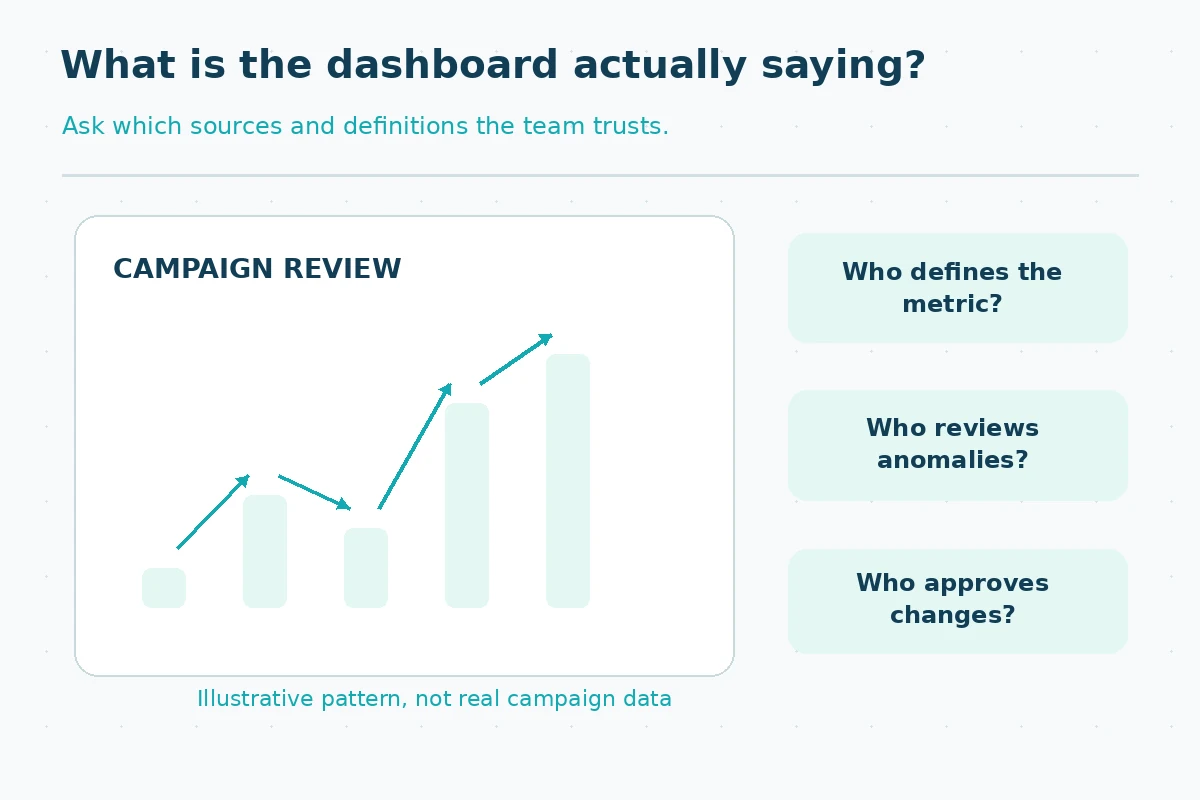
Try: ‘Which measures does this team review after a campaign, and how does it check data quality?’ Then ask which person owns dashboard definitions, conversion tracking, and access changes. You are not asking the employer to disclose confidential customer data or private campaign performance during an interview. You are asking whether a reasonable review system exists. Distinguish reach and clicks from qualified inquiries or verified downstream outcomes. If the interviewer describes a success metric without a definition, ask how that measure is calculated and who validates it. This gives you a better picture of what you could truthfully report in your first months.

Understand creative feedback before launch
Ask: ‘Who reviews copy, claims, accessibility, and design before a campaign goes live?’ Then: ‘What happens when reviewers disagree or a brief changes late?’ The details are especially useful for a content or channel role, because a quick campaign may still need brand, product, legal, or accessibility review depending on the organization. A candidate should not imply that all those approvals are mandatory everywhere. Listen for a named owner, a working revision channel, and a method of capturing the final decision. Ask whether the role is expected to draft, coordinate revisions, publish under supervision, or own the entire workflow.
Use a question-to-evidence comparison table
A question is useful when the answer tells you something you can verify later: the person who approves, the document the team uses, the training step, or the process for reporting an exception. This comparison grid captures the decision behind each question, so you can tell whether the interviewer actually answered it. If a topic was already covered naturally, replace the prepared question with a brief, relevant follow-up rather than forcing a repeated conversation.
| Decision point | Ask the interviewer | Listen for |
|---|---|---|
| Campaign goal | Who approves the brief? | Named owner and written criteria |
| Measurement | Who checks definitions? | Source, review and known limits |
| Creative launch | What requires approval? | Reviewers and revision path |
| First assignment | What does the manager inspect? | Concrete deliverable and feedback |
Separate team contribution from channel control
Ask about the actual systems the new hire may use: ‘Which reporting and publishing tools would I have access to at first, and what requires review?’ This avoids the assumption that knowing a platform means holding permission to change billing, tracking, or a live campaign. A useful follow-up is: ‘When a channel is underperforming, does this role propose a change, test it with approval, or apply an established playbook?’ Each response points to a different level of responsibility. The best interview conversation ties the tool list back to decisions and actual evidence, not to a checklist of platform names.
Look for a realistic first campaign assignment
Ask: ‘What would be a suitable first project, and what would the manager review before it ships?’ A useful answer might identify an audience research brief, a landing-page copy test, or a report of campaign observations. These are illustrative possibilities, not a promise of what any employer offers. If the answer is ‘you will own everything immediately,’ ask what documentation, training, backup reviewer, and existing analytics are available. A difficult job can still be a good one when the team is clear about what is known, what needs learning, and who signs off on public or spending decisions.
Turn vague questions into useful follow-ups
A vague prompt: “Will I get to be creative?” A sharper version: “Who signs off on a campaign brief, and how are requested revisions recorded?” If the answer is “we just watch the dashboard,” follow with “Which numbers are considered reliable enough for an external report, and who checks them?” Neither example should be asked verbatim if the interviewer already explained the process. A considerate candidate connects a follow-up to the employer’s answer: “You mentioned a shared queue. How does a new hire learn when to escalate an item?” That demonstrates listening while keeping your goal to understand the job rather than impress someone with jargon.
It is also useful to avoid questions that ask for restricted account details, identifiable personal records, private supplier terms, or internal performance numbers. Ask for the method and boundaries instead. If an interviewer cannot give a detailed response in a short screening call, note the subject and return to it in a later discussion with a manager. Silence or a partial answer is a reason to clarify at an appropriate stage, not proof that the organization lacks a policy.
Close on the evidence you would be judged by
Toward the end, ask: ‘After the first few projects, what would show that I am doing this job well?’ Invite the interviewer to identify a defensible output: clear briefs, reliable reports, fewer content corrections, or better stakeholder handoffs. Avoid asking for a guaranteed performance percentage or a promise of promotion. Note whether expectations are controllable by the new hire and whether the employer distinguishes activity measures from business outcomes. The answer helps you decide what work sample to discuss next and what you should verify before accepting an offer.
Choose three priorities before the meeting
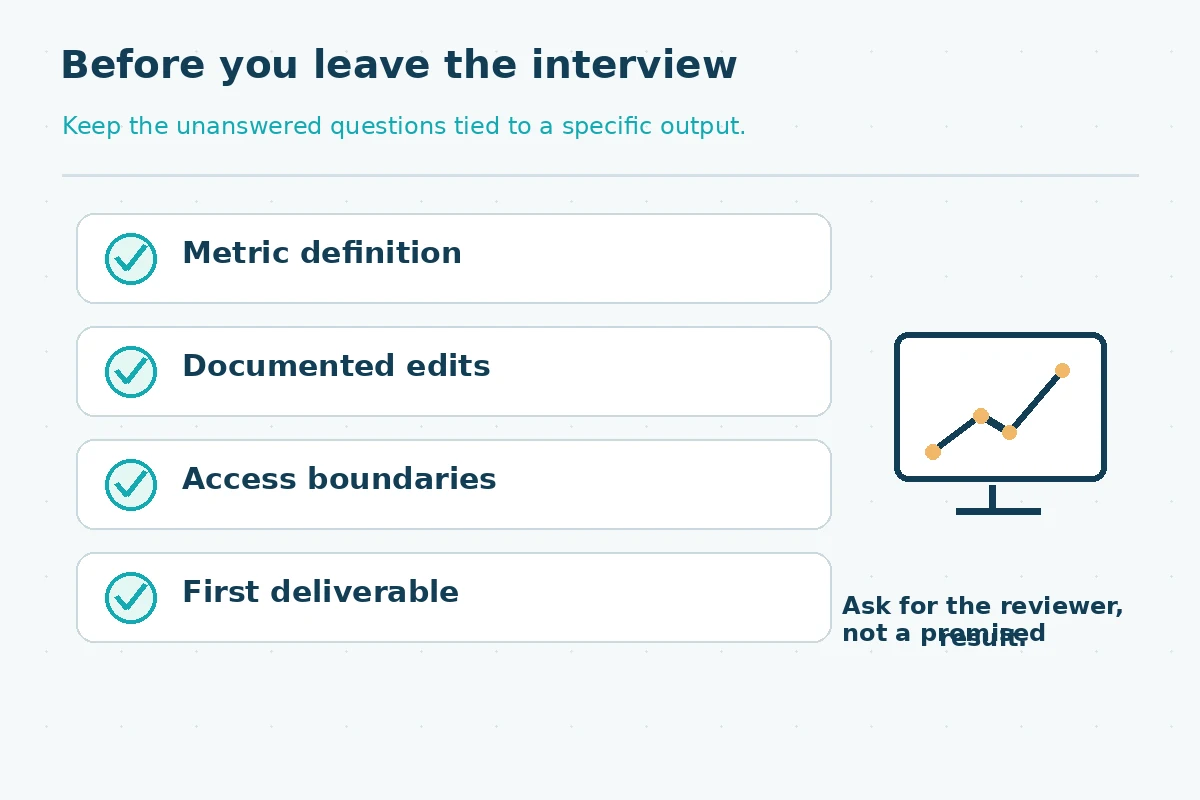
Prepare one operational question, one training or scope question, and one question about how good work is reviewed. If there is time, retain a fourth question about campaign brief and handoff to the next employee. Put the highest-value question first so a short interview still produces useful information. In your notes, mark whether the interviewer gave a specific example, named a reviewer, described a documented process, or deferred the answer. This is an organizing device for your decision, not a score for the employer.
A short follow-up email should thank the person for the conversation without requesting confidential examples. If a concrete gap remains, ask one narrow question such as ‘Who normally reviews this step during onboarding?’ rather than sending the entire list again. Before accepting an offer, compare the interview account with the written job description and any practical terms you receive. Do not treat an exploratory answer as a contractual promise. Your own goal is to understand expectations accurately and decide whether the day-to-day work matches the position you applied for.
How We Research and Verify Interview Guidance
We reviewed the University of Michigan and Santa Clara University career-center guidance on preparing role-relevant questions, together with the O*NET occupational description for marketing specialist work. The O*NET description for market research analysts and marketing specialists includes market research, reporting findings, and collaborating on marketing decisions; it does not define your future employer’s approval process. We distinguished broad occupational duties from employer-specific authority and used only hypothetical interview exchanges. Source review date: November 15, 2026.
Sources consulted: University of Michigan Career Center — Interviewing Resources; Santa Clara University Career Center — Practice for Interviews; O*NET — role duties. Each source helps frame questions; none tells us the policies of a specific employer.
Reader trust and commercial relationships are explained in the JobAsk affiliate disclosure. This page is independent career education; it does not guarantee an interview outcome.
More Interview Preparation Guides
You may ask which measures the team uses, but do not press for confidential accounts or client-level numbers. Learn the process and ownership first.
Ask who manages and authorizes spending rather than requesting confidential budget details. Approval boundaries matter if the role is junior.
Ask who makes the final decision when priorities conflict and how handoffs are documented. Shared collaboration still needs accountable decisions.
Yes. Frame it around the tools you will use and the training or permissions that come with the position, not credentials for a live account.
Ask which first deliverable the manager would evaluate and what useful feedback would look like. It makes expectations concrete.