
A CV template for a master’s application should make it easy for an admissions reader to see your academic preparation and the evidence that fits a particular program. A useful order usually begins with education and then emphasizes research, methods, relevant projects, presentations or other academic activity. There is no one layout that every graduate program requires. Read the actual department instructions first, because some programs ask for a resume, some for a CV, and others specify supplemental documents.
This guide provides a selection method rather than a one-size-fits-all checklist. It distinguishes credited coursework from independent research, a class presentation from a formal conference acceptance, and assistant work from project leadership. A student with no formal lab experience can still present relevant course methods honestly. The aim is to make an application clearer, not to manufacture research qualifications or repeat a statement of purpose paragraph by paragraph.
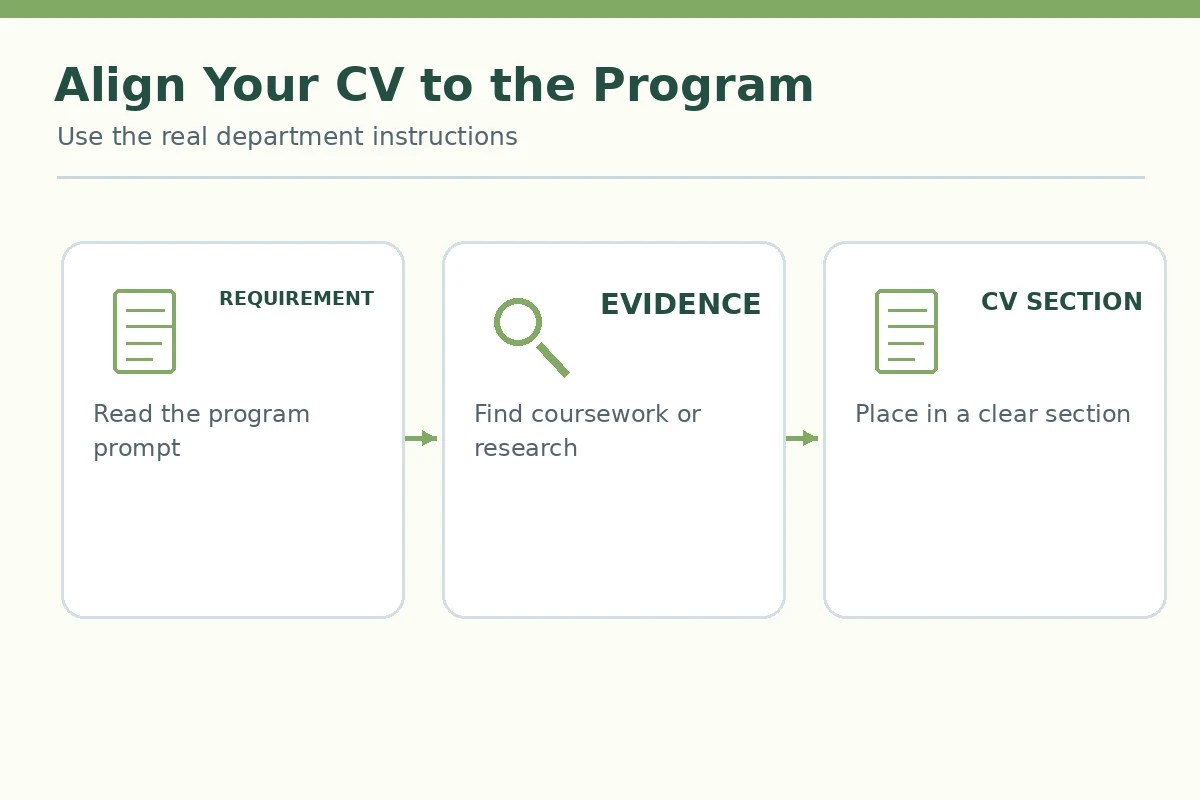
Map Each Program Requirement to a CV Section
Start with the admissions page, not a random downloaded template. Record whether the program asks for a CV or resume, a page limit, a preferred file format, publications, research interests, experience, language skills or references. Use these instructions to select headings. For a research-intensive master’s degree, Education and Research Experience may lead; for a professional taught program, Relevant Experience and Projects may be stronger. Do not assume that an academic CV must include every possible section if several would be empty.
Create a two-column private worksheet: on the left, the requirement as written by the program; on the right, your genuine evidence. If a program values quantitative methods, you might identify statistics coursework and a project that used clearly described analysis. If it asks for a writing sample, the CV should point to work you may share, but it does not replace the requested sample. A program-specific order is useful even when the underlying experience stays unchanged.
Explain Coursework as Preparation, Not as a Credential
Write the exact institution, degree name and status, field of study and dates accurately. Coursework belongs in a selective section when it supports the target concentration. “Relevant Coursework” may list courses such as Applied Statistics, Research Methods or Fluid Mechanics, but a long transcript copy adds little unless requested. An unfinished degree should not be described as awarded. If a transfer or exchange experience matters, state the correct school and period without implying a separate qualification.
Projects can demonstrate how methods were used: “Compared alternative survey coding approaches for a course research design; documented limitations in the final report.” This hypothetical example is specific without pretending that the student conducted a funded clinical trial. Mention the software or method only when you performed the work and can discuss the results. If a group project was evaluated, the team result should not be claimed entirely as your own.
Present Research Roles With Supervision and Permissions
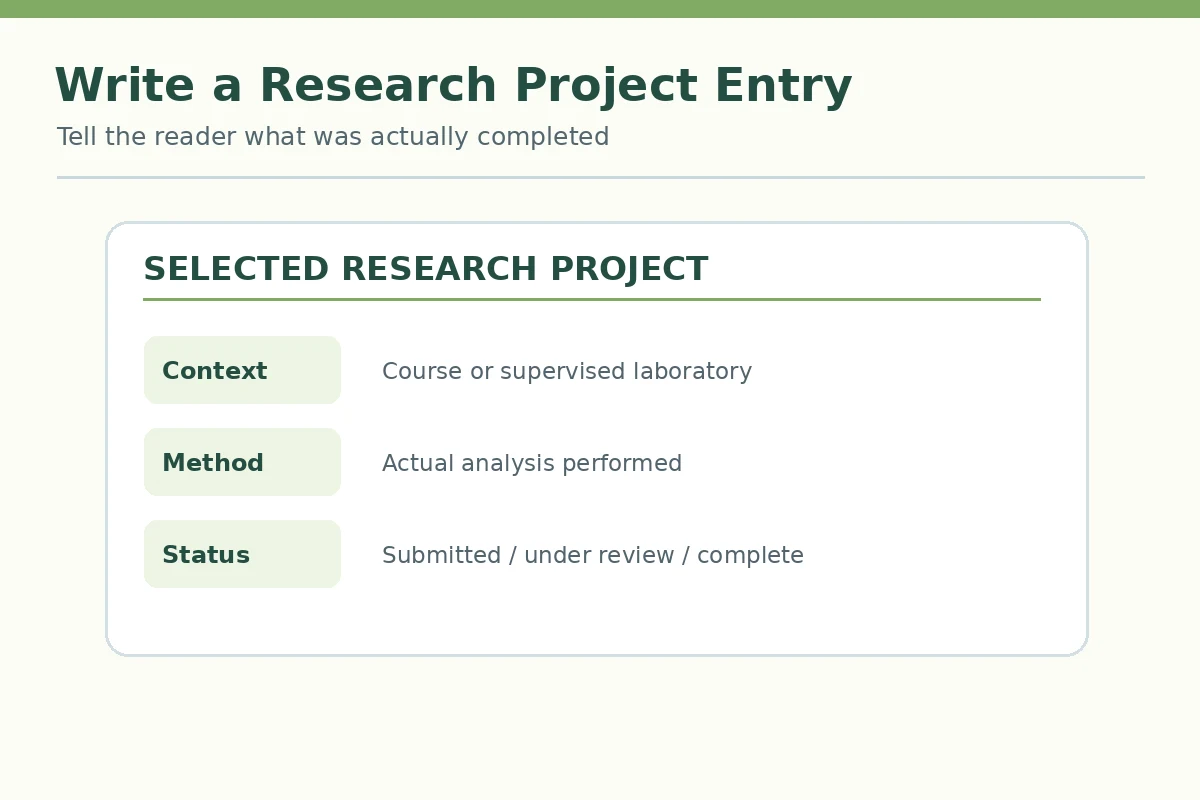
Research Experience entries should name the lab, institution, supervisor if relevant, your role and dates. Explain the actual task: literature review, data cleaning, laboratory preparation, structured interviews under an approved protocol or analysis of public datasets. If the work involved participant data, confidential records or human subjects, never publish identifiers or assume you can share research material. Scope and research approvals are determined by the institution and project, not by how impressive a CV sounds.
If you were an assistant, use “assisted,” “coded,” “organized,” or “prepared” where they fit. Reserve “designed the study” or “led fieldwork” for actual responsibility you can support. A poster created for a classroom is not automatically a peer-reviewed conference presentation. Likewise, a manuscript in preparation is not a publication. Include current statuses transparently, which helps a reviewer understand experience without making them infer achievements that did not happen.
| Evidence or document | What to show | Claim to avoid |
|---|---|---|
| Research-intensive program | Research roles and methods | Do not imply independent approvals |
| Professional taught program | Relevant work and projects | Do not copy generic employment history |
| Program with special instructions | Required headings and file type | Follow the actual prompt |
Order Publications, Awards and Service Selectively
Include scholarly products only when they exist, with exact authorship order and current status. Separate published work, accepted work and work in progress where necessary. A student award should name the awarding organization and year, not imply a national distinction if it was a course-level recognition. Relevant service may include tutoring, student committees or outreach projects with clear duties. Do not force a Publications section when there are no publications; a substantive Projects section may be more informative.
A practical CV layout could be: Contact, Education, Research Interests (brief and relevant), Research Experience, Selected Projects, Presentations, Awards, Teaching or Service, Skills. Adjust this order to the program prompt. Limit generic soft-skill adjectives; a concrete example of data documentation or lab safety training offers more evidence. Some applicants need a separate resume for an assistantship or campus position even while submitting a CV for admissions.
Proof the File Against the Application Portal
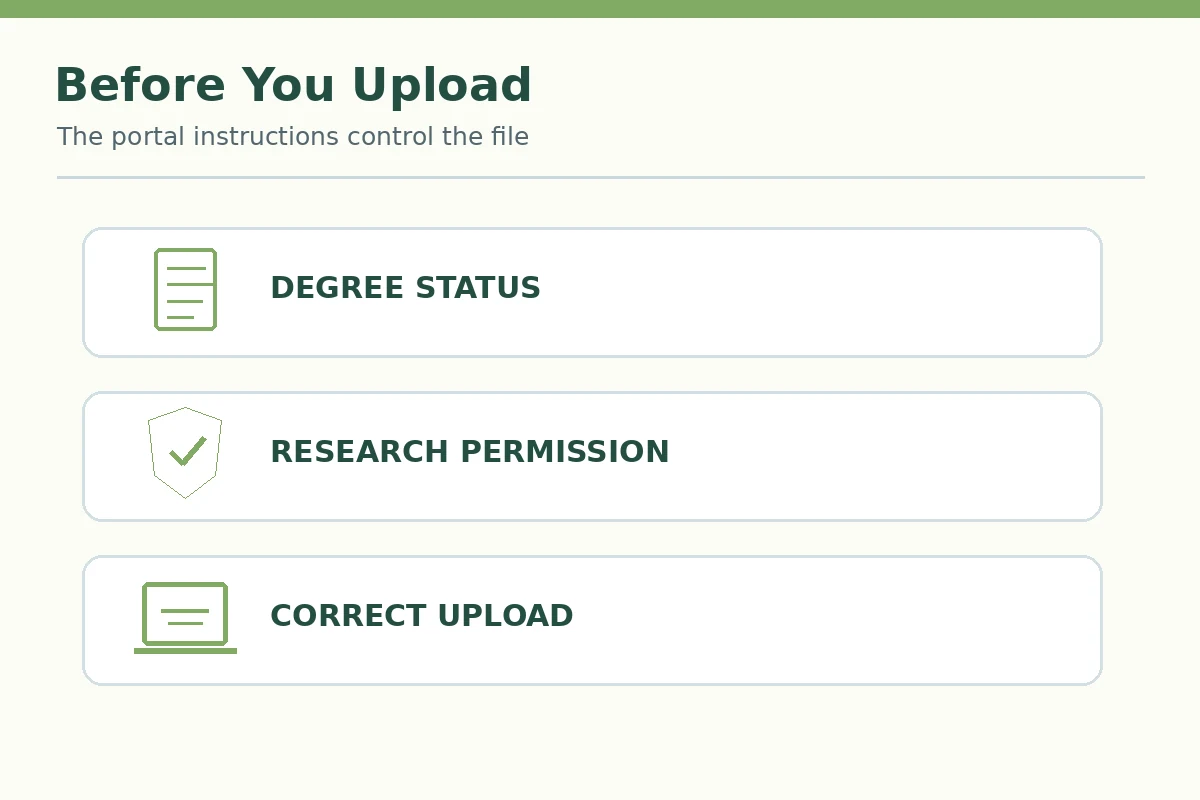
Check every school name, degree date, title, author list and link against your records. Compare the section list to the program’s stated requirements and remove boilerplate from the downloaded template. Export the specified file type and inspect every page break. An admissions CV can be longer than an industry resume when needed, but length should follow relevance and any explicit limit. Never send a file containing another university’s name, an outdated program title or a sample citation.
Finally, open the uploaded file if the portal provides a preview. Confirm that the text is selectable, the headings read in order, and any listed links work. Keep the statement of purpose and CV consistent about research interests, dates and project status without making them identical. The application is strongest when the CV is a verifiable evidence index that another reader can follow.
Two Illustrative Cases and What They Prove
Hypothetical case: A student applying to a statistics master’s program lists a completed applied regression course project, including the dataset type, question, and method. They accurately describe their role and avoid calling the classroom report a journal article. The CV shows academic readiness without manufactured publications.
Hypothetical case: A student helped a faculty lab organize deidentified survey responses but did not design the protocol or access participant identities. Their CV states the supervised data task and dates. It does not claim principal-investigator status or include private study files as portfolio evidence.
How We Research and Verify Resume Advice
This article was prepared using primary occupational, documentation, and university career resources checked on 2026-11-14. The careercenter.tamu.edu source supports texas A&M Career Center describes the CV as an academic and research-oriented record rather than a short industry summary. The grad.berkeley.edu source supports uC Berkeley Graduate Division publishes general graduate-application requirements and directs applicants to program-specific instructions. The career.berkeley.edu source supports uC Berkeley Career Engagement provides principles for demonstrating relevant experience in application materials. Examples above are hypothetical and must be replaced with your own verifiable dates, duties, permissions, and results. Our editorial purpose is to explain format choices rather than promise a hiring outcome or automated screening acceptance. Read the JobAsk affiliate disclosure for editorial transparency.
More Resume and Cover Letter Guides
No. Requirements vary by department and degree; read the program admissions instructions before selecting a format.
Yes, when the courses are genuinely relevant and paired with honest project or method evidence.
No. Clearly identify work in progress or manuscripts under review rather than presenting them as published.
Use the space needed for relevant academic evidence while following any stated page limit or format requirement.
Only if appropriate for the program and accurate; do not imply the person endorses you or is a recommender without permission.