
Study abroad belongs on a resume when it adds relevant education, applied learning, language use or a genuine internship. Identify the host institution and the program or study period; do not make attendance look like a degree awarded by that institution unless it really was. If you completed a separate internship, describe the actual organization and role under Experience rather than disguising it as an academic qualification.
The University of Iowa advises putting a study program in Education and an internship under professional experience. Pitzer College illustrates how to separate the awarding college from a host school, and Boston College recognizes study-abroad institutions as optional education details. The useful part is not merely travel: it is an accurate account of what you studied, produced or did, within the permissions of the program.
Identify the Home School and Host School Correctly
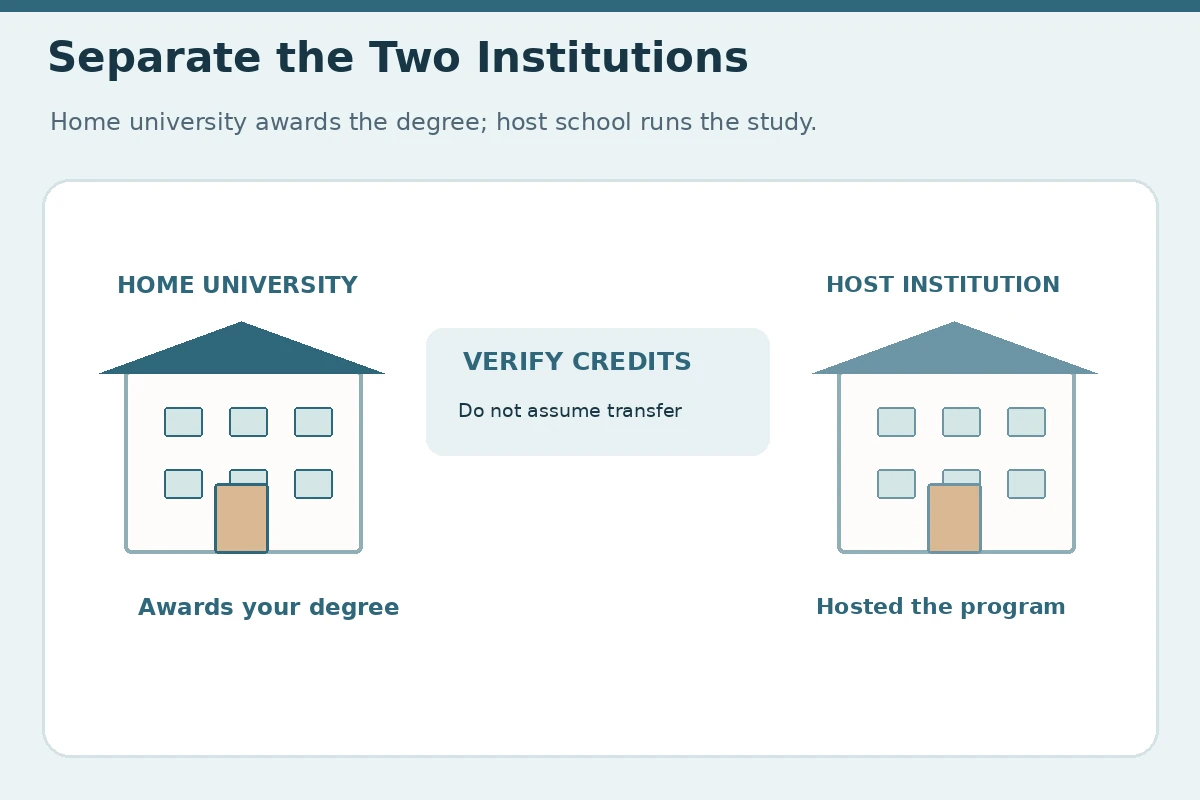
Start with the degree-granting university that appears on your official record. If you studied at a separate host institution for a semester or program, state the host institution, location, program name and period attended. Do not add a second degree from the host school unless that institution actually issued one. “Study Abroad Program, [Host Institution], [Location], Spring 2025” is a useful fictional structure, not a claim that the host awarded a credential.
Some programs use a consortium, exchange or third-party provider. The name on your enrollment documents may differ from the institution that awarded your course credits. Check which organization instructed the courses and which recorded the credits; present both only when needed for clarity. Avoid inserting an impressive international university name merely because you visited its campus or attended a short event there.
Describe Courses and Credits Without Inventing Awards
A program can be academic even when it produces no separate degree. Relevant course titles, a field-study project or credited seminar may justify an Education subline. If credits were transferred to your home school, say “coursework completed” or “credits transferred” only when that is verifiable. The fact of travel does not establish a major, a formal concentration or foreign credential equivalency.
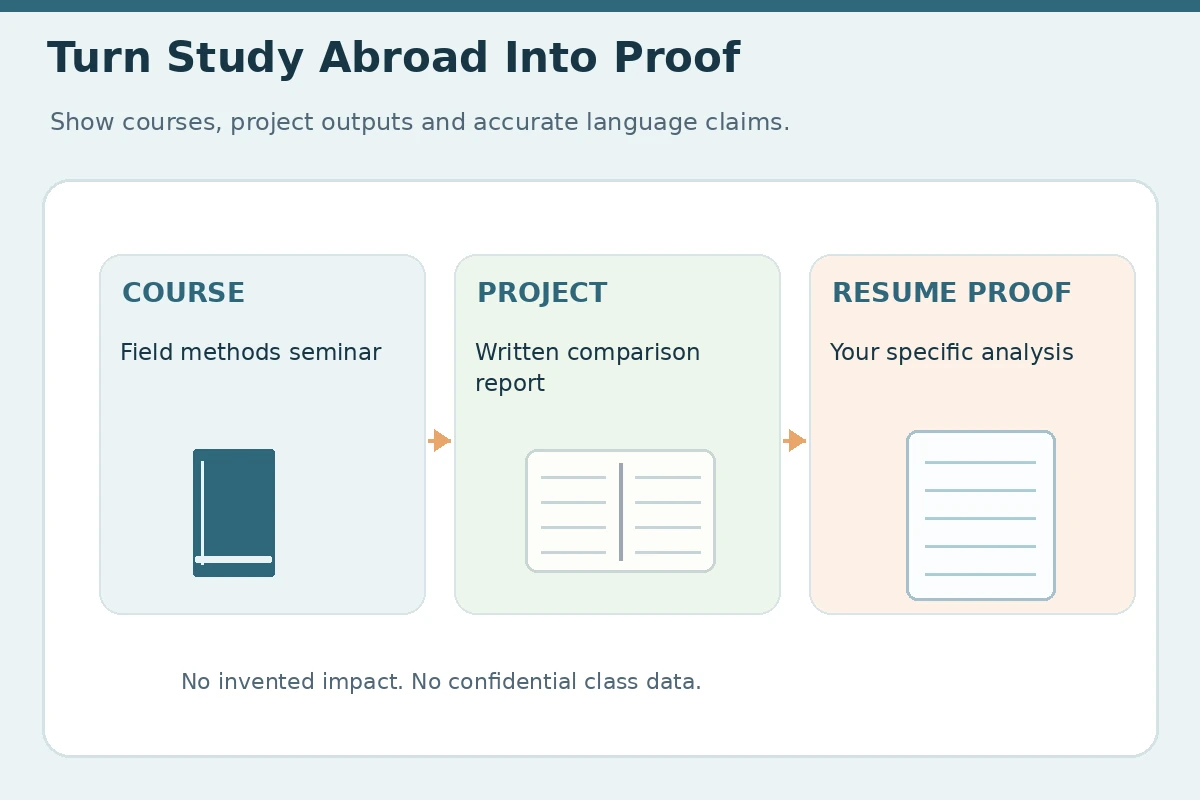
Choose two or three courses that relate to the job instead of copying the entire overseas transcript. For example, a hypothetical environmental science student might mention field methods and a class report while making clear these were academic tasks. If the work contains protected research or classmate information, describe the method rather than distributing the original document. Do not exaggerate a weeklong workshop into a semester abroad.
| What happened | Where it belongs | Evidence to retain |
|---|---|---|
| Academic exchange | Education | Host name, dates, courses |
| Course project | Projects or Education | Your actual deliverable |
| Formal internship | Experience | Role, supervisor, tasks |
Place a Real Internship in the Experience Section
An internship attached to a study-abroad program may deserve a separate Experience entry with the employer, role, dates and tasks. This is different from class participation, observation, volunteering or independent travel. List the level of responsibility and supervision honestly. A supervised student should not imply autonomous professional practice just because an international setting sounds impressive to a recruiter.
A hypothetical nonprofit internship bullet might say, “Organized workshop attendance records and drafted weekly summaries for supervisor review,” if that was the intern’s real task. It should not say “managed the nonprofit program” unless that responsibility truly existed. If your program was an academic site visit without work duties, keep it in Education or Projects rather than a job history. The University of Iowa makes this academic-versus-experience distinction explicit.
Explain Language or Cross-Cultural Learning With Evidence
Study abroad can offer language practice and adaptation to unfamiliar academic expectations, but time in another country is not proof of fluency or intercultural expertise. List languages separately with an honest level of ability and, when relevant, an example of reading, writing or conversation tasks you actually performed. A language immersion course can be described as coursework if it appears in your records.
If a role values collaboration across regions, a specific example is more useful than “global mindset.” Explain how you coordinated a group assignment, gathered information with appropriate consent, revised a presentation for a different audience or handled feedback on a project. Distinguish your own contribution from team output, and avoid turning other people or communities into decorative resume claims. Relevance comes from concrete work, not the passport stamps.

Use a Project Description Instead of Travel Superlatives
Many students learn through research papers, design assignments, interviews, data collection, field notebooks or community projects abroad. A resume project bullet can state the question, the method and the output, without invented impact. Mention tools only when you genuinely used them and have permission to describe the work. Do not claim to have conducted formal research or human-subject studies when an assignment consisted of basic observation or class discussion.
For example, “Compared public transit accessibility across two neighborhoods and presented findings in a course seminar” is a clearer hypothetical contribution than “revolutionized international mobility.” If the original data cannot be shared, present a public or synthetic example rather than copying private materials. Connect the project to the vacancy’s methods, such as document review, organization, analysis or presentation, while preserving the scope of the assignment.
Choose the Entry’s Placement and Validate Its Dates
Place study abroad under Education when the purpose was academic, under Projects when one deliverable is especially relevant, or under Experience for an authentic role. Avoid repeating the same program and bullets in all three places. For a recent graduate with limited experience, a clear Education entry can show useful context; for an experienced applicant, one concise line may be enough if the information still matters.
Verify the program’s official dates, course or credit status, host school spelling and award boundaries. Read the exported PDF to ensure the home degree and study-abroad program cannot be confused as two independent diplomas. If a job form separately asks about foreign degrees or education history, give the requested complete information there. Do not assume that a short exchange created a professional license or an automatically equivalent US credential.
How We Research Resume Education Claims
We checked the referenced career-center and registrar guidance on 2026-11-14: University of Iowa international programs (University of Iowa distinguishes study programs in Education from internships under Experience on resumes.); Pitzer College resume guide (Pitzer College illustrates how to list home degrees and study-abroad schools separately without conflating their awards.); Boston College Career Center (Boston College describes study-abroad schools, graduation details and dated academic honors as relevant education entries.). We also compared this specific intent with the supplied WordPress title exports, the existing batch inventory and public search results to reduce overlap. Institutional academic terms and policies vary: always verify a credential, date and honor against your own official records. All person, school, program and date examples in this article are hypothetical unless explicitly identified as source policy. Read the JobAsk affiliate disclosure; no paid relationship or approved affiliate program is claimed.
More Resume and Cover Letter Guides
An academic program normally fits Education; a real internship with duties can go under Experience. Describe both separately when applicable.
No, not unless the host institution actually awarded that degree. Label exchange or study-abroad attendance precisely.
Only at a level you can honestly demonstrate. A course or immersion period does not automatically establish professional fluency.
Use official course and credit records and label the transfer accurately. Avoid inventing a qualification that was not issued.
Class projects are generally academic projects. If you also held an internship or paid role, list its genuine work duties separately.